Art Deco Bathroom Ideas That Feel Classic, Not Costume
Art deco bathroom ideas scaled for a real house: the one-statement rule, black and white or green and black tile with a border, round mirrors, frosted sconces, a console sink on chrome legs, and the mistakes that make it look like a set.

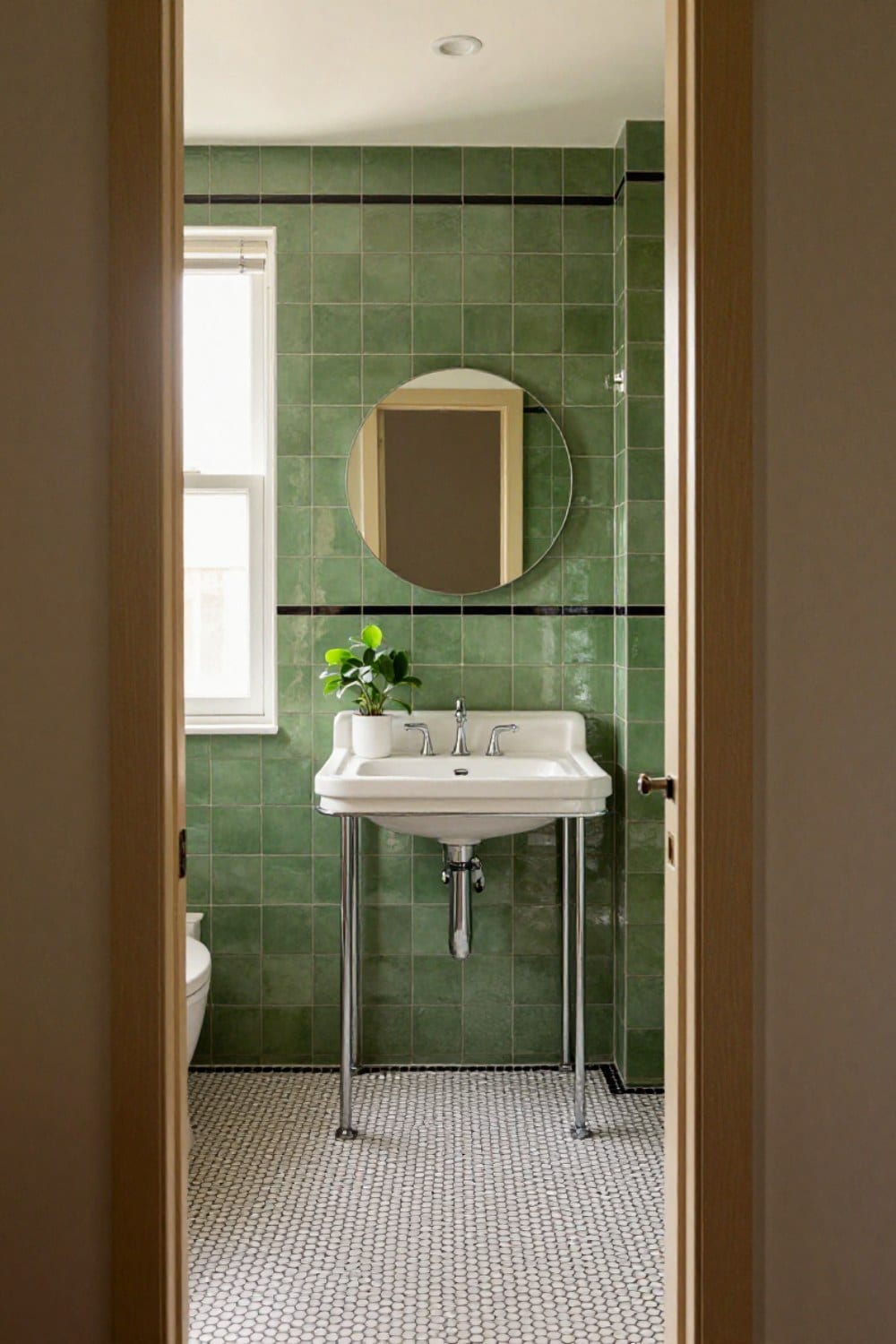
Art deco bathroom ideas usually start with a picture of a hotel lobby. Black marble, gold on every surface, a mirror the size of a garage door. It's glamorous, and it's not a room where anyone brushes her teeth on a Tuesday morning.
Here's the version I trust. The original 1930s deco bath was a small, tidy, tiled room built into ordinary houses. One wall of geometry, chrome on the fixtures, glass that glowed at night. That's the room this guide is about, scaled for a real family and a real Tuesday morning, so it feels classic and not costume.
You'll get the one rule that holds the whole look together, how to choose the tile and the border, the mirror and lights that finish the wall, the sink, and the mistakes that turn a deco bath into a movie set. If you'd like every era side by side first, the retro bathroom styles guide runs from the 1920s through the 1960s.
What an art deco bathroom actually is
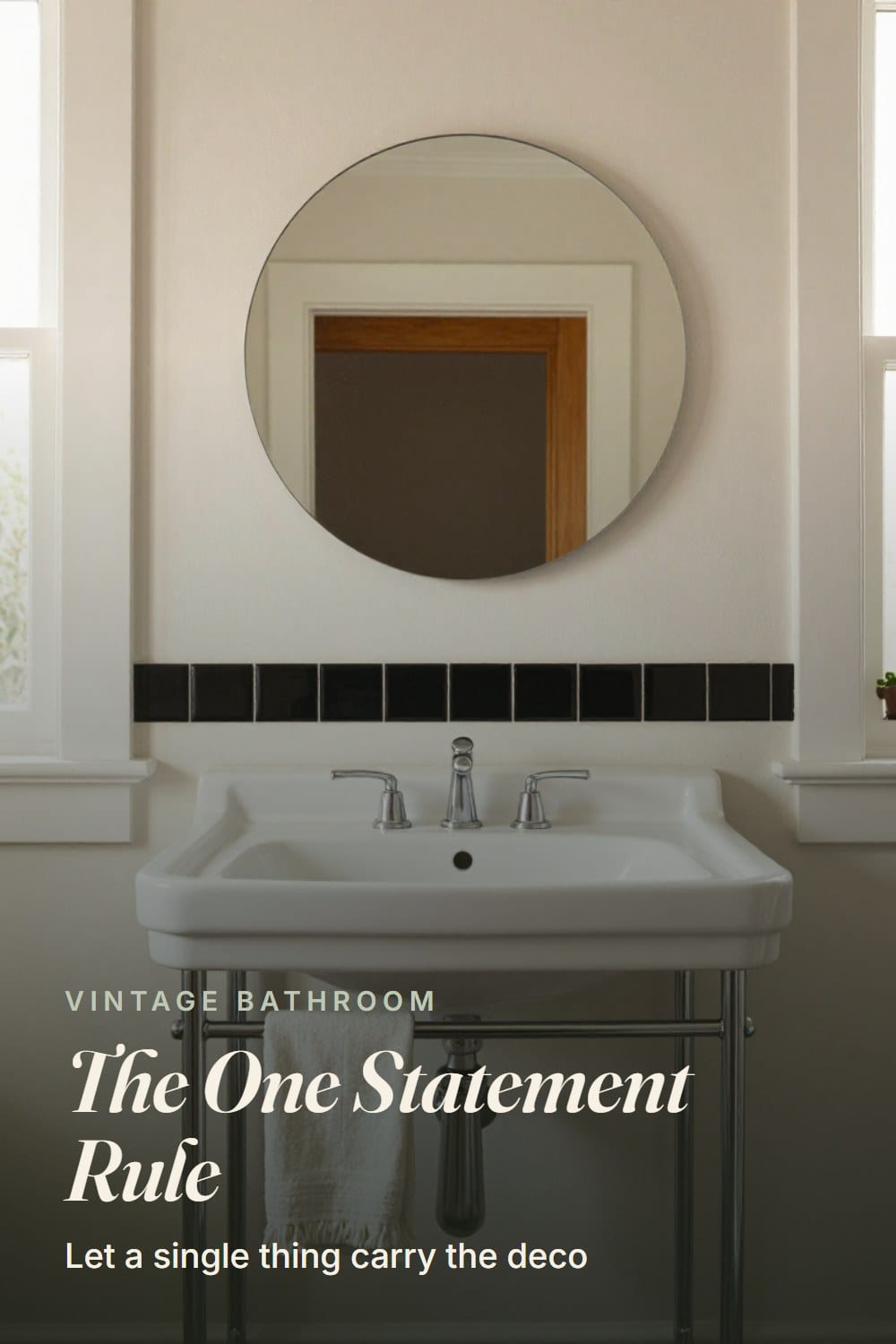
Deco ran from the 1920s into the late 1930s, and in the bathroom it came down to a short list. Glossy tile in a strong, flat color. A black border or trim row. Geometric shapes like stepped lines, fans and chevrons. Chrome or nickel fixtures. Glass that was frosted, etched or mirrored.
Late in the decade the look softened into streamline moderne, with rounded corners and curved glass. I won't split hairs between the two. If your room has glossy colored tile, a black edge and a rounded chrome fixture, you're standing in the right neighborhood.
I used to think deco meant gold and zigzags. Then I spent an afternoon in my friend Marian's original 1934 bath, which is jade green tile with a black cap, a plain white sink and one fan-shaped detail over the door. It was restrained. That room is what I keep measuring everything against.
If your house is a little older than deco, white hex and polished nickel are covered in 1920s bathroom ideas, and the two eras sit together more easily than you'd expect.
Art deco bathroom ideas start with one statement
This is the rule that fixes most deco baths before they go wrong. Choose one thing to carry the deco shape: the tile, the mirror or the wallpaper. Then let everything else be plain.
If the tile is the statement, the mirror is a simple round or rectangle and the walls above the tile are a calm warm white. If the mirror is the statement, say a stepped frame, the tile is plain white subway and the border is a single row. If wallpaper is the statement, the tile stays one flat color.
It works because the eye reads a bathroom from the doorway in about two seconds. One strong geometric shape tells it that someone chose this. Four of them tell it that a theme was bought in a single weekend.
I learned this by overdoing it. In our powder room I once hung a fan-pattern wallpaper, a stepped mirror and a geometric tile floor in the same week. It looked like a stage set for a play about the 1930s. The wallpaper came down and the room settled at once.
If wallpaper is the voice you want, vintage bathroom wallpaper ideas covers how to keep it alive in the steam.
Black and white, or green and black
Tile does most of the work in a deco bath, so it gets the most thought. Two combinations are the ones I'd trust, and they feel different from each other.
Black and white is the crisp one. White wall tile, a black border and a black and white floor read as clean and a little graphic. It can feel stern, though, and warming it up is the whole job. I wrote that out in how to decorate a black and white tile bathroom.
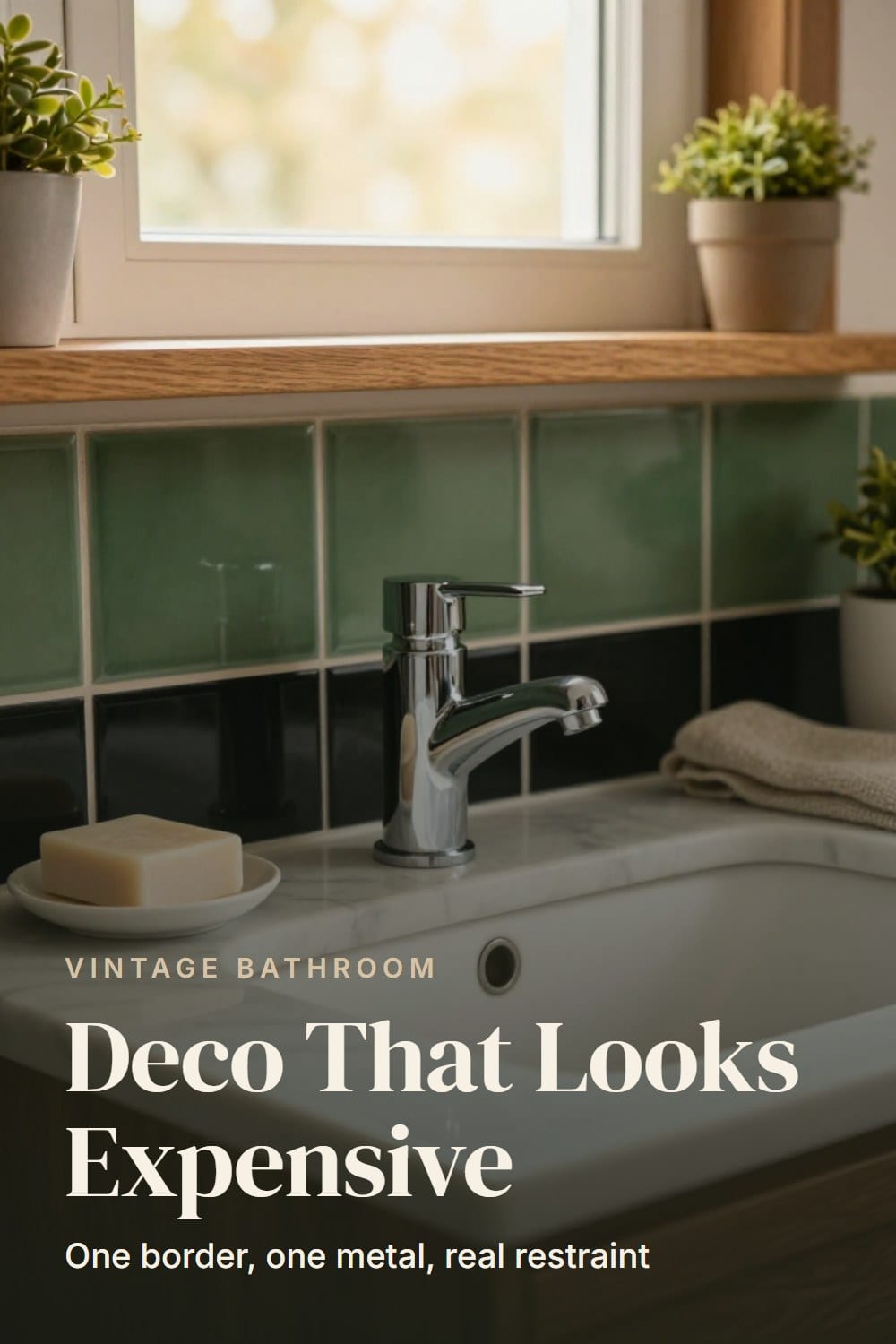
Green and black is the softer one. A jade, a mint or a deep bottle green with a black cap looks rich and a bit moody, and it flatters wood and brass in the rest of the house. Green tile bathroom ideas goes through the shades.
Where the border goes
The border is the deco part. Use one row of black trim tile, about 4 inches tall, at wainscot height. In a 1930s bath that was often around 48 inches, and it still looks right today. A black bullnose cap on top of the wall tile does the same job more quietly.
This is also the best place for your single stepped or fan motif. Put it in one inset panel over the tub or as one row of the border, and let the rest of the tile run plain. A motif repeated across the whole wall tips into costume.
The floor and the grout
A 3/4 inch hex or a 1 inch square mosaic in black and white is the classic floor. If you're deciding between shapes, hexagon vs penny tile compares them side by side.
Pick a warm mid-gray grout, not stark white. White grout shows every shadow and turns the floor into a chessboard of lines. I regrouted ours in a soft gray and the whole floor looked calmer overnight.
A round or stepped mirror does a lot of work
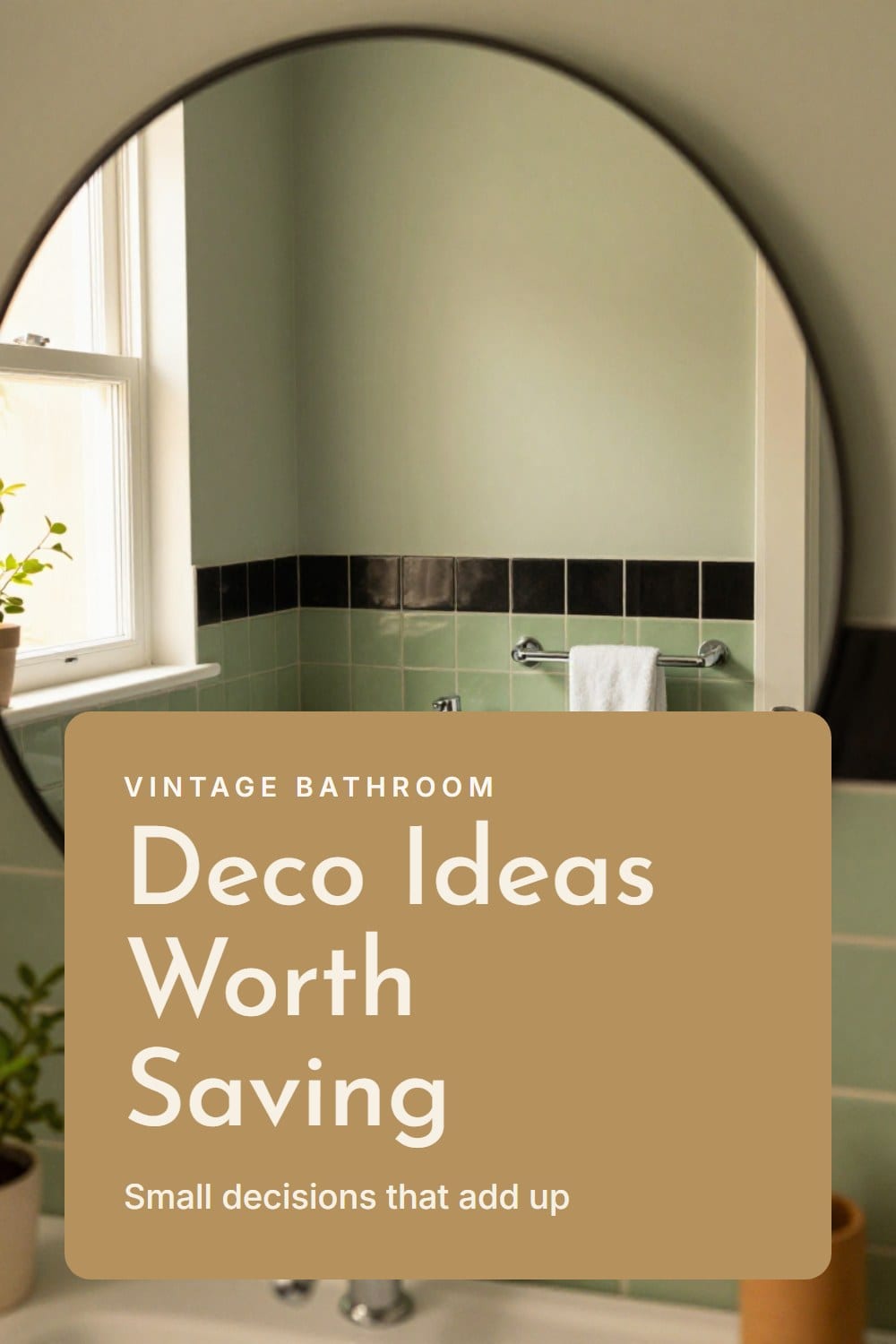
The mirror is where a deco bath gets its shape without a single piece of tile changing. A round mirror, 24 to 30 inches across, is the easiest. A stepped or tiered frame, where each layer is a little smaller than the last, is the more obvious deco choice.
Beveled glass catches the light in a way flat glass can't. Hang it so the center sits at about 60 inches from the floor, which puts it at eye level for most adults. Then check it with the tallest and shortest people in your house standing in front of it.
Choose the frame in the same metal as the faucet. A chrome or nickel frame ties the wall together, and a gilded one fights the fixtures. I tried a gold frame over a chrome tap and it looked like two rooms arguing.
Frosted glass sconces and the right bulb
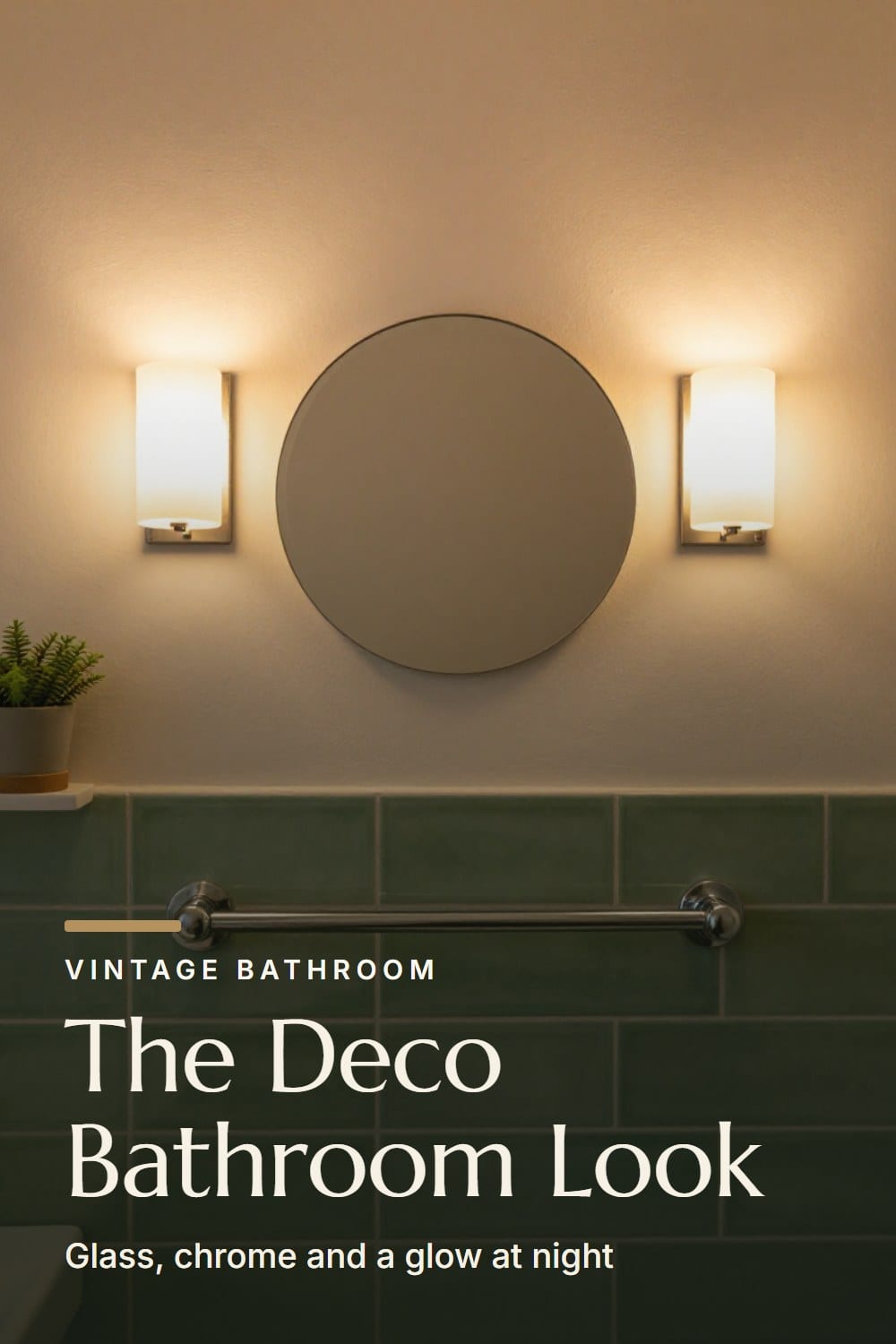
Deco was an electric age, and the lighting shows it. Frosted or etched glass shades, often in a fan, cylinder or half-moon shape, throw a soft even glow on tile. A pair of them flanking the mirror, centered about 60 to 66 inches from the floor, puts the light on your face instead of above it.
Use a 2700K bulb with a CRI of 90 or higher. Cooler bulbs turn a green tile gray and a black border flat. Warm ones make the glaze look wet and deep, even on a gray morning.
Any fixture near the tub or shower needs to be damp- or wet-rated, and rewiring an old sconce is a job for an electrician, not a Saturday experiment. The longer guide to vintage bathroom lighting covers shades, bulbs and placement.
A console sink on chrome legs
A console sink is a porcelain basin on exposed chrome legs, and it's the most deco thing in the room. It opens up the floor, shows off the tile and looks lighter than a vanity, which is why it suits a modest bath.
The tradeoff is storage. There's none, so you'll want a shelf or a lidded basket beneath, and the same tricks that work for pedestal sink storage work here. If you need drawers, vintage bathroom vanity ideas shows converted dressers and washstands.
Choose one metal. Chrome is cool and mirror-bright, and polished nickel is a shade warmer with a slight gold cast. Either one is correct for deco. Mixing them on the faucet, towel bar and sconce backplates is what makes a room look assembled in a hurry.
Terrazzo and marble, in small doses
Marble and terrazzo give deco its quiet richness. They also overwhelm a room fast, so keep them to a few pieces. A marble shelf 4 to 6 inches deep, a threshold at the door, or a terrazzo sink top is plenty.
A small marble hex or a terrazzo floor tile can also stand in for the black and white mosaic if you prefer a softer ground. Keep the flecks in colors already in the room, and the stone will read as part of the plan.
Where 2026's neodeco fits in
Neodeco, the recent revival of the style, trades some of the hard geometry for curves. You'll see arched mirrors, fluted glass and softer brass in place of chrome. It's a lovely direction, and a lighter one.
I'd borrow it lightly. An arched mirror in place of a round one, or a fluted glass shade on one sconce, gives a 1930s room a fresher feel. Keep the metal to one finish, though, whichever era it comes from. A brass mirror over a chrome tap pulls the room apart.
If you love the idea of going darker, black tile and old brass lean toward the moody vintage bathroom look, and deco is a natural fit for it.
Five mistakes that make a deco bath look like a set
- Repeating the zigzag everywhere. Wallpaper, mirror, rug, shower curtain and tile all in geometry. Give one of them the job.
- Going all black. A black tile floor, black walls and a black ceiling leave nowhere for the eye to rest. Keep the walls warm white above the border.
- Mixing metals. Gold, chrome and nickel in one small room look accidental.
- Choosing clear bulbs and cool light. Frosted shades and a 2700K bulb make tile glow.
- Buying a themed set. A matched line of deco-style accessories looks like a catalog. Pick one lamp, one towel bar and one mirror instead.
A checklist before you commit
- Choose the one thing that carries the deco shape: tile, mirror or wallpaper.
- Pick black and white or green and black for the tile, and keep the field color flat.
- Set a single border row at about 48 inches, capped in black.
- Choose a warm mid-gray grout, not stark white.
- Pick one metal for the faucet, towel bar, sconce backplates and sink legs.
- Hang a round or stepped mirror centered about 60 inches from the floor.
- Put frosted sconces and a 2700K bulb on both sides of the mirror.
My advice is to live with the tile and the border for a month before you add anything else. You'll know by then what the room wants, and it usually wants less. If you'd like to dress the finishing touches, the vintage bathroom decor guide covers them, and the how to make a bathroom look vintage guide shows how to get there without gutting anything.
For the larger plan that sits behind all of these rooms, the complete vintage bathroom guide is the place to start.
The Deco Bath Pairing Sheet
The printable is being finished. It will live here, free, with no sign-up wall.
Frequently asked
Can I do an art deco bathroom in a newer house?
Is an art deco bathroom always black and white?
Should the fixtures be chrome or brass?
How much deco is too much?
Sarah Whitmore
she keeps the teak, she oils it in spring
Sarah has furnished the same porch three times and finally stopped. She writes about what actually survives a decade outdoors — which wood silvers, which fabric fades, and which inexpensive piece quietly reads the same as the expensive one.
SarahMore from this corner
 Vintage Bathroom
Mid Century Bathroom Ideas for a House Built in the 1950s and 60s
Mid century bathroom ideas for a ranch or split-level: the floating vanity, square and penny tile, globe lights, a wide mirror, and which original features to keep and update around.
Oct 31, 2026 · 12 min read
 Vintage Bathroom
 Tile Ideas: The Patterns and Colors That Never Date
Vintage bathroom tile ideas that still look right decades on: the hex, penny, subway and checkerboard patterns, the glaze colors worth keeping, the grout rule that matters most, and how to decide between repair and reproduction.
Oct 29, 2026 · 12 min read
 Vintage Bathroom
 Lighting: Sconces, Schoolhouse Globes and the Right Bulb
Vintage bathroom lighting that looks period and still flatters a face: sconces at eye height, schoolhouse and milk glass globes, nickel or brass, damp-rated fixtures, and the warm high-CRI bulb that makes skin look right.
Oct 26, 2026 · 12 min read