Pedestal Sink Bathroom Storage Ideas That Keep the Old-House Look
Twelve pedestal sink bathroom storage ideas that look like they came with the house: recessed and framed cabinets, shelves, a skirt, a stool, hooks and jars, with real sizes and the reason each one looks original.

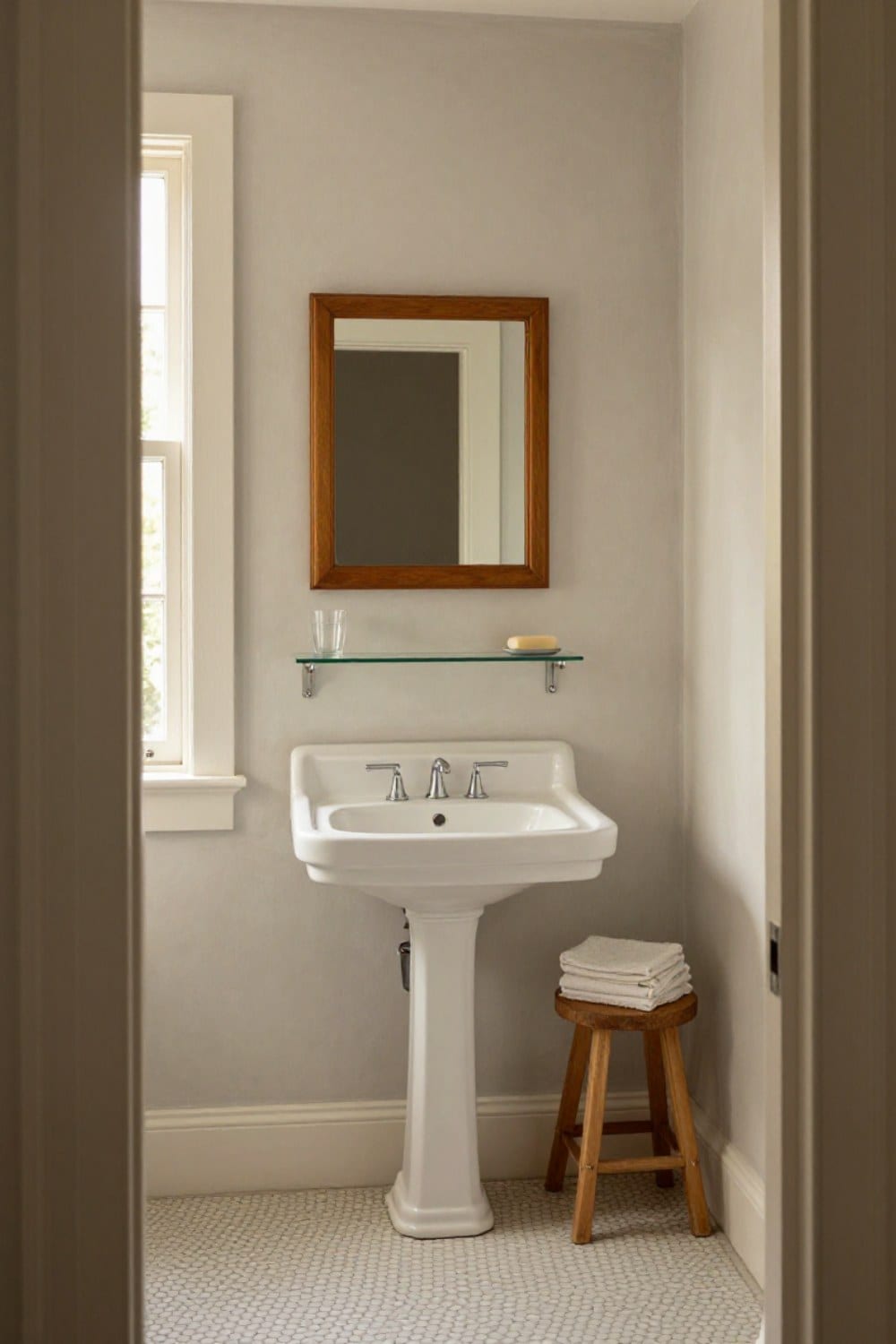
Pedestal sink bathroom storage ideas all start from the same small grievance. The sink is beautiful, and there is nowhere to put a toothbrush.
Ours is a 22-inch porcelain pedestal in a 1928 bathroom. For the first year, every tube, comb and cotton pad lived on the back of the toilet tank, and the room looked like a drugstore display. I nearly talked myself into a vanity. That would have meant losing the one thing that makes the room feel original.
You don't have to choose. Below are twelve ways to add storage around a pedestal sink that look like they came with the house, with sizes and the reason each one works. Pick two or three. If you're planning the whole room, vintage bathroom decor covers the finishing pieces that go with them.
Why a pedestal sink runs out of room so fast
A pedestal sink is a basin, a column and a rim about 2 inches wide. That's the whole surface. Most run 20 to 30 inches across, and the narrow ones barely hold a glass. They were made for houses where the toothbrush lived in a cup on a shelf and everything else stayed in the bedroom.
The good news is that three areas are completely free: the wall behind the sink, the wall beside it, and the floor next to the column. Every idea here uses one of them.
Measure before you shop. Stand at the sink and note how many inches you have to the nearest wall on each side, where your mirror starts, and where the water lines go into the wall. Sketch it on paper. It takes ten minutes and saves a wrong purchase.
A recessed medicine cabinet in the wall
Old houses nearly always had one: a box set into the wall between the studs, finished with a mirrored door. Studs in older houses are often 16 inches apart on center, which leaves a clear opening of about 14 1/2 inches. A recessed cabinet around 14 inches wide and 24 to 30 inches tall fits that gap with no framing changes.
It gives you 3 to 4 inches of depth, enough for a toothbrush cup, a razor and a tube. And it looks original because it disappears. Nothing sticks out from the wall, so the sink keeps the room.
Cutting into the wall is demolition. Plaster, joint compound and old paint can hold asbestos or lead, so have it tested before you cut or sand. I wanted one badly in ours. Then I found the supply pipes sitting exactly where the cabinet would go, and I moved on to the next idea.
A framed surface-mount cabinet when the wall won't open
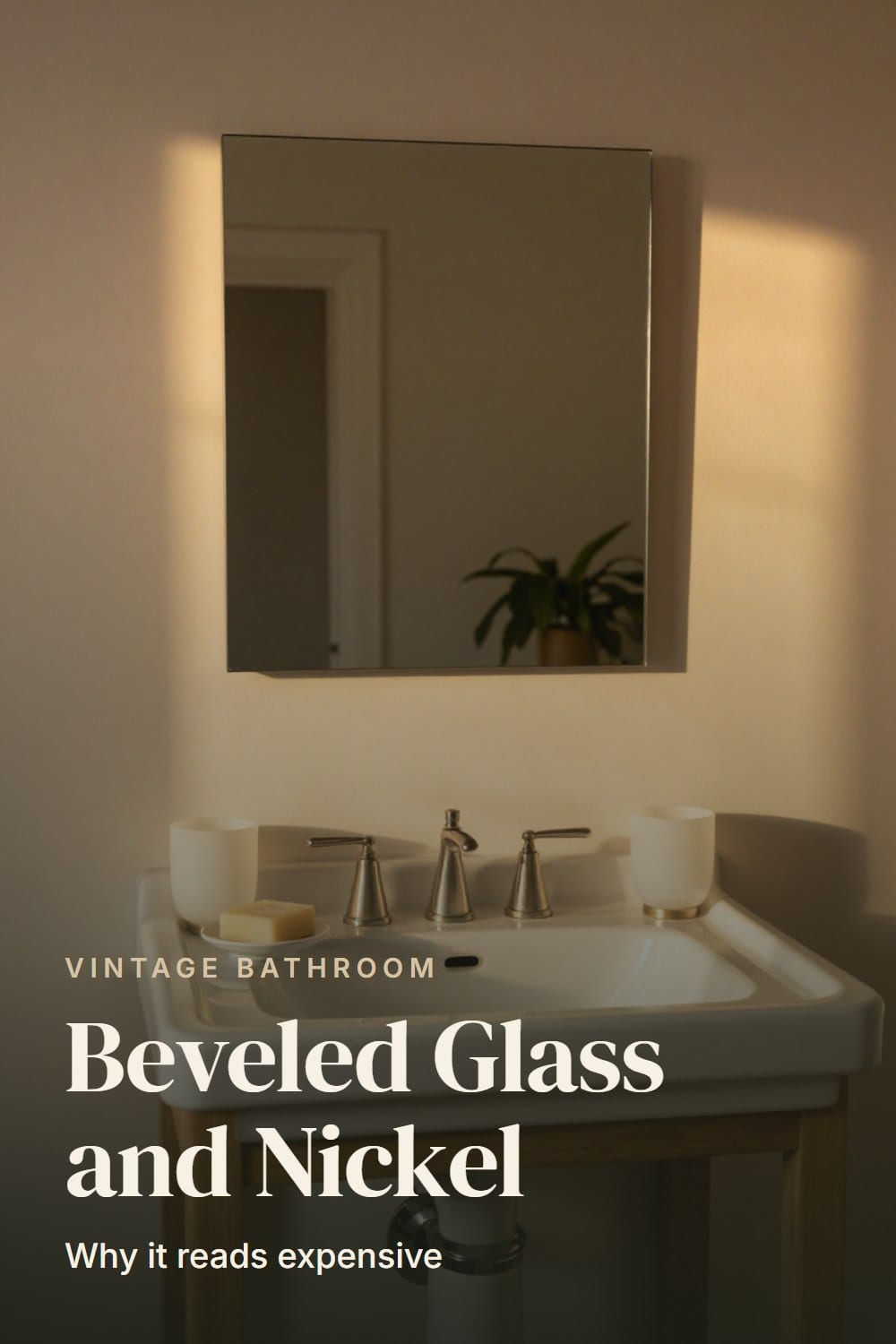
This is what I ended up with. Look for a wood or painted frame, a beveled mirror door and a depth of 4 to 5 inches. Hang it 16 to 20 inches wide, centered over the sink and narrower than the basin, so the two read as a pair.
Hang it into studs or plaster anchors rated well above the weight of the cabinet plus what you'll put in it. Keep the bottom edge about 8 inches above the faucet so it doesn't crowd your hands. A beveled edge catches the light the way old glass does, and that is most of the look.
A pair of sconces on either side finishes it. The vintage bathroom lighting guide covers which shades and bulbs flatter a mirror.
A glass shelf just under the mirror
A narrow shelf on nickel brackets is the classic. Make it 4 to 5 inches deep and 18 to 24 inches long, in 1/4-inch glass or a 3/4-inch board of oak. Set it so the underside clears the faucet spout by at least 6 inches.
It holds a tumbler, a soap dish and a small tray. That is the point. A glass shelf shows everything on it, so you edit without trying. Mine has four things on it, and when it reaches five I take one away.
Be honest about splash. Toothpaste and water land there daily, so wipe it every morning. Glass takes that better than painted wood does.
A wood shelf on brackets, set a little higher
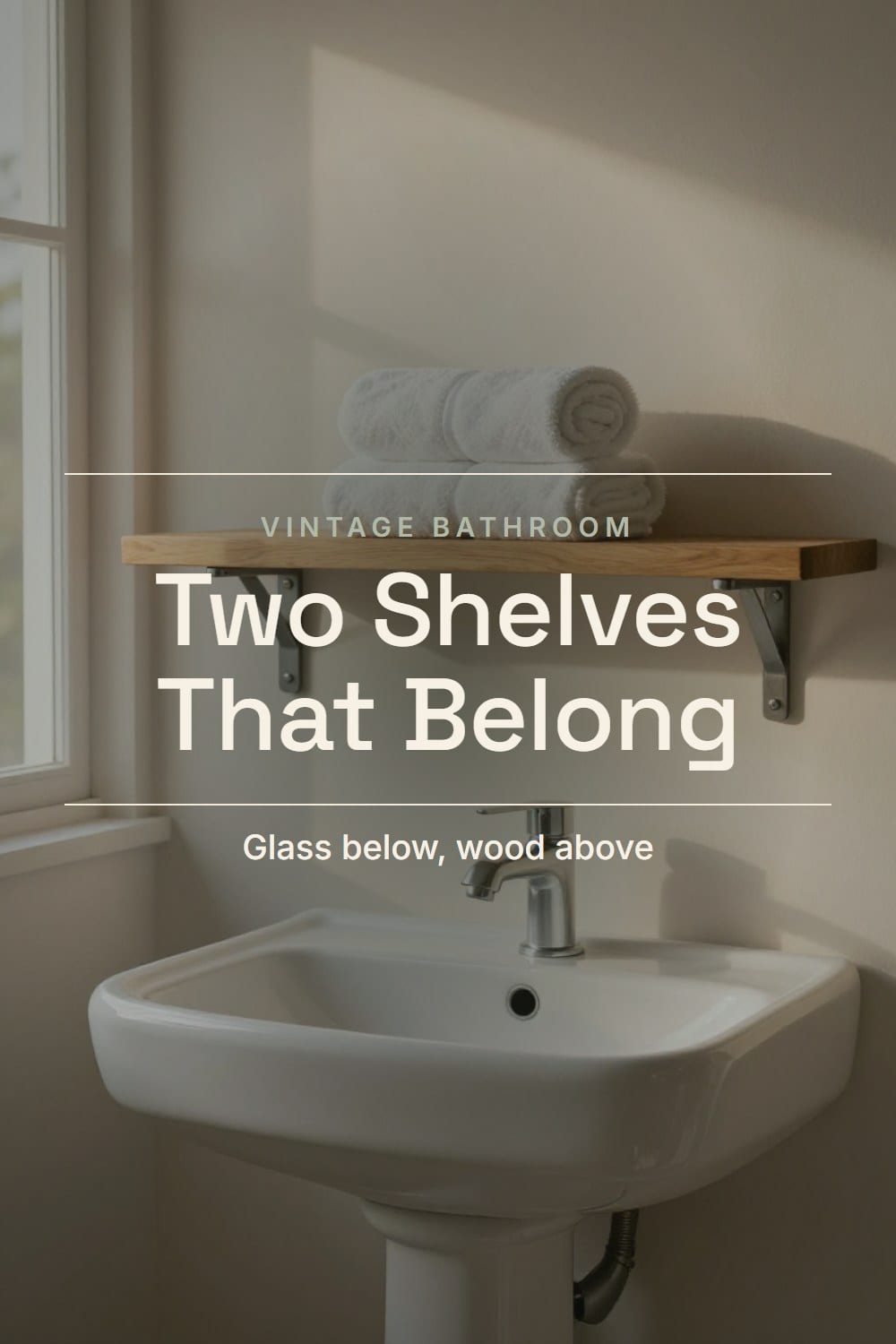
On the wall beside the sink or just above the mirror line, a plain board on iron or painted wood brackets holds rolled hand towels. Make it 7 to 8 inches deep and 24 to 30 inches long, with the top about 54 to 60 inches off the floor.
Screw the brackets into studs. A shelf loaded with towels weighs more than it looks, often 15 to 20 pounds, and plaster alone won't hold it for long. Ask me how I know. Paint or stain the board to match the trim and it will read as part of the room's architecture.
A slim étagère over the toilet
The wall above the tank is the most wasted space in most old bathrooms. A freestanding wood étagère with legs that straddle the tank gives you two or three shelves without drilling. Look for 22 to 26 inches wide, 7 to 9 inches deep and about 60 inches tall, with the lowest shelf at least 2 inches above the tank lid so you can still lift it.
Put the heavy things on the bottom shelf, folded towels in the middle and one pretty thing on top. My first one was raw pine, and by February the lowest shelf had a wave in it from the steam. Choose a stained or painted piece, and seal the underside as well as the top.
A sink skirt that hides baskets
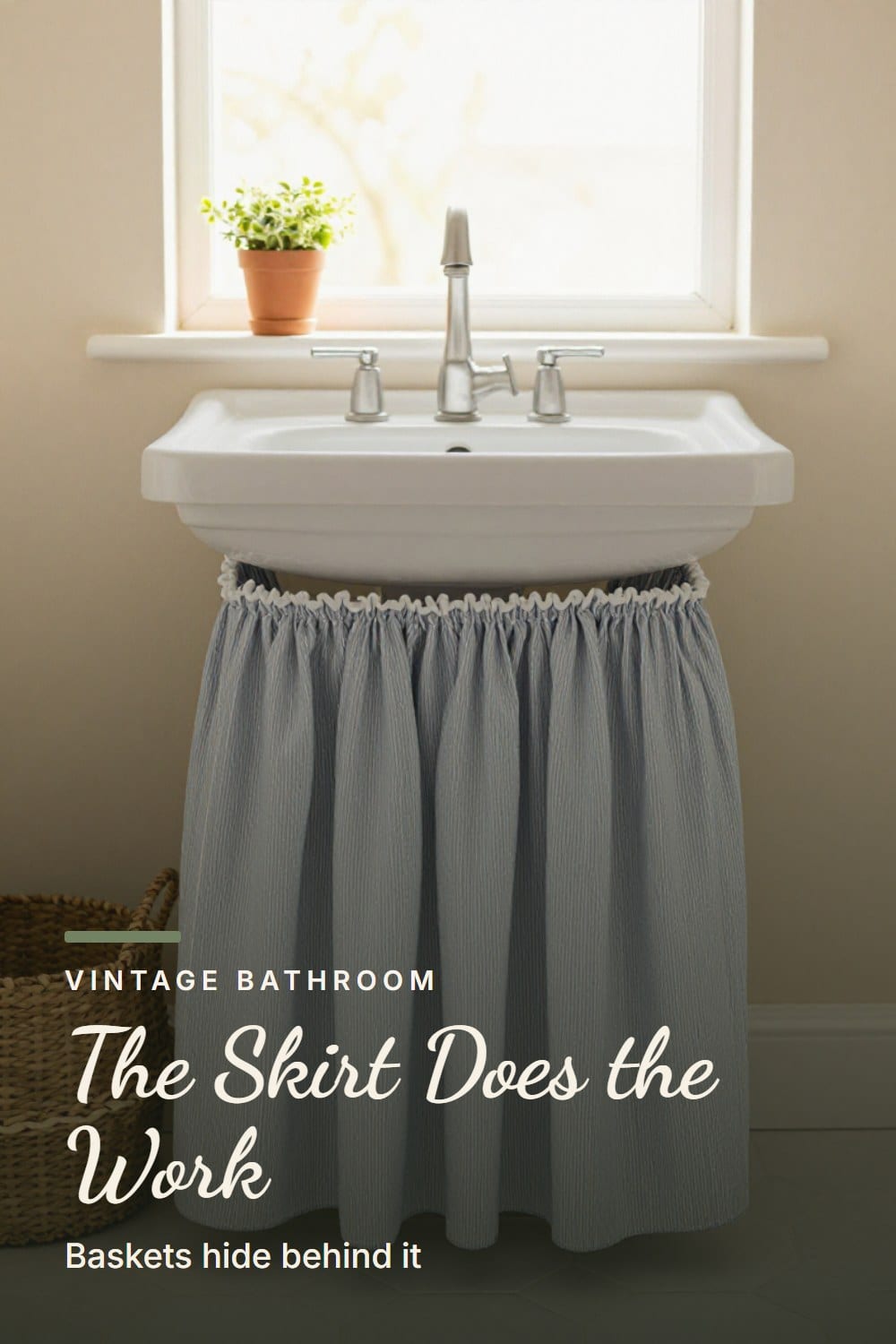
A gathered skirt hung from the basin rim on a small rod or hook-and-loop tape turns the open space around the column into a closet. Use washable cotton or linen in a ticking stripe, a small floral or a large gingham, and hem it about 1 inch above the floor.
Behind it, on the floor beside the column, a basket 8 to 10 inches wide takes spare toilet paper or cleaning cloths. It also hides the supply lines. Measure the gap on each side of your column first, because some sinks leave only 6 inches.
The first skirt I made dragged on the tile and wicked up every drip. Keep the hem off the floor, wash it every few weeks in hot water, and flip it up whenever you need the shutoff valves. For more pattern ideas, grandmillennial bathroom ideas goes further into skirted sinks.
A small wood stool beside the sink
Old bathrooms often had a stool or a bentwood chair for drying feet or washing a child's hair. A stool about 16 to 18 inches tall and 12 to 14 inches across holds a folded towel and a tray with a soap dish, and it adds a piece of furniture where fixtures have all the weight.
Choose hardwood with an oil or varnish finish, never raw. Keep it on the side away from the faucet, so the towel stays dry. If you have a clawfoot, a wood caddy across the tub does the same job and keeps the stool free. More on that in clawfoot tub bathroom ideas.
A freestanding linen cabinet
When towels and spare supplies need a home, a tall cabinet is the answer. Look for 12 to 16 inches deep, 24 to 30 inches wide and 60 to 72 inches tall, ideally with glass doors up top and solid doors below, so the bottom hides what the top shows.
It looks original because bathrooms used to be furnished rather than fitted. Keep 30 inches clear in front of the sink, and set the cabinet by the door or in a corner away from the tub.
Tall furniture tips. Anchor it to a stud with a strap, especially in a house with children.
A shallow vintage dresser, used as a dresser
I'm not talking about converting it into a vanity. That's a bigger project, and vintage bathroom vanity ideas covers it properly. Here the dresser just stands beside the sink with towels in the drawers and a tray on top.
Pick a shallow one, 16 to 20 inches deep and 30 to 36 inches tall. Seal the top with a few coats of water-based polyurethane, or set a marble slab or tray on it. Drawers swell in steam, so run the fan during the shower and for about 20 minutes after.
If the paint looks old and flaking, have it tested for lead before you sand it.
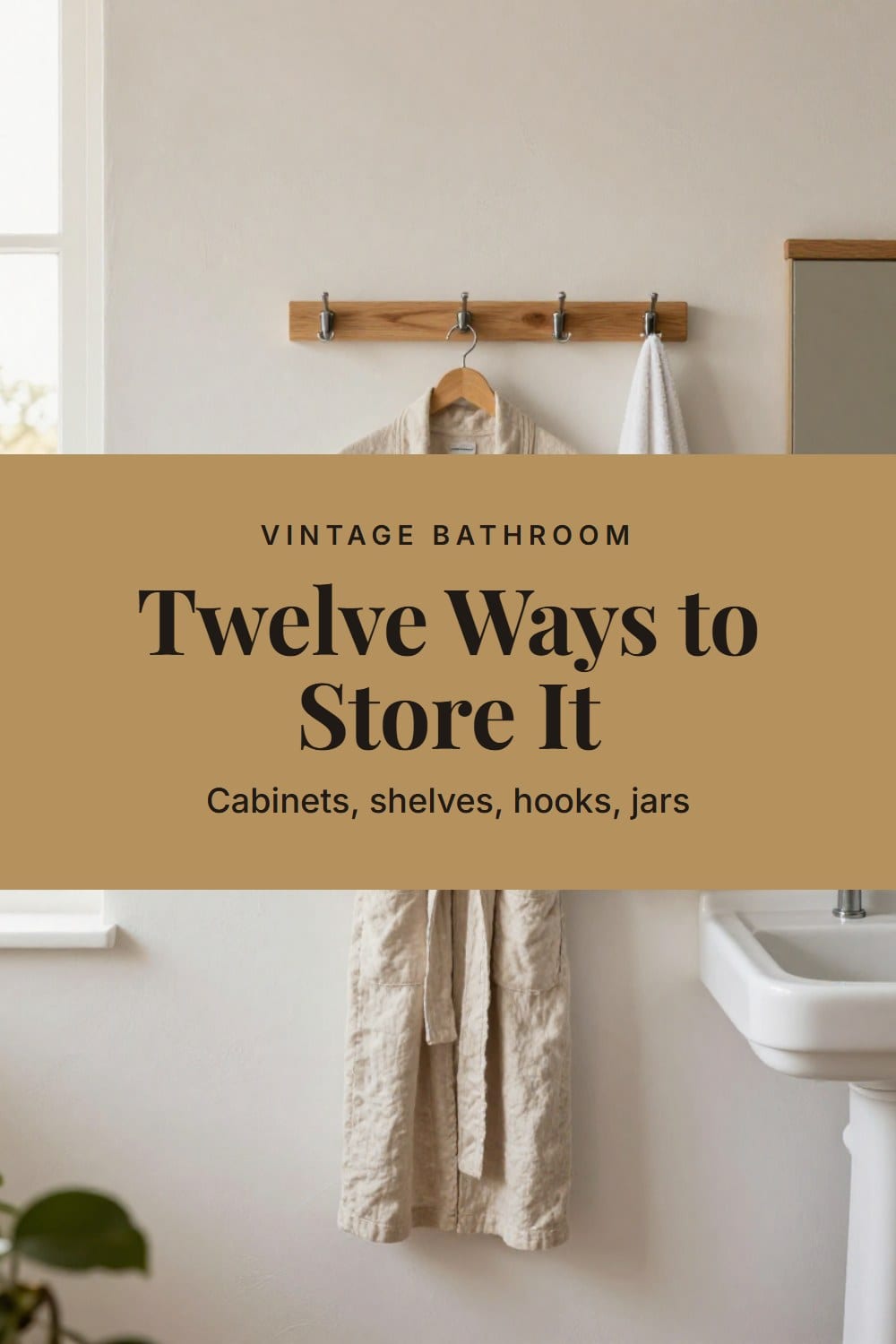
Wall hooks in a row
Hooks take less room than any other storage. Mount a board 3 to 4 inches wide with four nickel or porcelain hooks, spaced 6 to 8 inches apart. Put robes at 66 to 72 inches and towels at about 48 inches.
Bathrooms had hooks long before they had towel bars. A hook rail on the back of the door, or on the wall beside the sink, gets wet towels off the floor and out of the way.
Hang the board on studs. A wet towel, a robe and a bag add up to more weight than a screw in plaster can carry.
A towel bar with a shelf above it
A nickel bar about 24 inches long, with a shelf 5 to 6 inches deep above it, beside the sink stores two things in one footprint. Fold the hand towels on the shelf and hang the bath towel on the bar.
Leave 8 inches between the bar and the edge of the basin so a wet towel doesn't touch the sink. In old photographs you see this combination everywhere, and it never looks fitted, because the pieces are simple.
Lidded glass jars for the small things
Cotton balls, swabs and hair pins look neat in clear glass jars with lids, 4 to 6 inches tall. The lid keeps steam and dust out. A jar of cotton and a bar of soap on a dish are about as close to an apothecary as you need.
Decant anything with loud packaging. Bright plastic brands are the fastest way to ruin the old look. It takes ten minutes, and it is the step people notice most when they walk in.
Pedestal sink bathroom storage ideas in the order I'd add them
Start on the wall, move to the floor, and stop while there's still bare plaster showing. This is the order that has worked in our bathroom and in two friends' houses.
- A mirrored cabinet, recessed if the wall allows it and framed if it doesn't.
- One shelf under the mirror for the daily things.
- Hooks for towels and a robe.
- One piece of furniture for the rest: a stool, a linen cabinet or a shallow dresser.
- Jars and trays last, and only if something still looks homeless.
Mistakes that give the game away
- Buying a shelf wider than the sink. The basin should be the widest thing on the wall.
- Chrome-plated plastic or wire racks. They look like a catalog, and they rust.
- Open storage for everything. Put the ordinary things behind a door and show only what you like looking at.
- Blocking the sink. Leave about 24 inches clear in front of it so you can lean in.
- Skipping the pipes. Cutting or drilling before you know where the supply lines run.
For more on the look as a whole, vintage bathroom ideas is the full guide, and 1920s bathroom ideas shows the pedestal sink in its first decade.
The Pedestal Sink Storage Planner
The printable is being finished. It will live here, free, with no sign-up wall.
Frequently asked
Where do you put toiletries with a pedestal sink?
How wide should a shelf over a pedestal sink be?
Can I put a medicine cabinet on any pedestal sink wall?
Will a sink skirt look dated?
Sarah Whitmore
she keeps the teak, she oils it in spring
Sarah has furnished the same porch three times and finally stopped. She writes about what actually survives a decade outdoors — which wood silvers, which fabric fades, and which inexpensive piece quietly reads the same as the expensive one.
SarahMore from this corner
 Vintage Bathroom
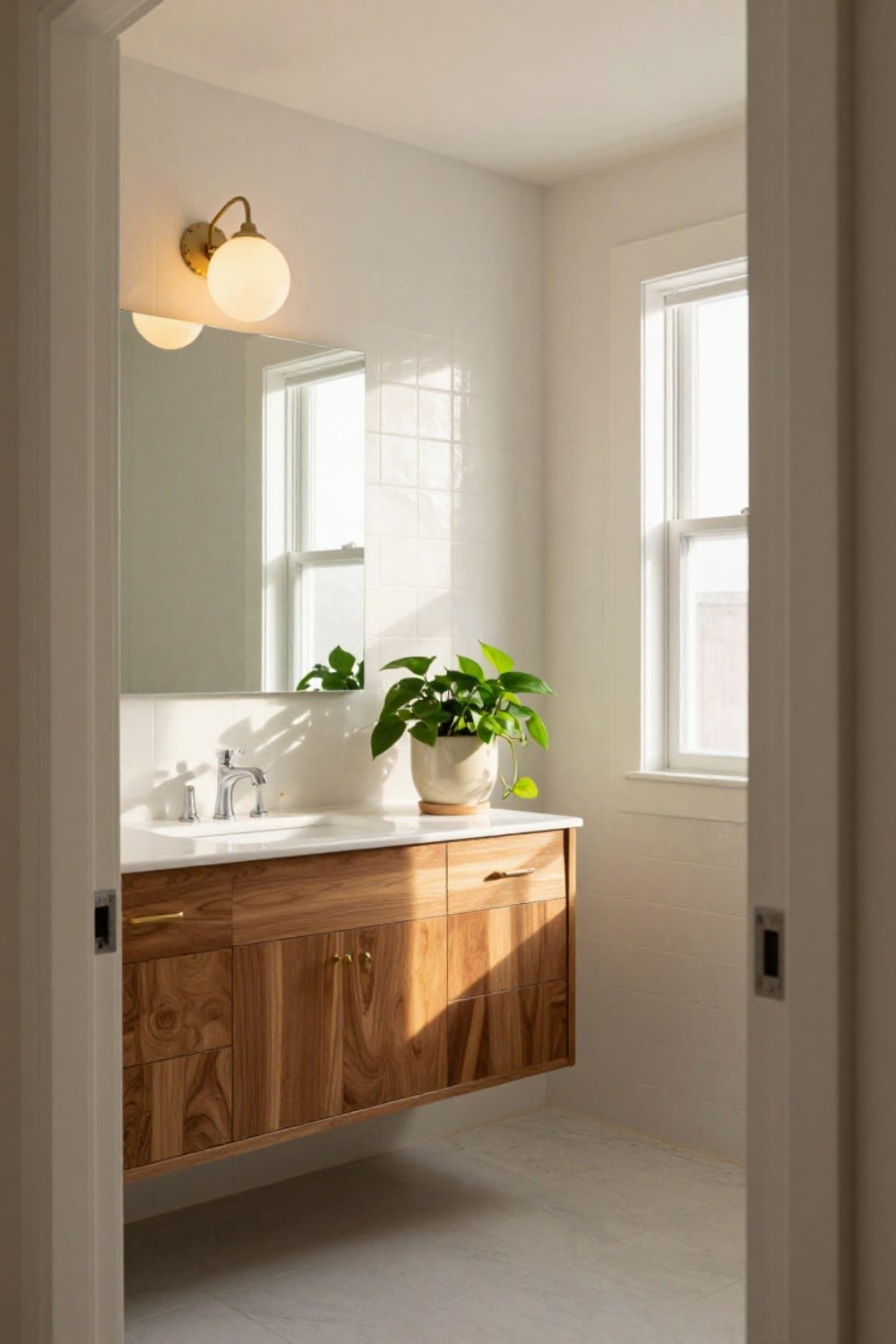
Mid Century Bathroom Ideas for a House Built in the 1950s and 60s
Mid century bathroom ideas for a ranch or split-level: the floating vanity, square and penny tile, globe lights, a wide mirror, and which original features to keep and update around.
Oct 31, 2026 · 12 min read
 Vintage Bathroom
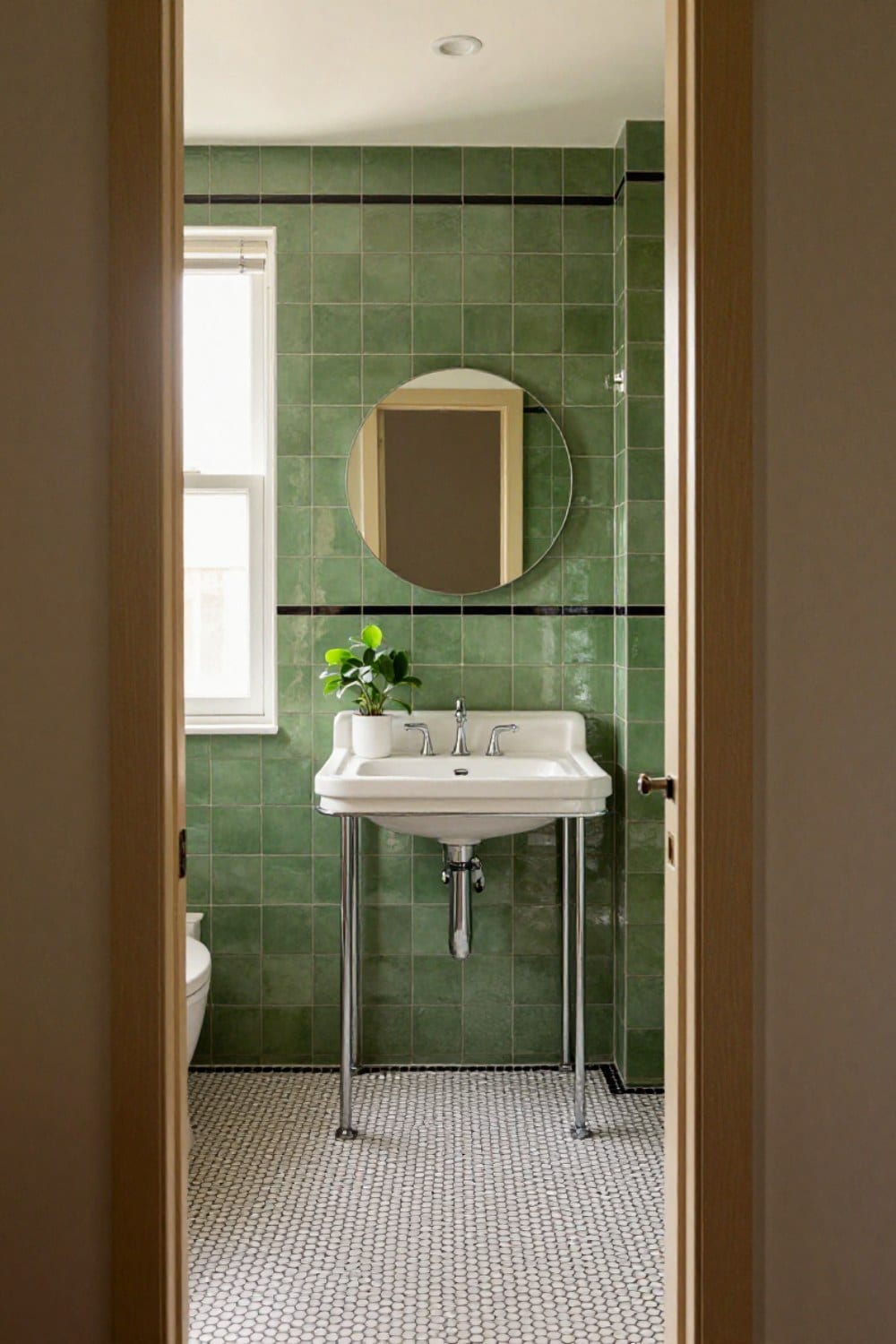
Art Deco Bathroom Ideas That Feel Classic, Not Costume
Art deco bathroom ideas scaled for a real house: the one-statement rule, black and white or green and black tile with a border, round mirrors, frosted sconces, a console sink on chrome legs, and the mistakes that make it look like a set.
Oct 31, 2026 · 11 min read
 Vintage Bathroom
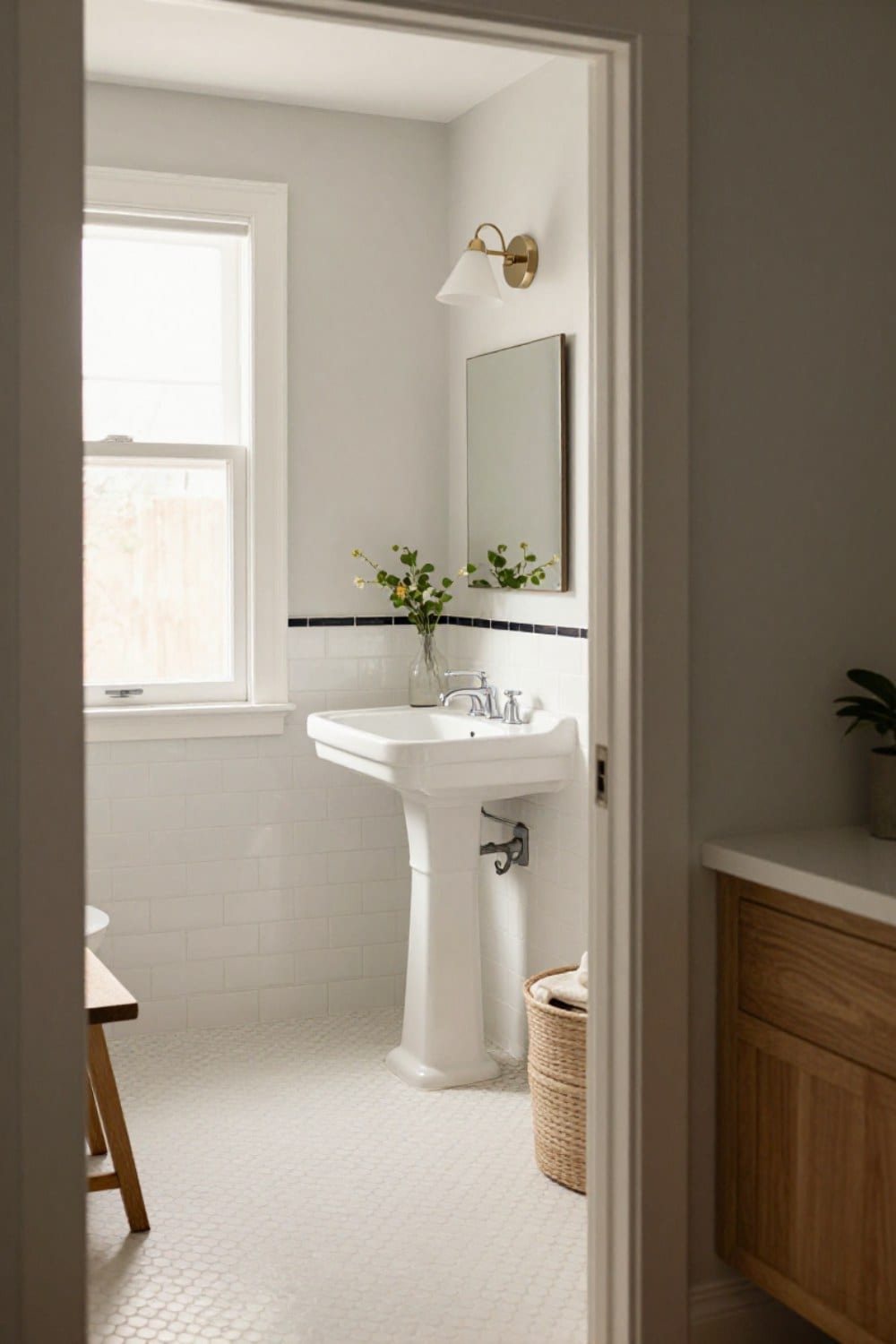
 Tile Ideas: The Patterns and Colors That Never Date
Vintage bathroom tile ideas that still look right decades on: the hex, penny, subway and checkerboard patterns, the glaze colors worth keeping, the grout rule that matters most, and how to decide between repair and reproduction.
Oct 29, 2026 · 12 min read