The Best Fluffy Pancakes recipe you will fall in love with. Full of tips and tricks to help you make the best pancakes.

The Welcome Committee: Why Every Front Door Needs a Washable Plaid Runner in 2026

By Timeless Manor | Front Door Rug · Washable Rugs · Plaid Rug · Patio Inspiration · Modern Rug
“Before anyone sees your furniture, your art, or your kitchen renovation — they see your front door. Make it say something worth remembering.”
I. The 5-Second Impression: What Your Front Porch Is Really Saying
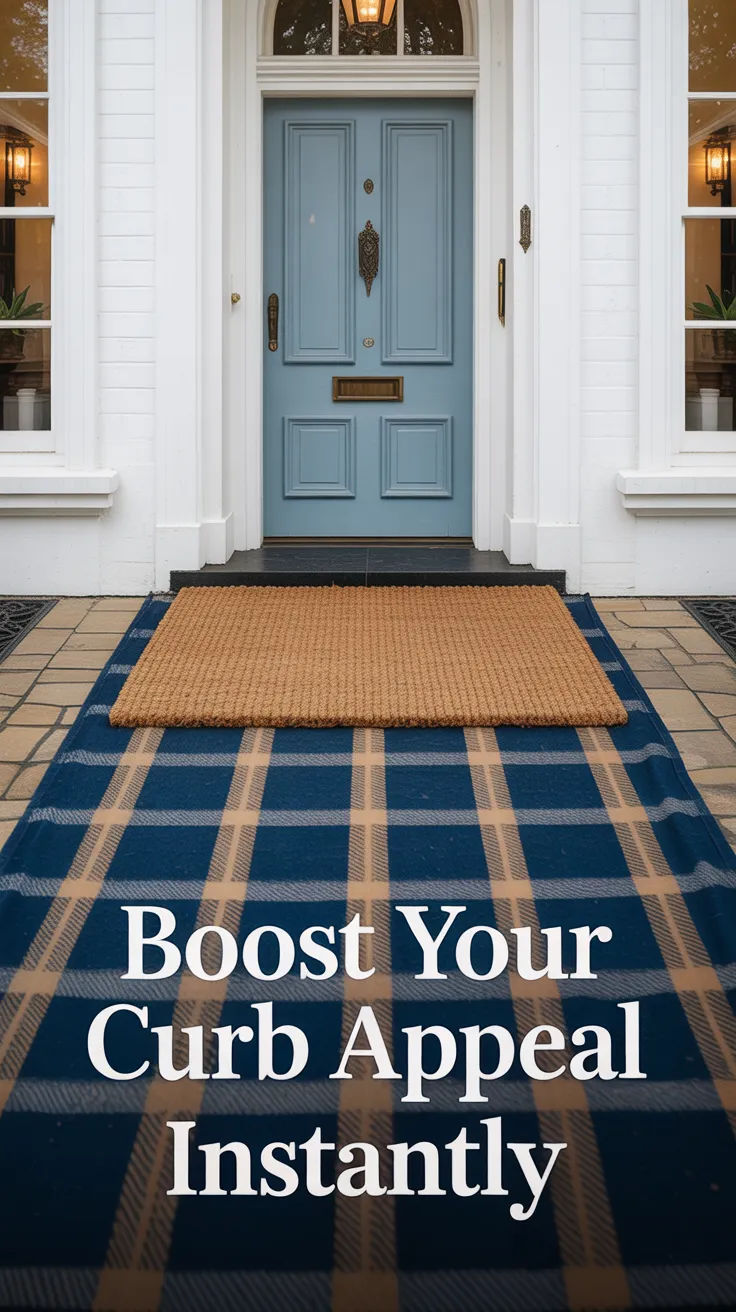
There’s a very specific feeling you get when you walk up to a house that’s been thought about. You can’t always articulate it immediately — the door is painted the right shade of dark green, the hardware catches the light in a satisfying way, there are planters that look intentional rather than accidental. And underneath all of that? A rug. Usually layered. Almost always patterned. Doing more work than anyone gives it credit for.
Now think about the house on the other end of the street — the one with a cracked rubber mat that says “WELCOME” in a font that gave up halfway through the design process. The house behind it might be immaculate. But you’ve already formed an impression that will take effort to undo.
That’s the five-second rule of curb appeal, and your front door rug is its ground zero.
In 2026, the way Americans approach their front entry has quietly evolved from functional afterthought to deliberate first chapter. What used to be a single rubber mat — bought because something had to be there — has become a considered layering system that sets the entire tone for a home’s personality before anyone sets foot inside. And the pattern that’s leading this shift in every corner of Pinterest? The plaid rug, specifically in washable performance materials that can take a spring thunderstorm, a season of muddy dog paws, and a summer’s worth of pollen without looking like they’ve been through any of it.
Here’s the problem this solves, and why it’s more emotionally loaded than it first appears: high-traffic zones are where luxury goes to die. That’s the unspoken frustration behind a lot of beautiful-home aspirations. You invest in a gorgeous flatweave runner, and within six weeks it’s stained, frayed at the edges, or faded to a ghost of its catalog self. So the next time around, you buy something cheap and accept the compromise.
The washable plaid front door rug is the refusal of that compromise — and this article is about exactly how and why it works.
🛍️ See the Look Before You Commit
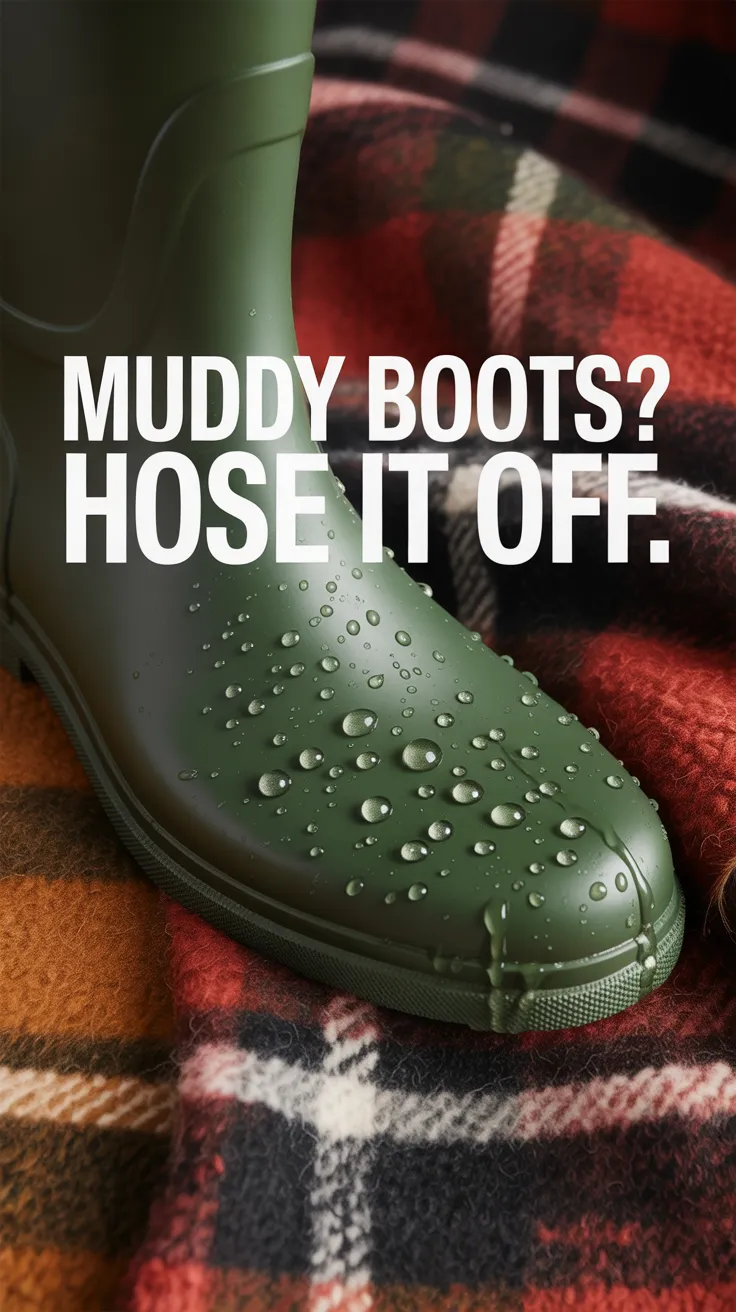
Before we get into the why, here’s the what — the visual that starts this entire conversation on Pinterest.
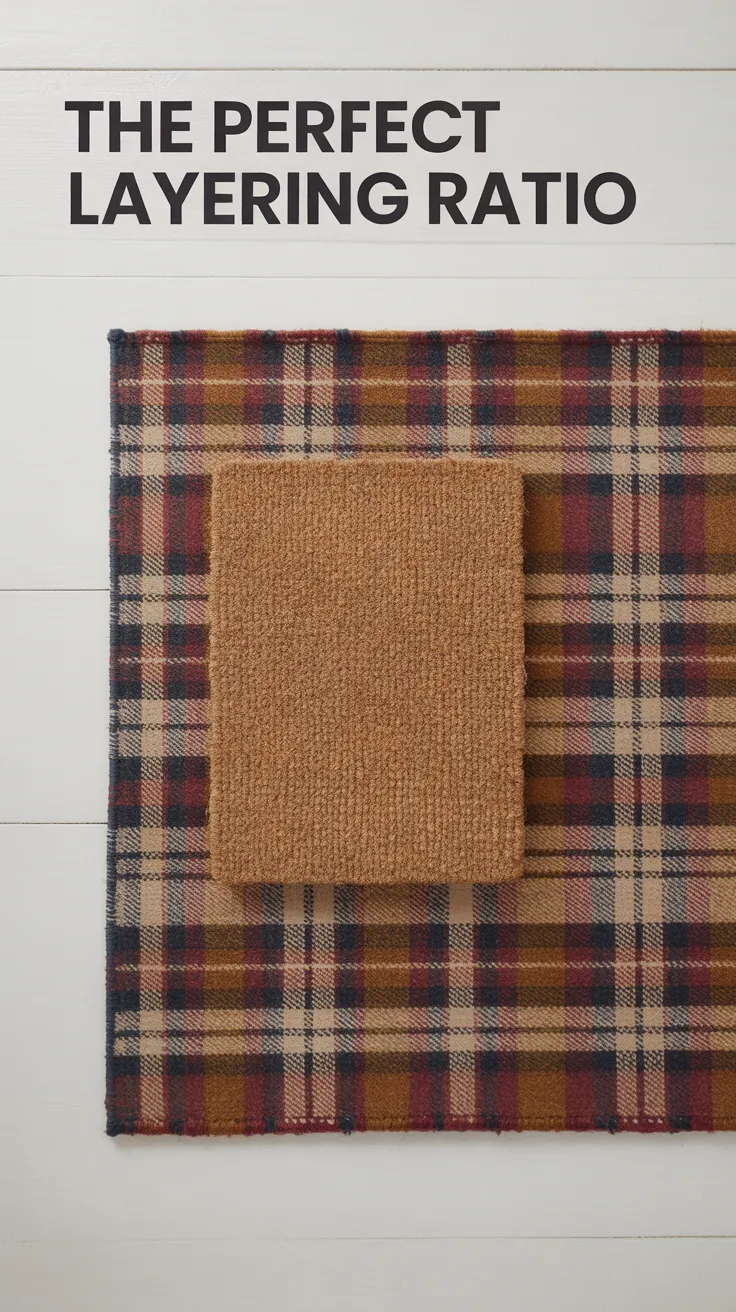
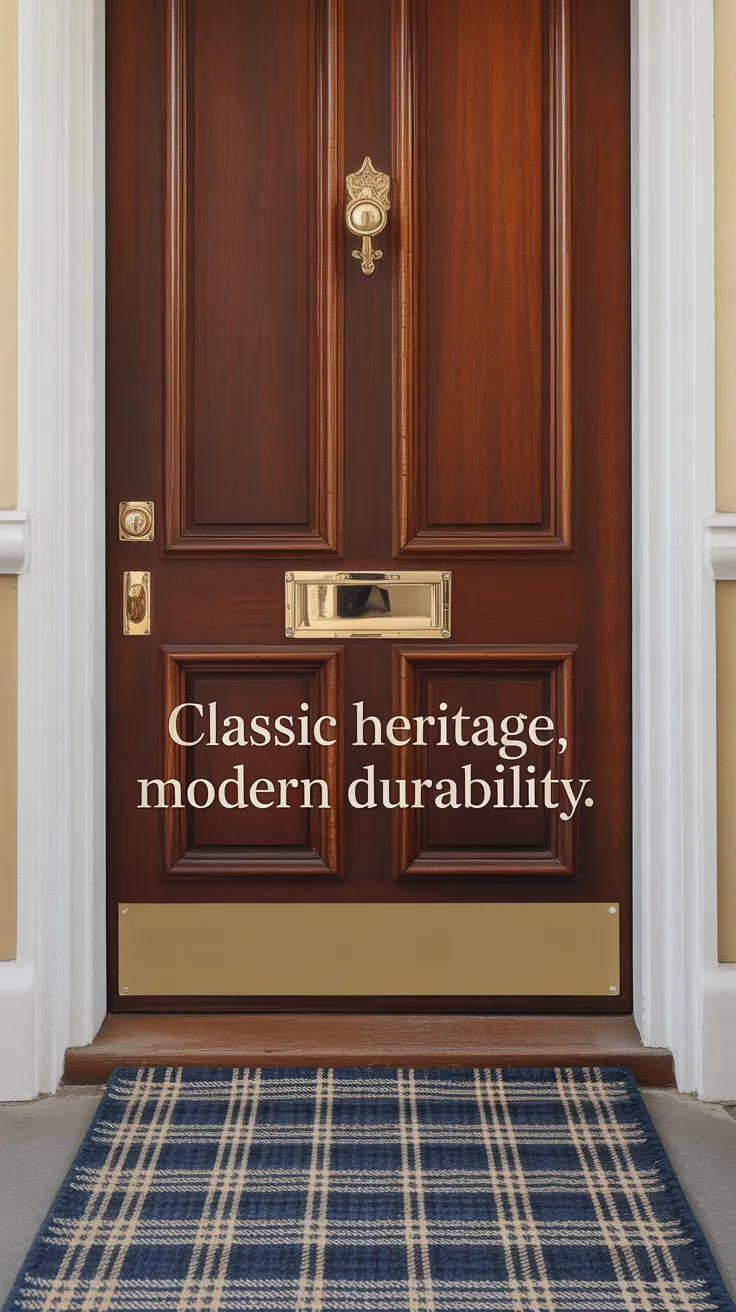
The Layered Entry Starter Set: Buffalo Check Plaid Rug (3×5) + Natural Coir Doormat (24×36)
This is the foundation of 2026’s most-pinned front door setup. A navy or charcoal buffalo check plaid rug as the base layer — wide enough to extend several inches beyond the door frame on both sides — with a natural coir mat centered on top. The coir does the scraping work; the plaid does the statement work. Together, they look like a front entry that belongs in an editorial shoot for a Southern Living feature on American farmhouse porches.
Search: “buffalo check plaid outdoor rug 3×5 navy for layering under doormat”
II. The Psychology of Plaid: Why This Pattern Earns Its Place Outdoors
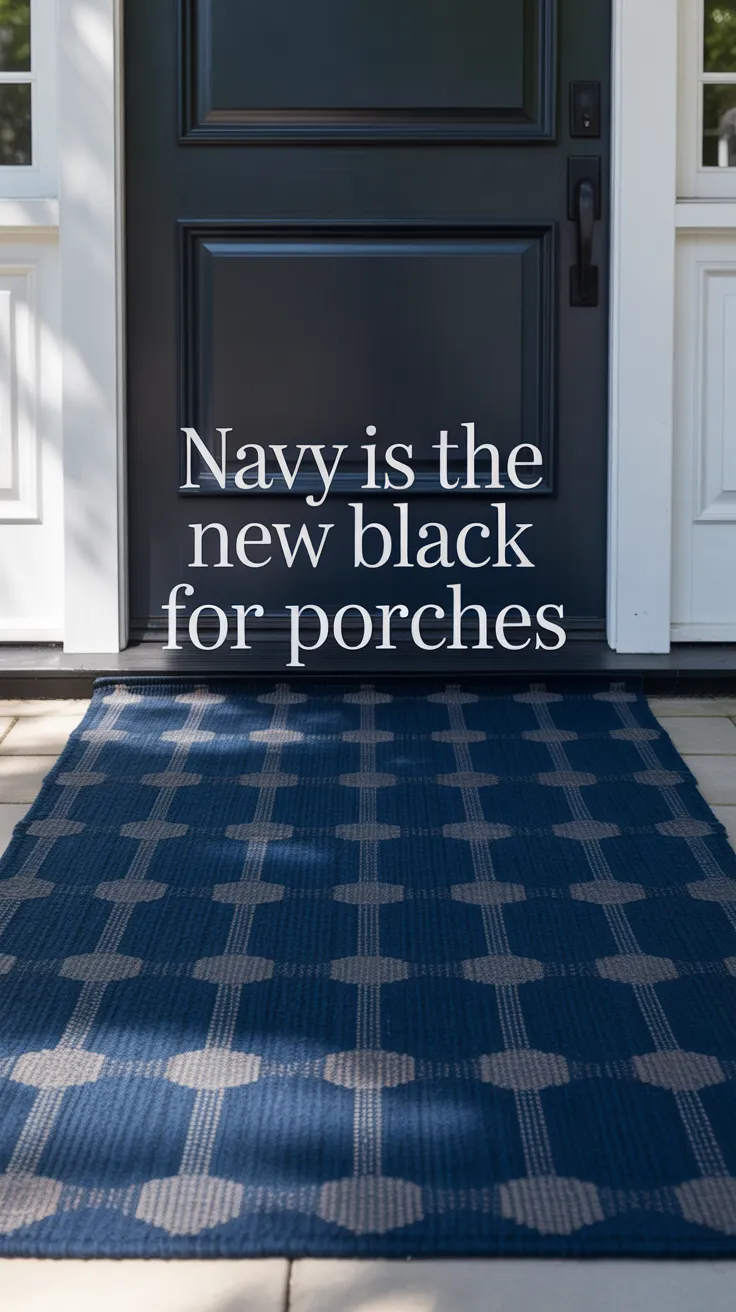
Plaid is one of those rare patterns in design that manages to feel both ancient and completely current at the same time. It’s been woven into American domestic aesthetics for well over a century — from the covered porches of Appalachian farmhouses to the coastal cottages of Cape Cod to the modern farmhouse movement that reshaped how millions of homeowners think about “cozy.” And in 2026, it’s found a new home outdoors in a way that feels less like trend-chasing and more like homecoming.
But there’s something important happening beneath the nostalgia: plaid is doing structural work that solid colors simply can’t.
Think about what a front door rug actually faces over the course of a season. Pollen settles in a thin yellow film. Dirt gets tracked in from grass and gravel. Rain creates muddy water that splashes and drags. Dry leaves and pine needles embed themselves in the pile. On a solid-colored rug — even a dark navy or charcoal solid — all of this reads as visible wear and accumulation. You see it every time you open the door.
On a plaid rug, particularly one with multiple tones in its pattern, the eye reads the pattern first and the debris second. The intersecting lines and color blocks absorb visual information in a way that lets the rug look composed even between cleanings. A navy/cream plaid hides light debris in its light tones and dark debris in its dark ones simultaneously. A slate/sand check does the same. This isn’t a styling trick — it’s genuinely how pattern perception works, and it’s a big part of why plaid has remained so relevant in high-use areas of the home for so long.
The 2026 Palette Shift: Beyond Red and Black
For a long time, “outdoor plaid” in America meant red-and-black buffalo check — a pattern so associated with hunting lodges and Christmas porches that it practically had a seasonal address. And while that classic will always have its rightful place, 2026 is expanding the plaid conversation considerably.
The color combinations taking over Pinterest boards this year are what designers are calling “elevated neutral plaids” — combinations that carry the structure and warmth of traditional plaid but land in a more sophisticated, year-round territory:
Navy and Cream is the coastal heritage combination — equally at home on a New England shingled cottage and a Pacific Northwest farmhouse porch. It’s crisp, it photographs beautifully in natural light, and it transitions from summer through fall without needing to be swapped out.
Greige and Slate is the option for the homeowner who wants pattern without obvious color — two neutral tones in different weights that create depth and dimension without committing to a specific seasonal mood.
Forest Green and Sand brings the outdoors in (or rather, extends the outdoors onto) the porch. Against a dark-painted front door or a natural wood entry, this combination reads as deeply considered and just a little unexpected — the sign of someone who’s thought past the obvious.
Charcoal and White is the modern rug interpretation of classic plaid — graphic and architectural, working best on contemporary home exteriors with clean lines, black hardware, and minimal landscaping.
🏡 Timeless Manor Tip: When choosing a plaid palette for your front door rug, pull one color from something already fixed in your entry — your door color, your shutters, a planter glaze, your house numbers. That single connection is what makes the rug look chosen rather than placed.
🛍️ The Modern Heritage Pick
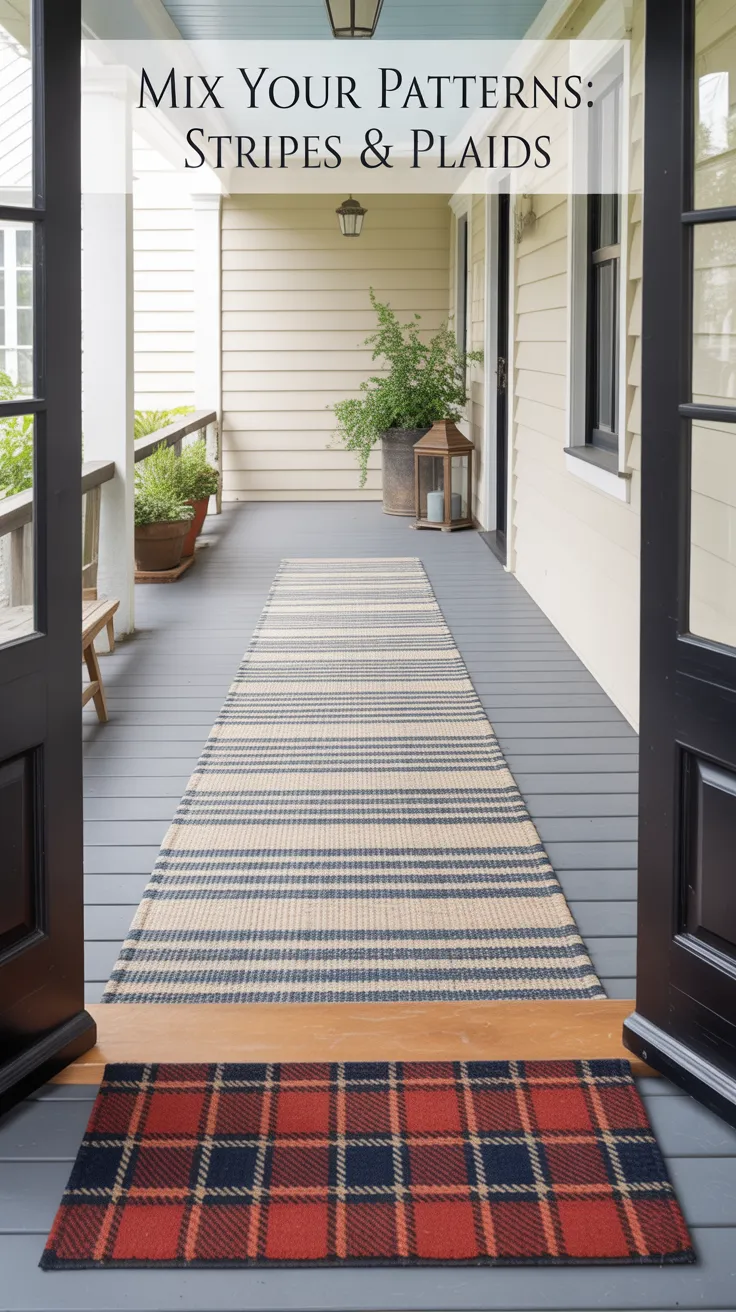
This is the product that belongs in the middle of this conversation — after you understand why plaid works, but before you start building the full layering system.
Gertmenian Outdoor Plaid Runner — 2×8, Navy/Cream Buffalo Check, Polypropylene
A navy-and-cream buffalo check in a runner format is the Swiss army knife of the front door rug world. It works as the base layer under a coir mat at the front door, as a walkway accent on a covered porch, as a transition piece between indoor and outdoor spaces, and as a styling element in a mudroom or back entry. The polypropylene construction is fade-resistant and hose-clean — meaning after a muddy week in March, you drag it to the driveway, hit it with a garden hose for two minutes, let it dry in the sun, and it’s back to looking catalog-ready by dinner.
Search: “Gertmenian outdoor plaid runner 2×8 navy buffalo check polypropylene washable”
III. Why “Washable” Is the Real Luxury in 2026
Let’s address the elephant on the porch directly: the single biggest reason beautiful front entry rugs end up in the trash within a season isn’t budget — it’s maintenance.
A gorgeous sisal runner that can’t be hosed down becomes a crime scene after the first rainstorm. A cotton doormat that can’t be machine-washed becomes a permanent record of every pair of wet boots that crossed it in November. And the cycle that follows is predictable and exhausting: buy something nice, watch it fail against real life, settle for something cheap that at least you don’t feel guilty throwing away.
Washable changes the entire calculation. And in 2026, washable doesn’t mean what it used to.
The Material Revolution Behind the Washable Rug
Recycled PET — the same fiber we discussed in the context of patio rugs — is reshaping the front door category specifically because it mimics the weight and hand-feel of heavy cotton or woven wool while being completely impervious to moisture, mold, and UV degradation. A 5×8 rug made from recycled PET contains roughly 460–500 repurposed plastic bottles, feels like a quality textile underfoot, holds its color through seasons of direct sun exposure, and can be hosed off after a spring storm in about ninety seconds.
For a front door rug that genuinely functions as a “welcome system” — something that traps dirt, handles moisture, looks beautiful, and can be refreshed without professional cleaning — recycled PET is about as close to perfect as current materials engineering gets.
Treated polypropylene, the workhorse of the outdoor rug world (used extensively by Safavieh, among others), rounds out the washable category. It’s power-loomed, UV-stabilized, and specifically engineered for hose-clean maintenance. Safavieh’s Performance collection, for example, uses an 85–88% polypropylene blend that resists fading, staining, and moisture equally well — making it one of the most genuinely reliable choices for any outdoor entryway.
The Math That Changes the Decision

Here’s the sustainability case that most rug marketing won’t spell out for you clearly, but that actually matters for American homeowners making practical purchasing decisions:
A cheap natural coir doormat costs around $20–$35 and lasts, in most American climates, about one full season before it starts shedding, flattening, darkening with embedded grime, or growing mold from below. Four of those per year costs you $80–$140 annually, and sends four synthetic-backed mats to the landfill.
A high-quality washable plaid runner or performance rug in the $90–$160 range, maintained with basic hose-cleaning and kept on a breathable rug pad, lasts 4–6 years at the front door. The math is simple. The environmental case is even simpler. One washable rug is better than four cheap ones in every measurable way — financially, aesthetically, and ecologically.
The stained front door rug doesn’t just look bad in isolation. It makes the whole house look neglected, regardless of what’s happening on the other side of the door. A clean, maintained washable rug signals something specific to every person who approaches: someone who lives here pays attention.
🏡 Timeless Manor Tip: For maximum washability without sacrificing style, look for rugs specifically labeled “machine-washable” (not just “hose-clean”). The machine-washable designation means the rug has been engineered to survive the mechanical action of a wash cycle — a significantly more demanding standard than a garden hose.
🛍️ The Easy-Clean Hero
Ruggable Outdoor Rug — 3×5 or Runner 2×7, Machine-Washable, Navy/Grey Woven Pattern, Non-Slip Pad Included
Ruggable’s outdoor washable system — a machine-washable rug cover that attaches to a waterproof non-slip anchor pad — is purpose-built for the exact problem front door rugs face. When the cover needs washing (and it will need washing, which is not a complaint — it’s a feature), you peel it off the pad, run it through a standard home washing machine, and have it back in place within a few hours. The anchor pad stays put, gripping the porch floor and preventing any bunching or migration. The available colorways include several navy and greige woven options that work equally well as a standalone front door rug or as the decorative base layer in a layered entry setup.
Search: “Ruggable outdoor rug 3×5 machine washable navy grey non-slip pad front door porch”
IV. The Welcome Layer Formula: Building the Look Correctly
Now for the part where this all comes together — the actual layering system for a front door that reads as genuinely designed rather than just decorated.
The Proportions That Make It Work
A 3×5 rug under your doormat gives the best visual balance for most front doors. The standard doormat is 24″×36″ — meaning a 3×5 base rug extends roughly 12–18 inches beyond the mat on every side, creating a visible “frame” of pattern that reads as intentional. The doormat becomes a centered accent on the rug rather than just a functional object parked in front of a door.
If your porch is particularly generous — a wide covered front porch with room to breathe on both sides of the door — you can move to a 4×6 base rug. A 4×6 rug can dwarf a standard doormat a bit, so in that case use a larger mat (24″×36″ is the sweet spot) to maintain proportion. The principle remains: the doormat should sit centered on the base rug with visible border all around.
For a narrower entry, or a home with a single step leading to the front door rather than a full porch, a 2×3 or 2×4 base rug works — though you’ll see less of it peeking out from under the mat. In those situations, the base rug functions more as a color anchor than a full layering statement.
The formula in numbers: base rug should be at least 12 inches wider and 12 inches longer than the doormat in every direction. This is the minimum that reads as intentional. More is more here.
Texture Contrast: The Coir-and-Performance Pairing
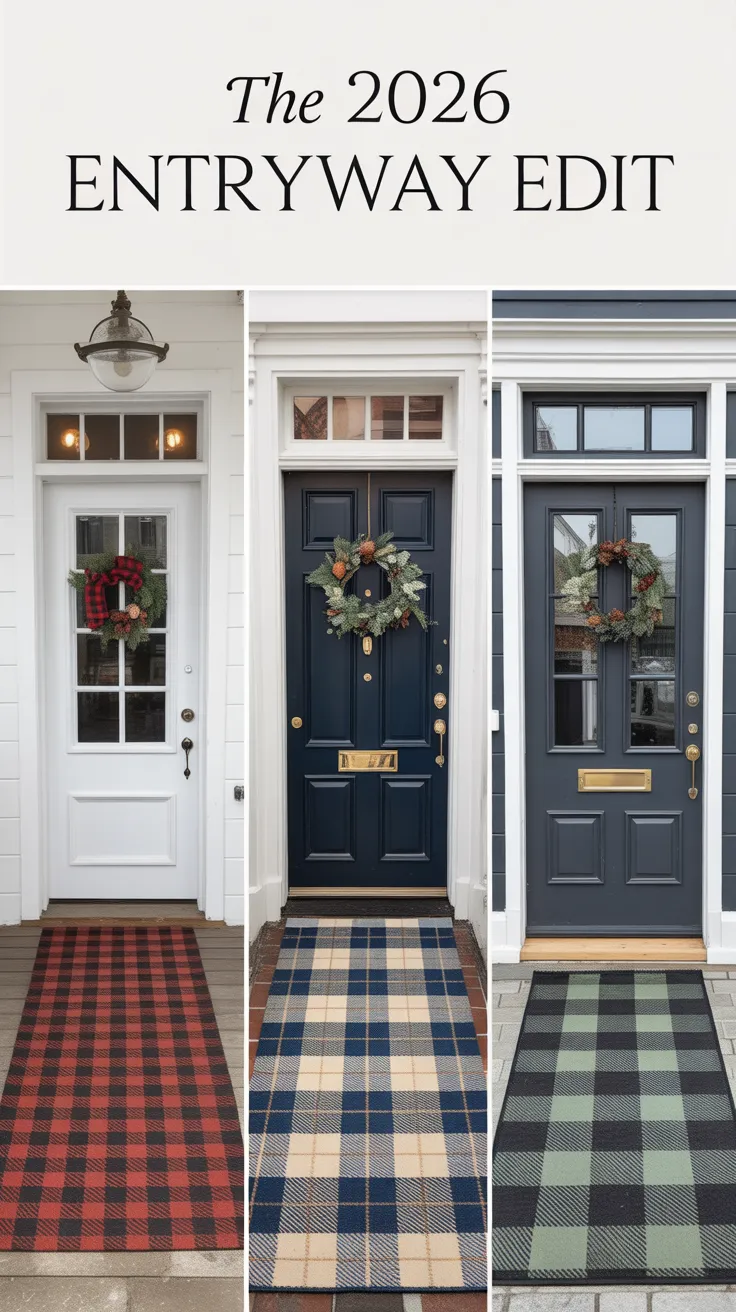
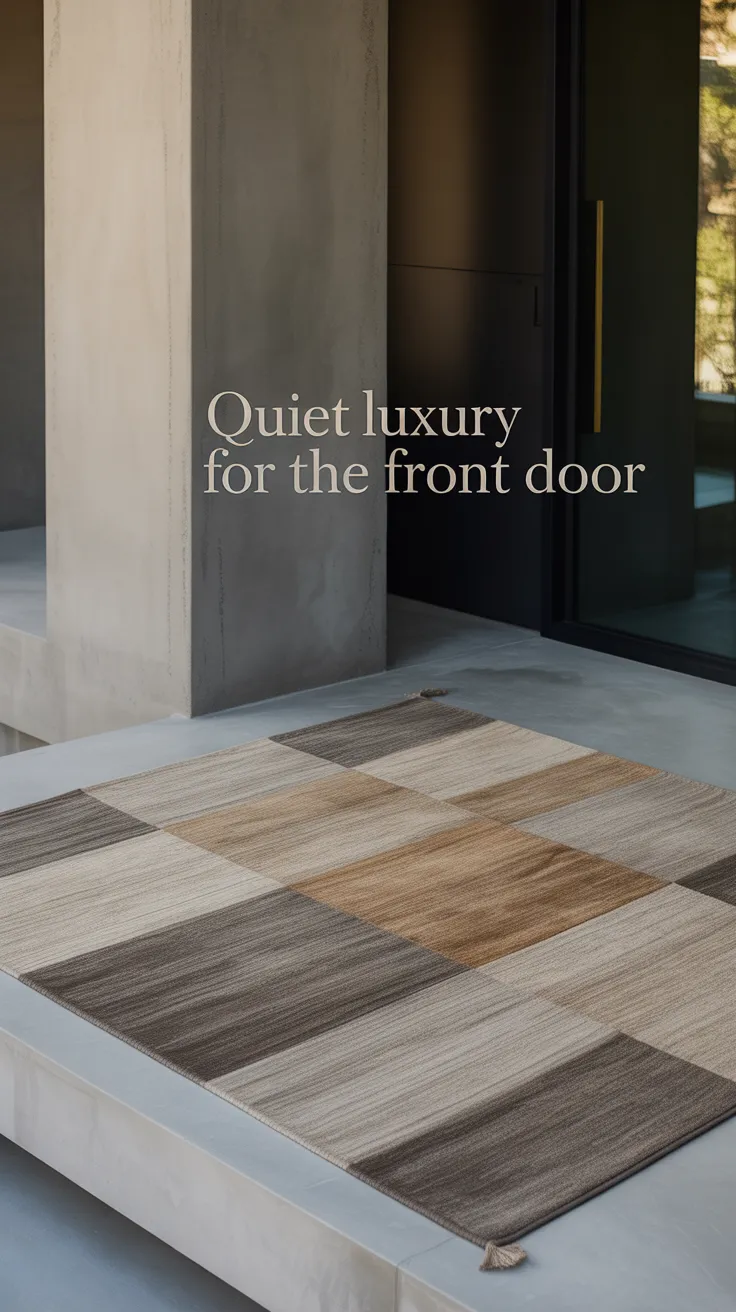
The layered front door setup works on a texture contrast principle as much as a size one. The natural coir mat on top — rough, coarse, dense — and the performance rug on the bottom — flatweave or low-pile, smooth, patterned — read as clearly different materials. Your eye registers both, moves between them, and interprets the combination as considered.
High-performance scraper mats are unrivaled at cleaning boots — essential for protecting your home’s floors. But a standalone coir rectangle rarely makes a dramatic design statement on a large porch. The layering system solves this exactly: the coir handles the function (mud-trapping, boot-scraping, moisture-absorbing) and the plaid base handles the aesthetic (color, pattern, visual scale, curb appeal). Neither rug is being asked to do something it wasn’t designed for.
For texture contrast that works, the base rug should always be the smoother of the two. A flatweave plaid or a low-pile performance rug under a coarse coir mat — the contrast is clear, pleasant, and purposeful. If both rugs have a similar pile height or texture weight, the layering loses its distinction and the composition flattens.
Symmetry and Framing: The Finishing Touches That Complete It
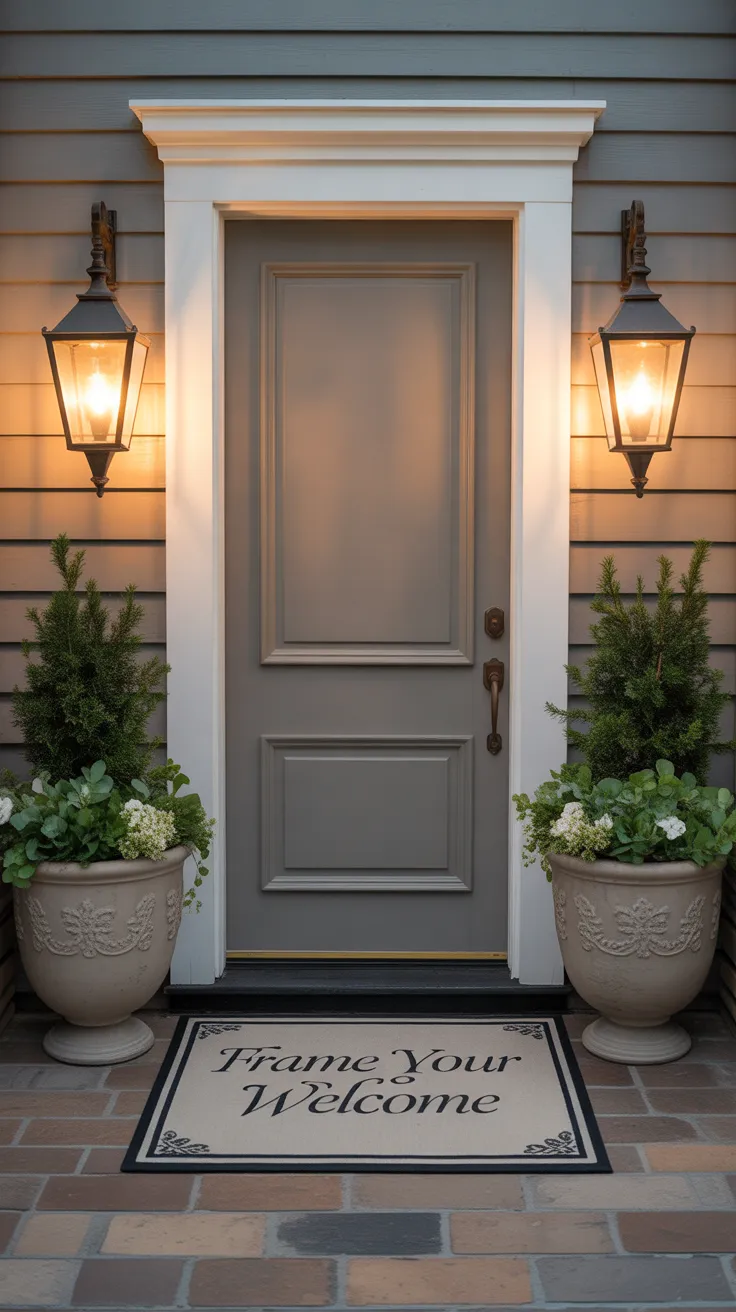
A layered front door rug on its own is a strong start. But the porch setups that generate serious Pinterest saves — the ones that get hundreds of repins — almost always include two additional framing elements:
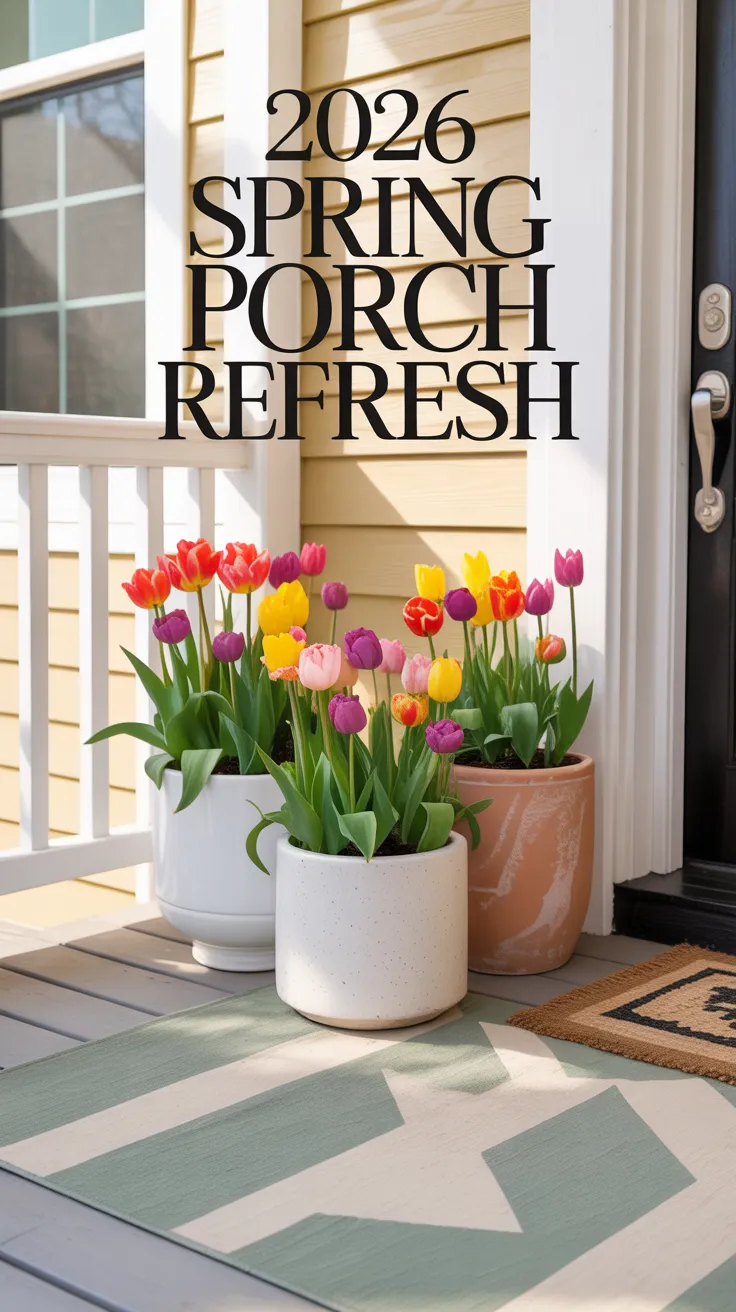
Planters, placed symmetrically. Two matching planters, one on either side of the layered rug, do something powerful: they visually anchor the corners of the entry and create a framed “stage” for everything within. The planters don’t need to be enormous — a pair of 10–12 inch ceramic or terracotta pots at consistent heights reads as intention. Fill them with something structural year-round: a dwarf boxwood, ornamental grasses, or a trailing fern, depending on your climate. The planters should either match (matchy-matchy is fine here — symmetry is the point) or be clearly in the same material family.
Lighting, at door-frame height or slightly below. A wall-mounted lantern on each side of the door — or a pair of cordless outdoor lanterns placed directly on the porch floor flanking the rug — extends the entry’s visual composition into the evening. This is one of the most underestimated curb appeal moves in residential exterior design: a front door that’s beautifully lit at night photographs brilliantly, reads as welcoming from the street, and transforms a daytime design into a 24-hour one.
🏡 Timeless Manor Tip: When placing planters around your front door rug, the rule is: planter height should be roughly equal to the height of your door handle. Too tall and they crowd the door; too short and they read as decorative afterthoughts. That mid-height sweet spot frames the door without competing with it.
🛍️ The Foundation Piece
If you’re approaching this from the ground up and don’t yet have a neutral base rug to work with — or if you want to build a front entry look that works without a doormat layered on top, just as a standalone statement — this is the piece that does it.
Safavieh Courtyard Collection Outdoor Area Rug — 3×5, Sand/Greige, Performance Polypropylene
A solid or subtle-textured 3×5 in a warm sand or greige is the base from which nearly every 2026 front door layering combination works. This Safavieh Courtyard option is UV-stabilized, hose-clean, and carries the low-pile flatweave construction that lies flat under a coir doormat without buckling. It’s also the piece that transitions most easily between seasonal decorating rotations — navy accessories in summer, rust and olive in fall, silver and evergreen in winter — without the rug itself ever needing to change.
Search: “Safavieh Courtyard 3×5 sand neutral outdoor performance rug flatweave polypropylene”
V. Beyond the Porch: How the Same Logic Carries Inside
The plaid washable runner’s usefulness doesn’t stop at the threshold — and understanding this is what makes it feel like a genuine investment rather than a single-purpose purchase.
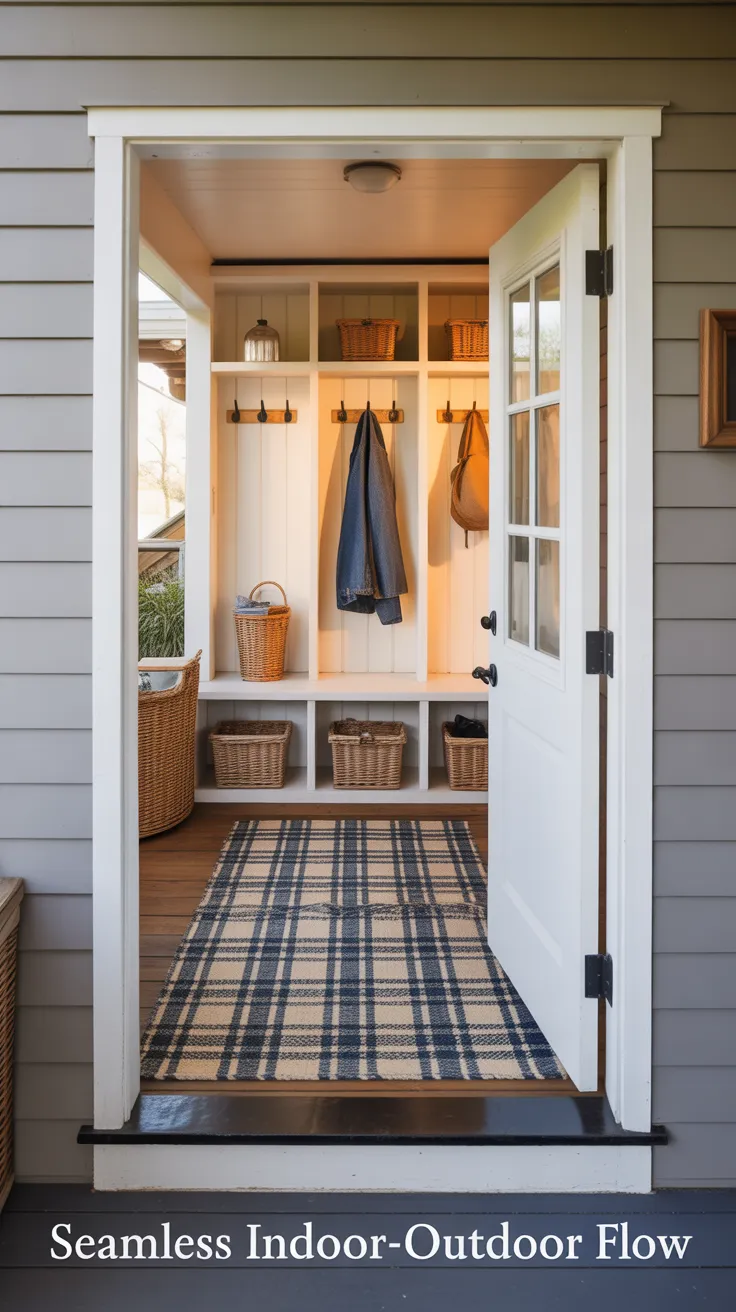
The Mudroom Transition: Creating a Cohesive Flow
The most intentionally designed homes in America — the ones that feel like they were genuinely thought through rather than decorated room by room — share a quiet quality: the transition from outside to inside feels continuous rather than jarring. The front porch leads into the entry which leads into the mudroom which leads into the hallway, and the design language threads through all of it.
The plaid front door rug is the beginning of that thread. Carrying a similar pattern — or at minimum, a similar color palette — into the mudroom runner creates a visual continuity that says: this home was designed from the outside in, not the inside out. It’s a subtle thing, but guests register it. And perhaps more importantly, the homeowner feels it every day.
Indoor/outdoor rugs are a fantastic choice for mudrooms — they’re easy to clean and highly durable, making them perfect for high-traffic areas. A navy-toned flatweave or performance rug runner in the mudroom — the same palette as your front door plaid — quietly unifies the transition. Washable mudroom rugs are the smart choice: mudrooms can get messy, and a washable rug can withstand frequent cleaning without losing its appeal.
The continuity doesn’t require the pieces to match exactly. A navy plaid at the front door pairs beautifully with a navy-and-cream stripe in the mudroom, or a solid navy flatweave in the hallway beyond. The color does the threading; the patterns can vary.
Clearance and Construction: The Practical Case for Flatweave
One of the most consistently overlooked problems in front door and mudroom rug shopping is door clearance. A rug with a half-inch pile height will prevent certain doors from opening smoothly, create a trip hazard at the threshold, and visually over-scale a tight entry. Low-profile rugs — often a flatweave or with a very short pile — reduce the risk of tripping and are usually easier to vacuum, offering a sleek, modern look to a mudroom or entryway.
For any door with less than ½-inch clearance between the bottom edge and the finished floor (which describes the majority of American front doors and interior mudroom doors), flatweave is the only safe construction. It lies completely flat — no pile to compress under the door swing, no edge to catch on frame weather-stripping. Performance flatweave rugs in polypropylene or recycled PET are the best of all worlds here: they’re thin enough for clearance, durable enough for the traffic, and washable enough for the reality of what happens in an entry zone.
This is also why runner formats matter in a mudroom. A 2×8 or 2×10 runner running lengthwise down the mudroom — from the door to the interior threshold — gives the space direction and scale without overwhelming it. It guides the eye (and the foot traffic) down the hall, and it puts washable, scrubbable material exactly where the boots come off, the wet coats drip, and the dog shakes out after a rainy walk.
🏡 Timeless Manor Tip: Measure the gap between your door bottom and your floor before you order any entry rug. The standard tolerance is ¼ inch of clearance above the rug surface. If your gap is smaller than ¾ inch total, choose flatweave only. If you have more than ¾ inch, you have room for a very low-pile performance rug — but flatweave is still the safer, cleaner choice.
🛍️ The Mudroom Runner
Ottomanson Paterson Performance Flatweave Rug Runner — 2×7 or 2×10, Charcoal/Navy or Greige/Cream, Non-Slip Backing
Ottomanson’s Paterson runner is one of the better-reviewed high-traffic entryway runners in its category for a simple reason: it’s designed from the material up for the abuse that mudrooms and entry halls actually deliver. The polypropylene flatweave construction sits at under ¼ inch pile height — genuinely compatible with virtually any door clearance. The non-slip backing prevents migration on hardwood and tile. And the charcoal/navy and greige/cream colorways thread naturally from a navy plaid front door setup into the interior of the home, maintaining that continuity of palette that distinguishes a designed home from a decorated one.
Search: “Ottomanson Paterson performance flatweave runner 2×7 navy charcoal non-slip high traffic entryway”
VI. Investing in the “First Hello”
If you’ve ever been tempted to dismiss the front door rug as a minor detail — a finishing touch rather than a real design decision — consider this: it is often the only part of your home’s design that every single person who visits experiences directly. They step on it, they stand on it while you open the door, and they see it every time they approach. Your gallery wall? Guests might notice it. Your kitchen renovation? Some people never make it to the kitchen. But everyone who comes to your front door meets your rug.
Given that outsized exposure, the front door rug might actually be the highest-ROI design decision in residential exterior decorating — and yet it’s typically where homeowners spend the least and think the least.
The 2026 case for a washable plaid runner at your front entry isn’t a trend argument — trends come and go. It’s a logic argument. A plaid pattern masks debris better than a solid. A washable performance material survives the front door’s real-life conditions without degrading or staining permanently. A layered entry system looks more designed than a single mat while costing less than most single statement pieces. And a front entry that looks genuinely considered tells every person who approaches your home something specific about the people who live inside it.
That’s worth getting right. And it’s entirely within reach.
“Don’t just greet your guests. Welcome them home — all the way from the front walk to the kitchen table.” — Timeless Manor
The Complete Welcome: Finishing the Entry
The rug is the foundation. These are the pieces that complete it.
🛍️ The Finishing Touches: Black Metal Outdoor Lanterns + Ceramic Garden Stool
Two matching black powder-coated outdoor lanterns — one on each side of the door, mounted at handle height or placed directly on the porch floor — give your front entry a finished quality that photographs beautifully in any light condition. Add one matte ceramic garden stool in a stone or greige tone (positioned off to one side of the entry, not centered) as both a surface for small seasonal decorations and an unexpected sculptural moment that separates a styled porch from a merely decorated one.
These pieces aren’t accessories. In the context of a layered plaid front door rug with flanking planters, they’re the completion of a composition — the visual punctuation that makes the whole entry read as finished.
Search: “outdoor black metal lantern set of 2 front porch” · “matte ceramic garden stool outdoor greige stone”
📌 Your Takeaway Checklist: The Front Door Rug Done Right
The Proportions:
- Base rug should be at minimum 12 inches larger than the doormat in every direction
- 3×5 base rug + 24×36 doormat = the standard front entry formula
- Runner format (2×8) works for wide covered porches and mudroom transitions
The Pattern:
- Plaid: best debris-masking pattern for high-traffic outdoor use
- Navy/cream, charcoal/white, greige/slate = the 2026 elevated palette choices
- One patterned layer + one solid or natural-texture layer = the rule
The Material:
- “Washable” ≠ “outdoor rated.” Confirm machine-wash or hose-clean capability before buying
- Recycled PET for soft feel + max washability
- Treated polypropylene for maximum UV and traffic durability
- Flatweave for any door with less than ¾ inch clearance
The Framing:
- Symmetric planters anchor the rug zone visually
- Lighting at door-frame height extends the composition into evening hours
- Ceramic stool or small side surface adds an unexpected styled moment
The Continuity:
- Carry the same palette (not necessarily the same pattern) into the mudroom runner
- The color threads the journey from porch to interior — that’s what “designed” feels like
Coming Next from Timeless Manor: “The Patio Color Blueprint: Building an Entire Outdoor Living Space from One Navy Rug Outward” — how a single anchor rug choice in the right color becomes the decision that makes every other outdoor purchase easier.
Keywords: front door rug · washable rugs · plaid rug · navy rug · area rug · outdoor living space · patio inspiration · modern rug · outdoor rug 2026 · performance rug · backyard patio · striped rug · flatweave · mudroom runner · entryway rug · curb appeal
© 2026 Timeless Manor. This article contains affiliate links. We only recommend products that genuinely earn their place in a well-considered home.