The Best Fluffy Pancakes recipe you will fall in love with. Full of tips and tricks to help you make the best pancakes.

How to Layer Outdoor Rugs Like a Pro: The 2026 Pairing Guide

By Timeless Manor | Outdoor Living Space · Patio Inspiration · Area Rug · Washable Rugs · Modern Rug
“One rug makes a patio. Two rugs make a room.”
I. The “Double Rug” Secret Your Pinterest Feed Isn’t Explaining
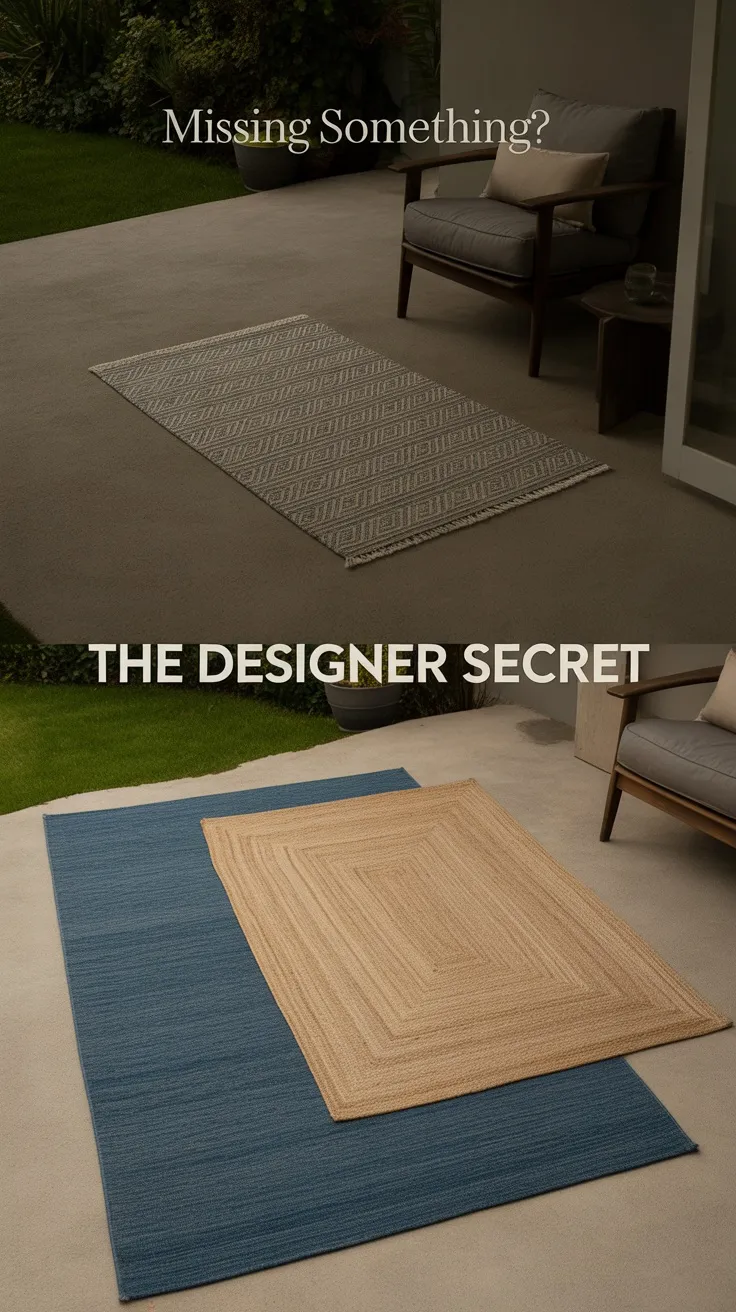
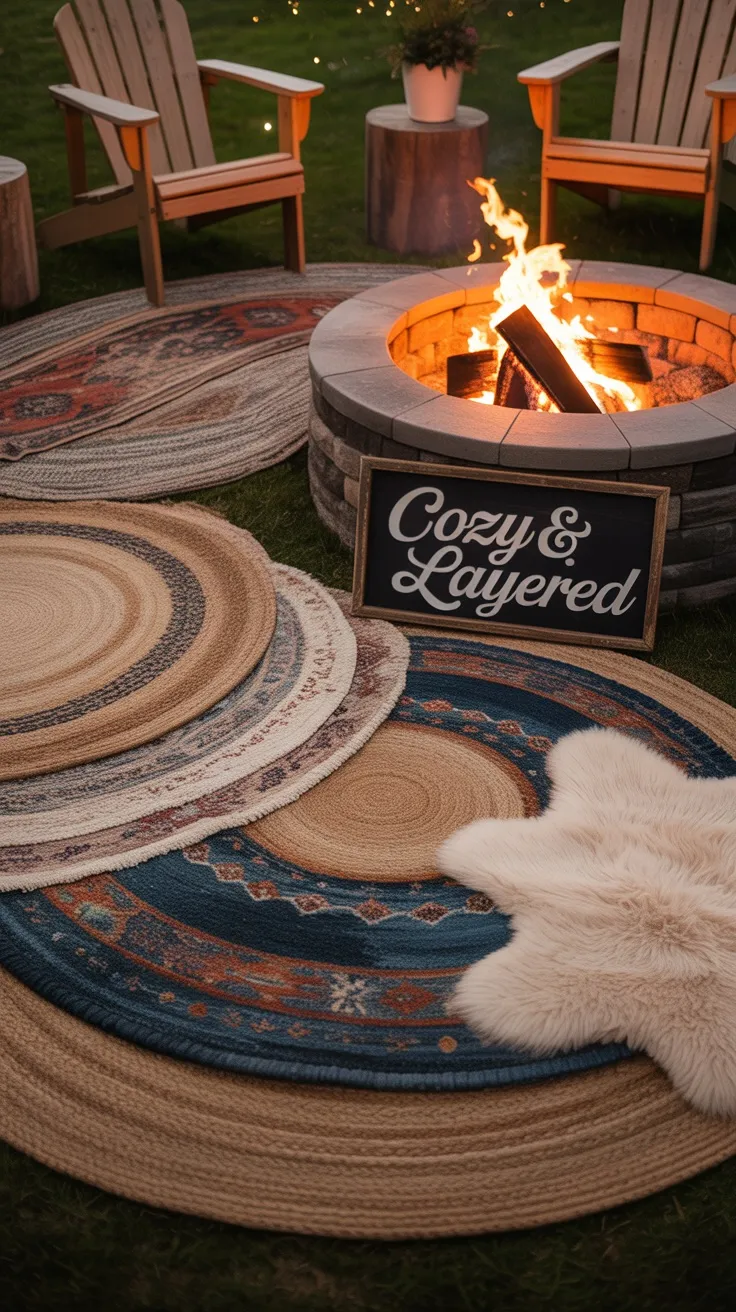
You’ve saved the photo at least a dozen times. A covered porch somewhere in the Carolinas, or maybe a California backyard with a pergola dripping in jasmine — and on the ground, this impossibly layered, effortlessly curated combination of rugs that somehow manages to look both relaxed and deeply intentional. You screenshot it, save it to your “patio goals” board, and wonder: how do they do that without it looking like a yard sale?


Here’s what the caption isn’t telling you: that look isn’t about expensive furniture or professional staging. It’s almost entirely about the rugs. Specifically, two of them, stacked with purpose.
Layering rugs indoors has been a designer’s trick for decades — place a vintage kilim over a sisal base, anchor a sheepskin on top of a flatweave, and suddenly a room has warmth, depth, and personality that no single rug could deliver. But in 2026, that same technique has fully arrived outdoors, and homeowners across the country are discovering it changes everything about how a patio feels.
The hesitation is always the same: “Won’t it look cluttered?”
Not if you know the formula. And that’s exactly what this guide is.
There’s a big difference between two rugs thrown together and two rugs composed together — and once you understand the rules of proportion, texture, and pattern, you’ll never look at a single-rug patio the same way again. More importantly, you’ll realize that a layered patio rug setup solves several real-life problems at once — maintenance, zone definition, curb appeal — not just the aesthetic ones.
Let’s get into it.
II. The Golden Rule: The Two-Size Difference
Before we talk textures or colors or patterns, we need to talk about scale — because this is where most layering attempts go wrong.
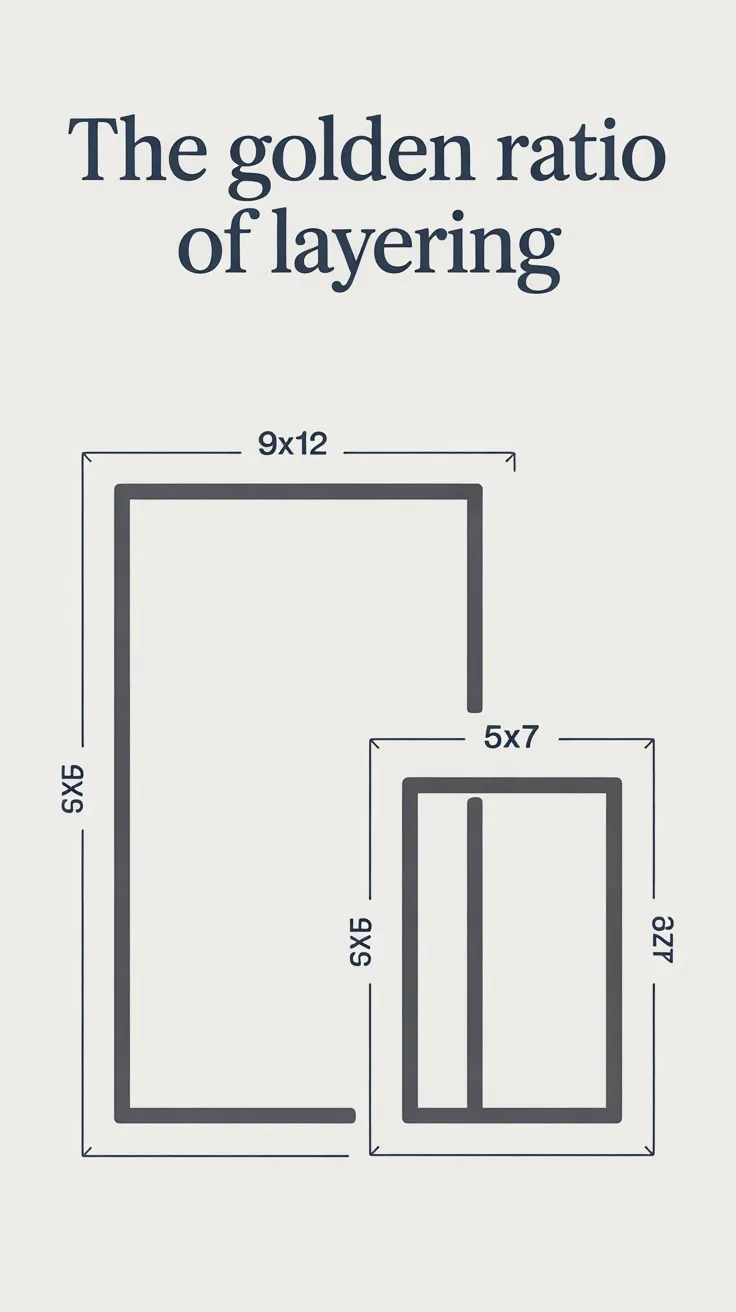
The foundational rule of outdoor rug layering is simple enough to remember after one read: your base rug and your accent rug should always be at least two standard sizes apart. Not one. Two.
Here’s what that looks like in practice:
If your base rug is a 9×12 (the workhorse of patio anchor rugs), your accent rug should be a 5×7 or 6×9 at the largest. If your base is an 8×10, your top rug should be a 4×6 or 5×7. That gap in size is what creates the visible “frame” — the border of the base rug that shows around the edges of the accent piece, giving the whole arrangement structure and intention.
When the size gap is too small — say, a 9×12 base under a 8×10 accent — the two rugs look like an accident. Like the wrong rug showed up. The frame disappears, and you lose the entire visual logic of the layering.

The Base Layer: The Visual Footprint
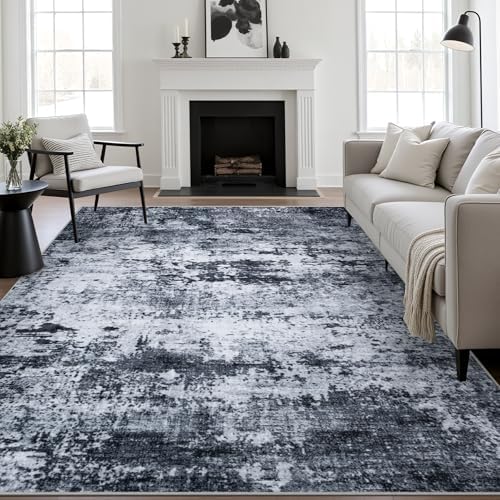
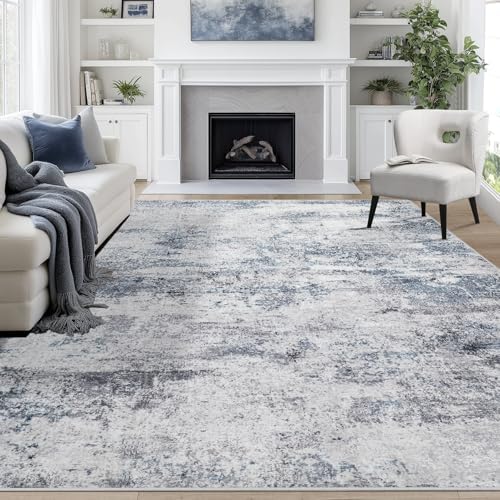
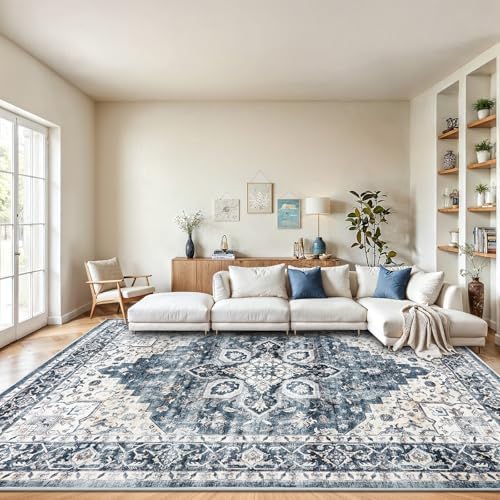
Think of your base rug as the floor plan. Its job is to define the entire outdoor sitting area — not just where furniture legs land, but the full perimeter of the zone. In a typical backyard patio conversation area with a sofa, two chairs, and a coffee table, a 9×12 performance area rug is usually the right call. The front legs of all the furniture should sit on it. The rug should extend roughly 18–24 inches beyond the sofa on three sides.
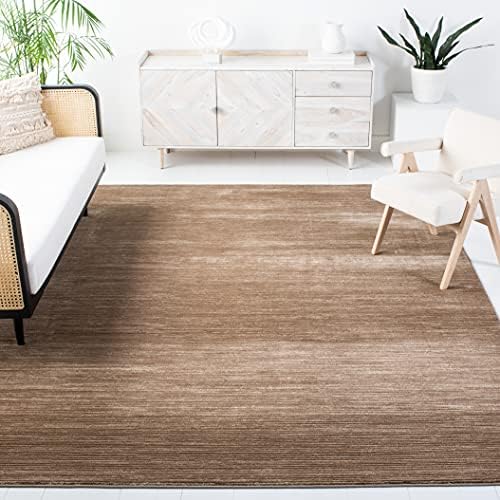
The base rug also needs to be the quieter one. A solid color, a subtle tone-on-tone weave, or at most a very low-contrast texture. Its job is to be a stage, not a performer. A modern rug with clean lines — no busy border, no loud motif — serves this role beautifully and keeps the overall look from skewing bohemian when you may actually be going for something more refined.
Timeless Manor Tip: If you have a medium-toned wood deck or warm concrete, a sand or greige base rug will visually extend the flooring rather than interrupt it. The patio reads larger and more cohesive as a result.
The Accent (Top) Layer: Where the Personality Lives
The top rug is where you get to be decisive. Pattern, color, texture — this is the piece people will notice first and remember. But here’s the counterintuitive truth: because it’s sitting on top of something larger, it actually needs to work less hard to make an impact. You don’t need a wildly bold print. A classic navy plaid on a cream ground, a simple wide-stripe in ivory and charcoal, or a soft geometric in muted blue and sand will feel like a considered statement when it’s floating on a generous neutral base.
Placement matters too. Center it under the coffee table — not pushed to one end — and let it sit a few inches in from the edges of the furniture legs. The whole conversation circle then feels like it’s orbiting the layered rug composition, which is exactly the effect you want.
🏡 Timeless Manor Tip: Still nervous about sizing? Measure your space first, then use painter’s tape on your deck or patio to map out where each rug layer would land before you buy. It takes five minutes and saves a return trip entirely.
🛍️ The Foundation: Start Here Before Anything Else
If you’re building this look from scratch, the single most important purchase is the base rug. Get the foundation right, and every layer you add on top almost chooses itself.
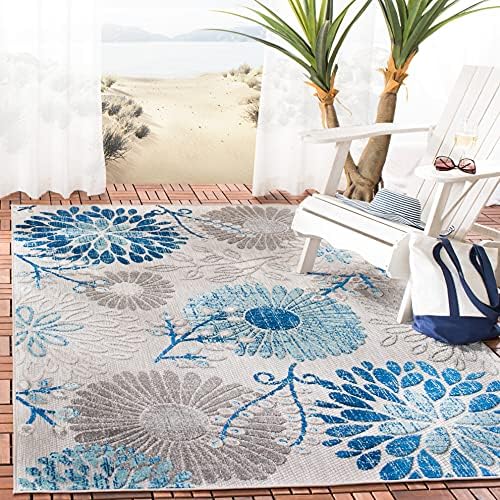
Safavieh Courtyard Collection Indoor/Outdoor Area Rug — 9×12, Natural/Navy This power-loomed polypropylene rug is a genuine workhorse: UV-stabilized, hose-clean, low-pile (so chairs slide easily), and available in the sand-and-navy colorway that forms the backbone of 2026’s most popular outdoor palettes. It’s the kind of rug that disappears under your furniture in the best way — letting everything else shine while quietly doing all the structural work.
Search: “Safavieh Courtyard 9×12 natural navy indoor outdoor rug”
III. Winning Texture Combinations for 2026
Once you have the proportions sorted, the next decision — and honestly the fun one — is texture. This is where a layered patio stops looking like two rugs and starts looking like a designed space.
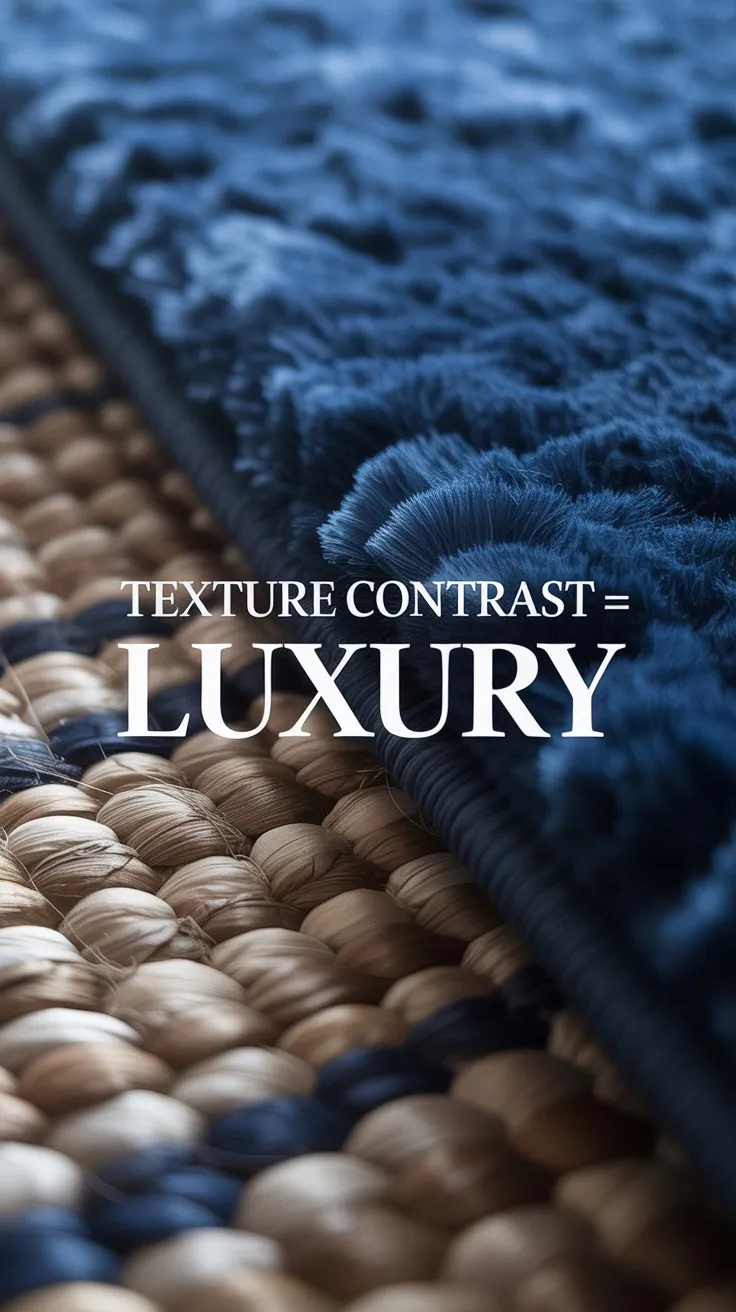
The textures need to contrast without competing. Think of it like pairing a smooth leather sofa with a chunky-knit throw. Each material reads clearly because it’s different from what’s beside it. You register both. When two textures are too similar — both flatweave, both low-pile — the layered look flattens out and you lose the whole point.


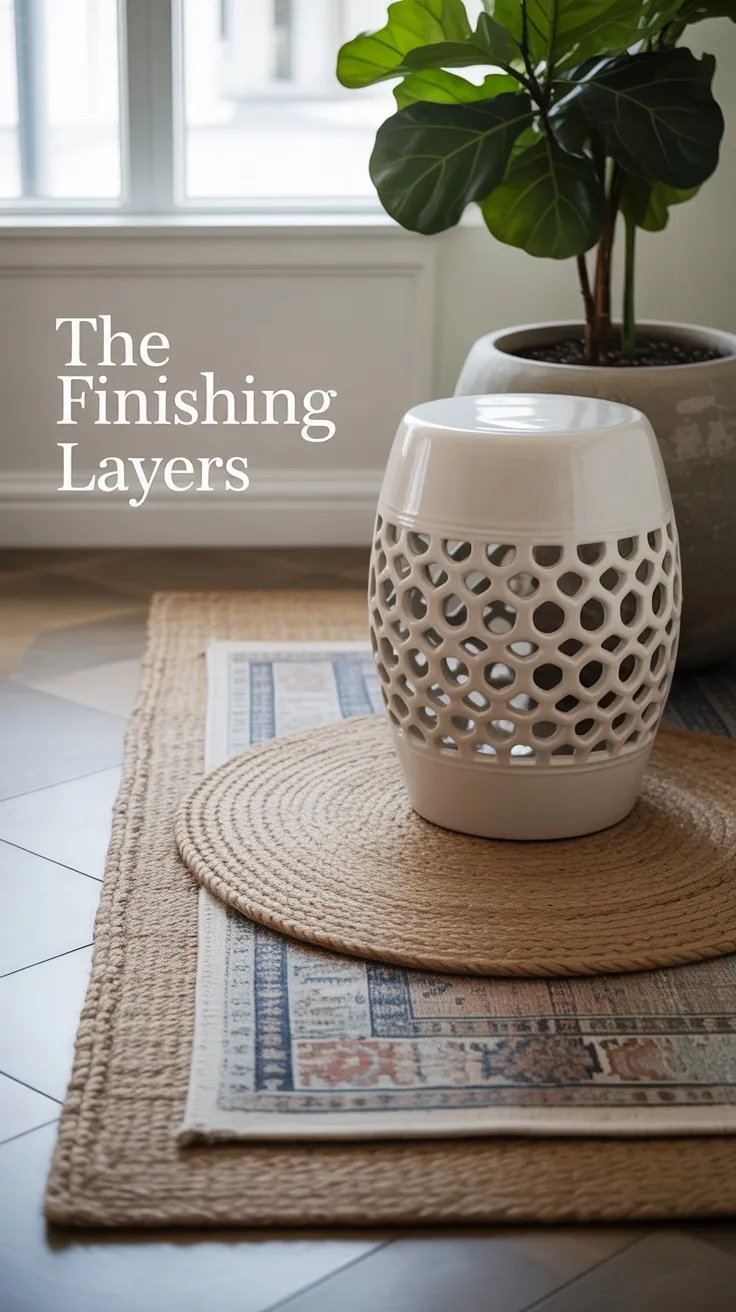
The Classic Pairing: Sisal-Look Base + Soft Performance Top
This is the combination you’ll see in the most-saved outdoor living posts on Pinterest right now, and there’s a reason: it’s almost impossible to mess up, and it reads as expensive with relatively modest pieces.
The base is a sisal-style or woven flatweave rug — tight construction, natural-looking texture, in a warm neutral like oat, linen, or pale greige. It has just enough visual texture to be interesting but never distracting. Then the top layer is a softer, slightly plush accent rug — a recycled PET washable rug with a low-to-medium pile, in a pattern or a deeper color.
The contrast between the two textures is tactile and visual: rough ground beneath, softer surface above. The effect is layered and casual-luxurious at the same time. Think of it as the outdoor equivalent of linen drapes over white walls.
Why it works for real life: The sisal-look base is nearly indestructible — you can hose it down, it dries fast, and it hides texture-based dirt beautifully. The softer top rug is where the spills land, the dog naps, and the kids sit. And because it’s the smaller of the two, when it needs a deep clean, you roll it up, deal with it, and your patio still looks styled with the base layer in place.
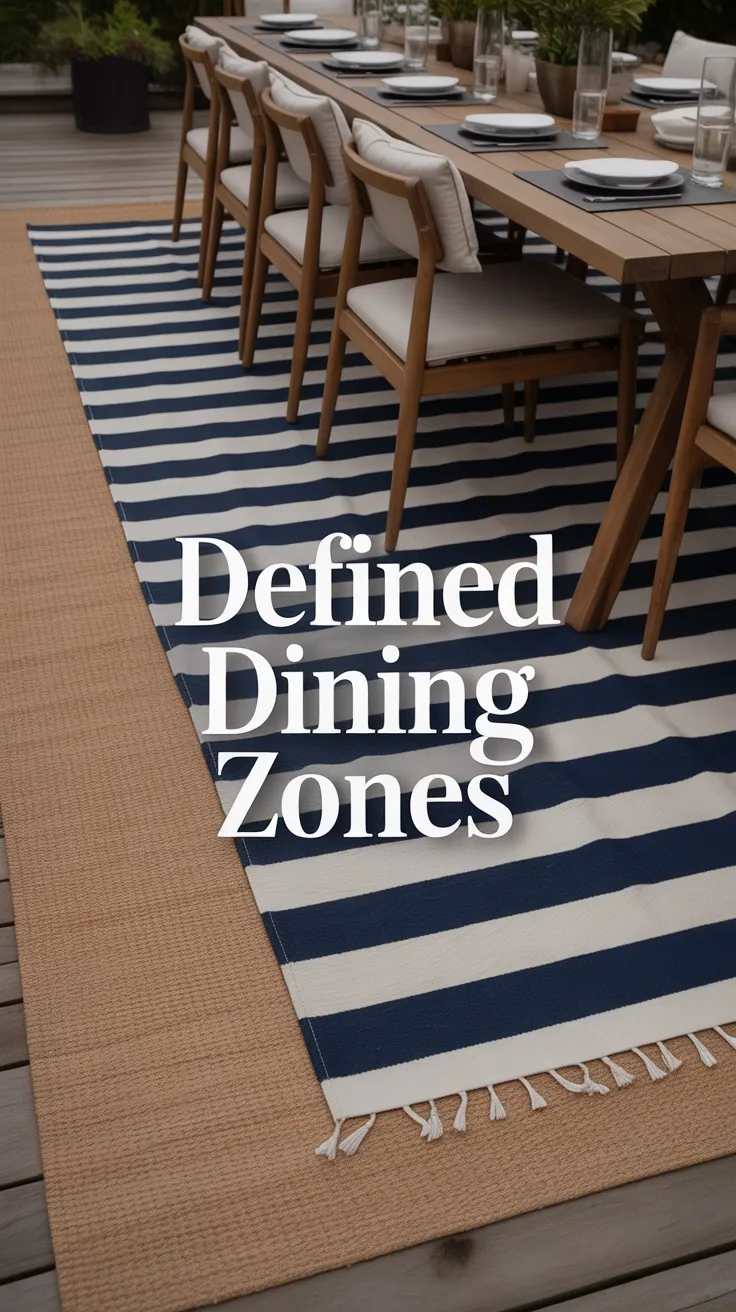
The Statement Pairing: Sand-Colored Base + Midnight Navy Accent
This combination is the “navy and neutral” story told through texture and scale rather than a single rug’s pattern.
A large, warm sand-colored area rug (9×12) as the foundation creates an expansive, sun-drenched base that makes outdoor spaces look bigger than they are — a genuine optical trick that designers use constantly. Against that backdrop, a 5×7 navy washable rug in a woven or geometric pattern sits with real visual authority. The contrast between sand and navy is classic — it’s Cape Cod and Kennebunkport and every beautiful coastal Maine porch you’ve ever envied — but it also works just as well on a suburban deck in Ohio or a rooftop terrace in Austin.
The practical beauty of this combination: Navy reads as almost a neutral in outdoor settings. It hides debris between cleanings better than almost any other color. And when the accent navy rug eventually needs washing — whether it’s hose-clean polypropylene or a machine-washable style — the sand base underneath keeps the whole space looking put-together.
The Architectural Pairing: Flatweave Base + High-Low Pile Top
This one is for the homeowner who wants their patio to genuinely feel like an interior room — not just a nice version of “outside.”
The base is a flatweave outdoor rug — low to the ground, tight construction, almost architectural in its simplicity. On top, a rug with a high-low pile (also called a carved or sculpted pile), where the pattern is created by varying the height of the fiber rather than the color. The contrast between the flat, graphic base and the dimensional, tactile top layer creates a sense of depth that reads as genuinely sophisticated.
In 2026, layering has emerged as one of the key techniques designers use to create homes that feel grounded, welcoming, and beautifully personal — and this particular combination achieves exactly that outdoors, blurring the line between your interior living room and your backyard patio.
IV. Pattern Play: How to Pair Without Chaos
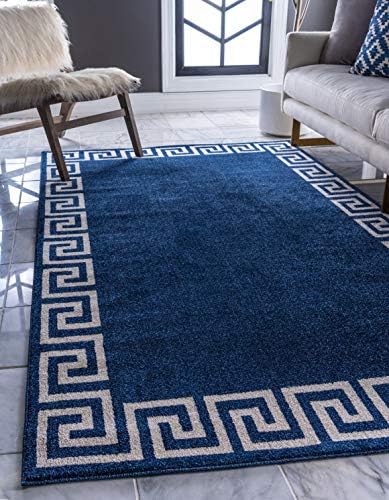
This section is where people get nervous, and understandably so. Patterns are powerful. Two of them in close proximity can either sing together or fight each other, and the difference isn’t always obvious before you’re already committed.
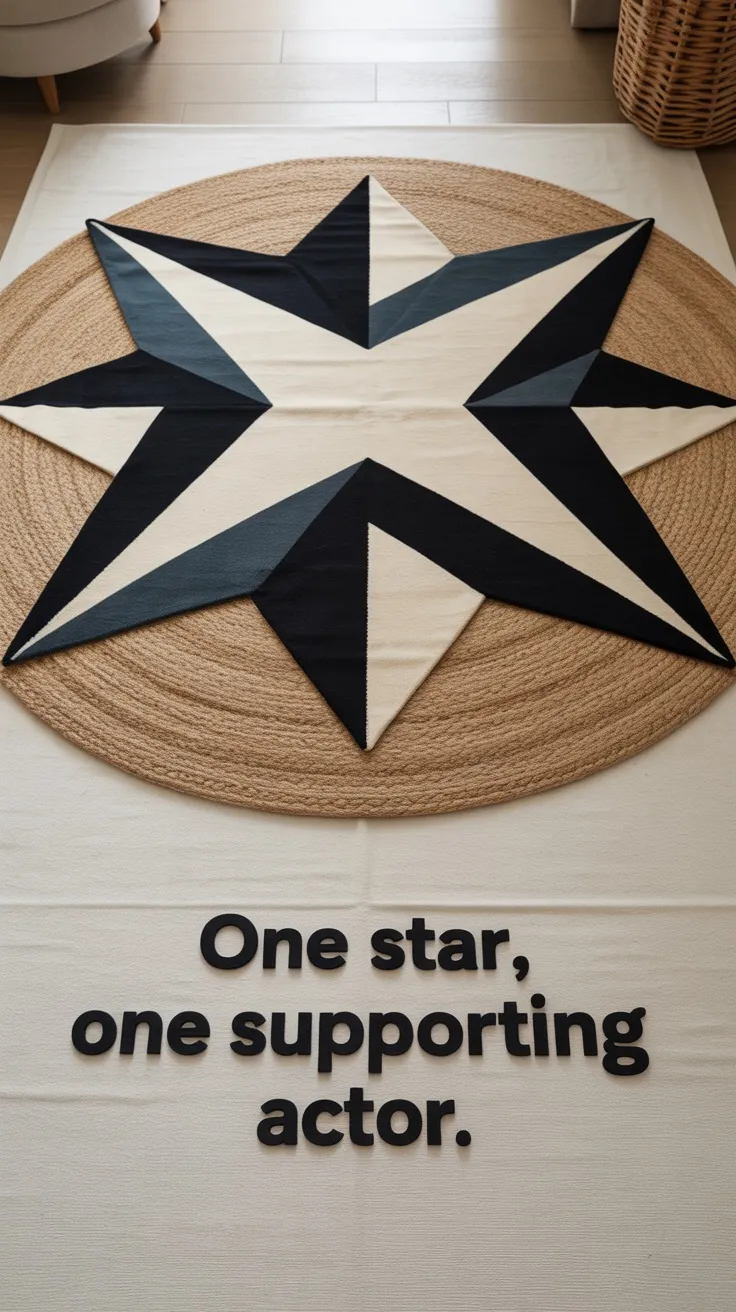
The rule that simplifies everything: One Star, One Supporting Actor.
One rug carries the pattern. The other one steps back. If both rugs are clamoring for attention at the same volume, the whole composition becomes exhausting to look at — and that’s the thing people are afraid of when they imagine a layered patio. The answer isn’t to use fewer patterns; it’s to use them with different levels of confidence.


The Farmhouse Duo: Neutral Base + Plaid Rug Accent
This is the combination that lives at the heart of what people call “cottage-core” — and it’s one of the most enduringly popular patio aesthetics in the American Midwest, South, and Northeast.
The neutral base (cream, natural, greige — pick whatever reads warmest against your home’s exterior) does its quiet work as the foundation. On top, a plaid rug in a traditional buffalo check or an oversized tartan in navy-and-cream brings an unmistakable quality of warmth and heritage to the space. It says: this family has eaten a thousand meals on this porch and intends to eat a thousand more.
Plaid is the rare pattern that works at any scale — small check or large block — and it photographs beautifully in both bright afternoon sun and golden-hour light. If you have Adirondack chairs, a wood farm table, any hanging planters, or a porch swing, a plaid rug will feel like it was always meant to be there.
The Supporting Actor Rule in action: The neutral base has no pattern at all — it lets the plaid do all the speaking. Nobody’s interrupting anybody.
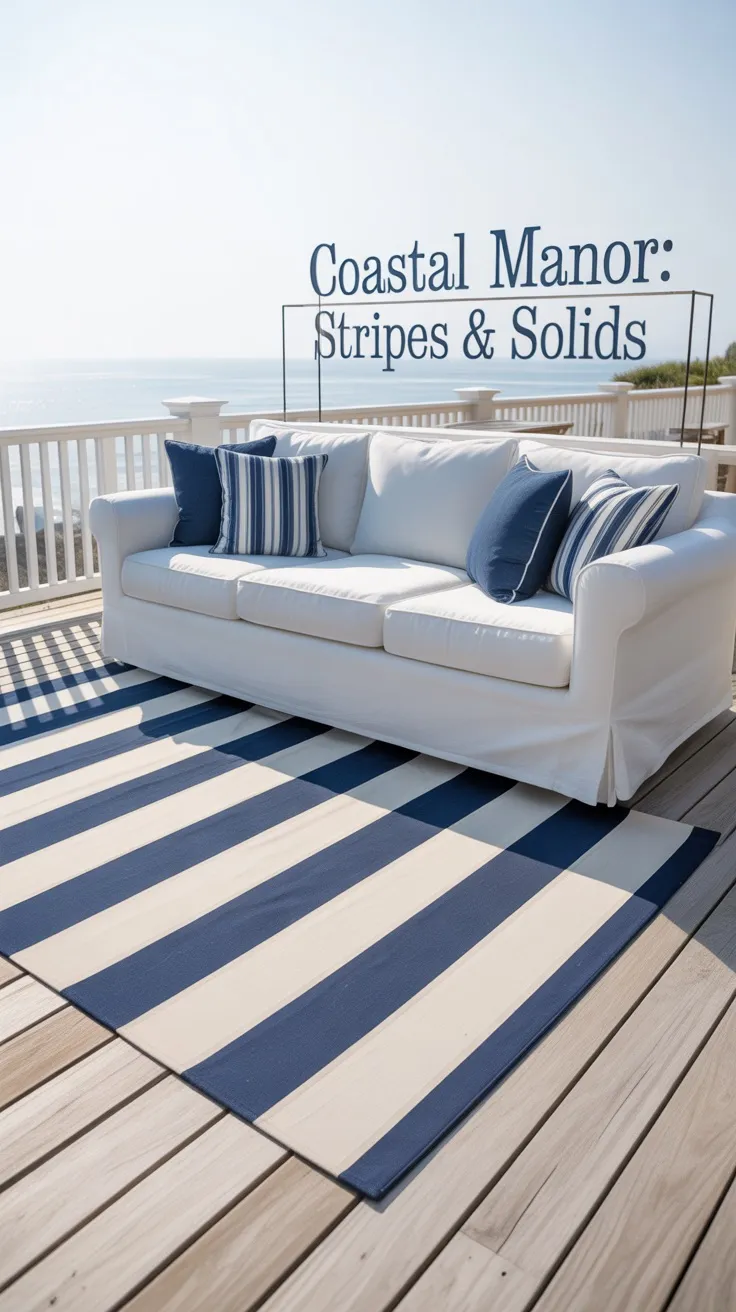
The Coastal Duo: Solid Base + Striped Rug Accent
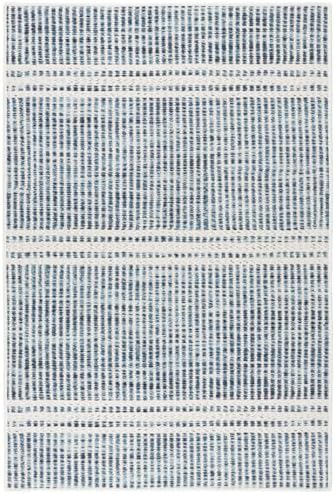
Wide-stripe outdoor rugs are having a sustained moment, and the reason is functional as much as aesthetic: horizontal stripes on a rug visually lengthen the space beneath them, making narrow patios, long covered porches, and compact balconies feel significantly more spacious.
Pair a wide-stripe accent rug in navy and cream or sand and white over a solid greige or natural base, and the combination lands somewhere between Hampton classic and breezy California easy. It’s polished without trying. It works under white powder-coated outdoor furniture, under teak, under natural rattan — it’s one of the most versatile pattern combinations in the outdoor design playbook.
Where this combination particularly shines: Long, narrow covered porches where you want to draw the eye down the length of the space. The stripes handle the perspective work; the neutral base grounds it.
The Two Patterns: When (and Only When) It Can Work
It can. But the rules are strict.
If you want to layer two patterned rugs, one must be micro-scale and the other macro-scale. A large plaid base under a small-scale geometric top. A wide stripe base under a dense diamond-weave top. The patterns must never be at the same scale — because at the same scale, they create visual interference, like two radio stations playing at once.
The trick to great contrast is that it also needs balance — contrast for visual interest, balance so neither rug overwhelms the other. When this works, it’s genuinely stunning. But if you’re new to layering, start with the “one pattern” rule and build confidence before you go to two.
🛍️ The Accent Layer: What Goes on Top
The accent rug is the most swappable piece in your outdoor setup — which is exactly why this is where washability matters most. You want something that looks considered but can handle real life.
Ruggable Outdoor Rug — 5×7, Washable, Navy Woven Pattern Ruggable’s outdoor line is built on their two-piece system: a machine-washable rug cover that snaps onto a waterproof anchor pad. For the top layer of a layered patio setup, this is ideal — when the spills and paw prints accumulate (and they will), you pull the cover off, run it through a standard washing machine, and have it back in place within hours. The navy woven pattern options photograph beautifully and complement virtually any warm neutral base.
Search: “Ruggable outdoor rug 5×7 navy washable machine wash”
V. Functional Benefits: This Isn’t Just About Looks
Beautiful as it is, the layered outdoor rug approach is solving real problems for real homeowners — and understanding these benefits is what makes it feel like a genuinely smart decision rather than a decorating splurge.
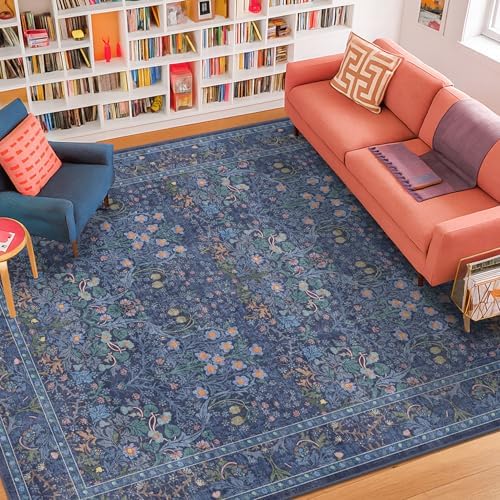

Zone Definition: Creating Rooms Without Walls
One of the dominant interior design principles of the past five years has been the idea of using rugs as architecture — placing them deliberately to create defined zones within open-plan spaces. That same principle has moved outdoors, and it’s reshaping how American homeowners think about their patios.
A rug instantly anchors a seating area and makes it feel like a complete space — choosing one that’s slightly larger than your furniture layout so everything sits comfortably on it creates visual calm and makes the space feel more intentional.
The layered approach doubles down on this: the outer base rug defines the perimeter of the zone (“this is where the conversation area lives”), while the inner accent rug anchors the coffee table at the center of that zone (“this is the heart of it”). Two rugs create a sense of nested space — rooms within rooms — that a single rug simply cannot replicate. On a large deck or backyard patio where you have both a seating area and a dining area, the layered seating zone reads as a completely separate “room” from the dining zone, even with no walls separating them.
The Maintenance Hack Nobody Tells You About
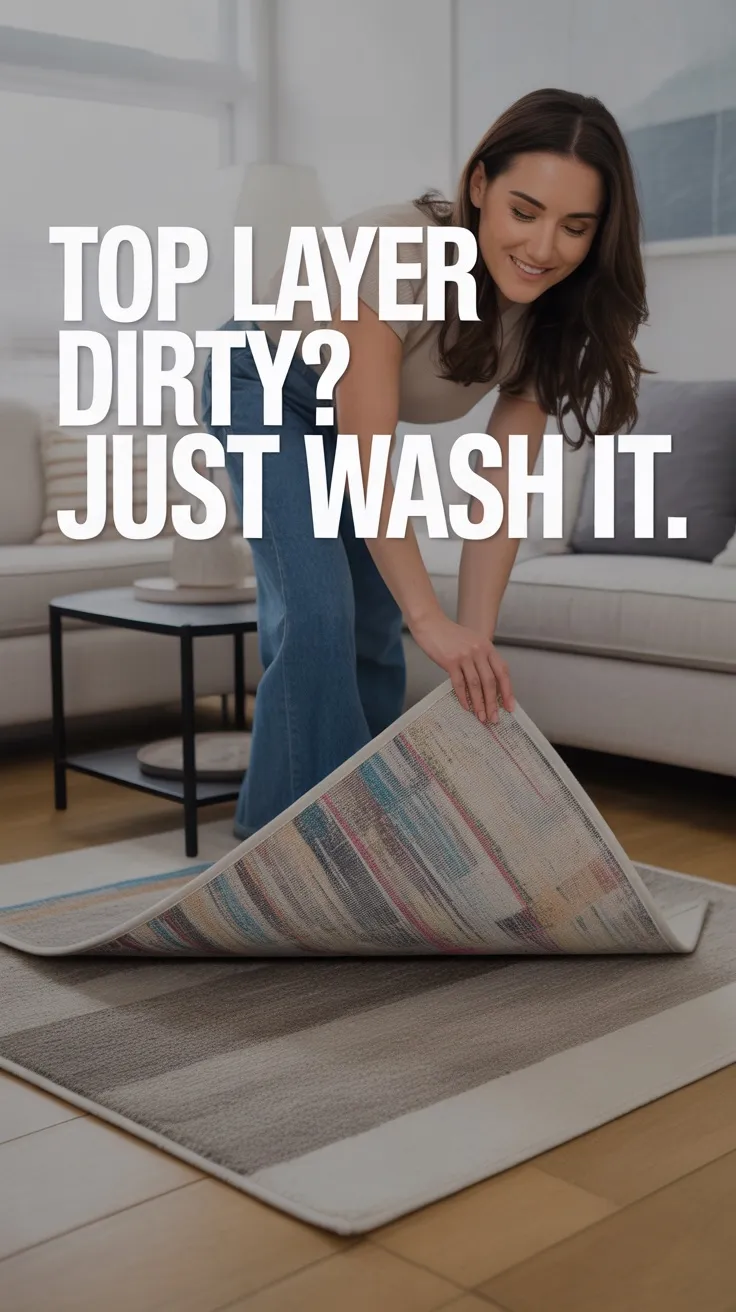
Here’s a genuinely practical reason to put your most washable rug on top rather than on the bottom.
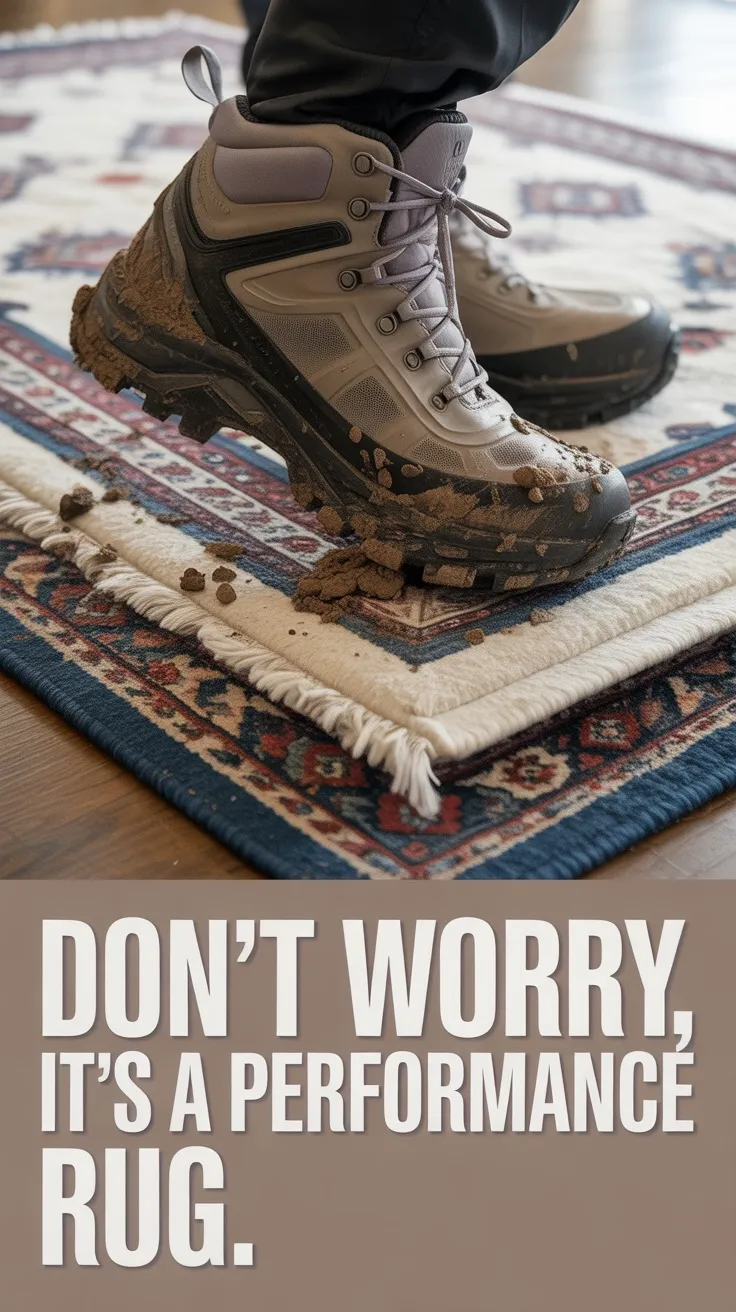
The top rug is where life happens. It’s the one the dog chooses to track muddy paws across. It’s where the sunscreen-sticky kids sit. It’s closest to the coffee table where drinks get knocked over. And because it’s the smaller of the two — a 5×7 or 4×6 — it’s the easiest to manage: roll it up, shake it out, hose it down, or run it through the wash.
Meanwhile, the large base rug stays put. Furniture legs hold it in place. It rarely takes a direct hit from spills. It gets a monthly hose-down and that’s genuinely sufficient.
The result: Your patio maintenance routine splits into two very manageable tasks — instead of one enormous, unwieldy chore of trying to clean a 9×12 rug that four people have to carry to the driveway. The system is more practical than a single-rug setup, not less.
The Front Door Moment: Layering Where It Counts Most
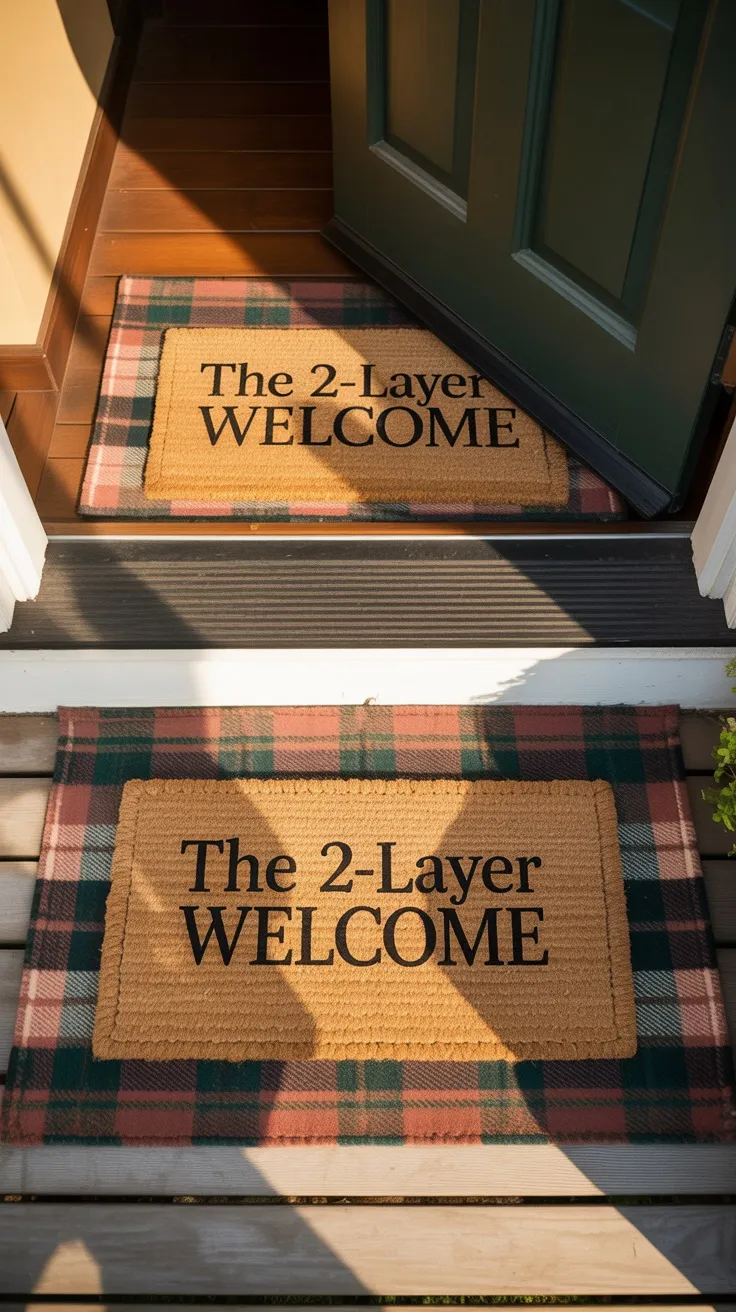
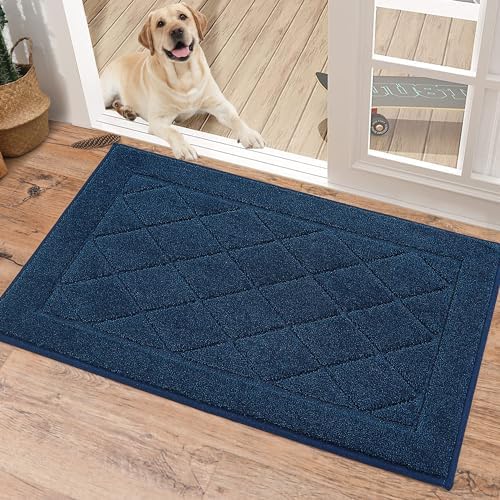
The entryway is now recognized as the definitive “first chapter” of your home’s story. The design trend defining 2026 is layering — placing a decorative, larger outdoor rug underneath a smaller, highly functional mat — a styling technique borrowed from interior design that instantly adds scale, luxury, and personality to a porch.
In front of a front door, the layering formula shifts slightly:
- Base layer: A 3×5 or 4×6 outdoor rug in a plaid, stripe, or solid — wide enough that it extends well beyond both sides of the door frame, creates “visual landing” space, and holds its own as a proper welcome surface
- Top layer: A 2×3 natural coir mat (or a washable cotton doormat with a simple motif) centered on the base, handling the heavy duty dirt-scraping work that a flat decorative rug can’t do
This combination delivers curb appeal that goes well beyond a single doormat. The base rug provides color and pattern. The top mat provides function. Guests register both as a complete composition — and a home’s front entry immediately looks like it belongs to someone who pays attention.


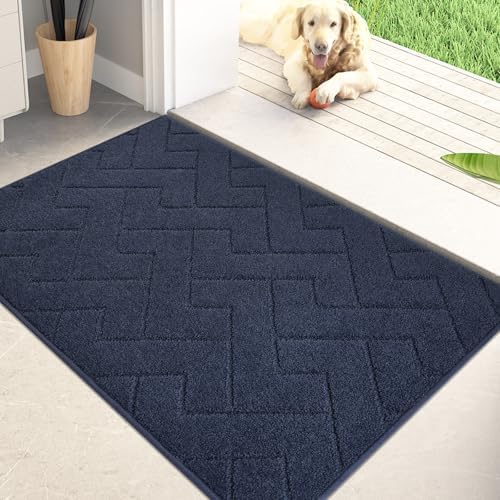
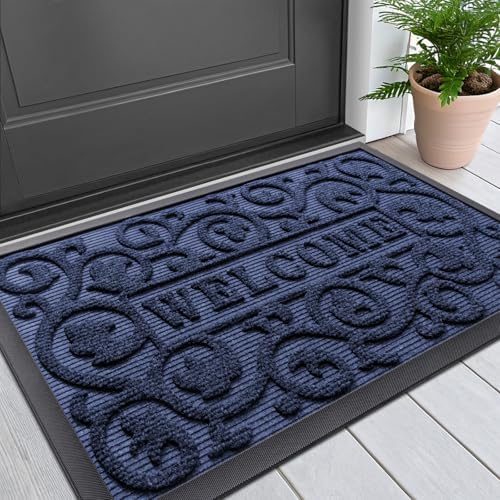
🏡 Timeless Manor Tip: For front door layering, pick a base rug that echoes something on your home’s exterior — a porch color, a shutter tone, a planter shade. The rug should feel like it was chosen for that specific spot, not just placed there. That’s what separates a styled entry from a decorated one.
🛍️ Keep It All in Place
The single most overlooked purchase in an outdoor rug setup — and the one that separates a beautiful layered patio from one that constantly needs adjusting — is the rug pad underneath your base layer.
RUGPADUSA Dual-Surface Non-Slip Rug Pad — 8×10 or 9×12, Outdoor Safe RUGPADUSA makes a dual-surface pad specifically engineered for use on hard outdoor surfaces like deck planking, concrete, and stone tile. One side grips the floor; the other holds the rug above it in place. The open-weave construction lets water drain through rather than pooling underneath — which means no mold risk and no buckling after rain. If you’ve ever had a patio rug migrate across your deck all summer long, you’ll understand immediately why this is not optional.
Search: “RUGPADUSA dual surface non slip outdoor rug pad 8×10 deck concrete”
VI. Before You Buy: The Timeless Styling Checklist
Layering outdoor rugs isn’t complicated — but it does benefit from a quick pre-purchase gut check. Run through this before you click “add to cart” on the second rug:
Proportions
- Is my base rug at least two standard sizes larger than my accent rug?
- Does my base rug extend beyond all four sides of my furniture grouping (ideally 18–24 inches)?
- Will the “frame” of the base rug be clearly visible around the edges of the accent rug?
Color Harmony
- Do the two rugs agree without necessarily matching? (Same temperature — both warm or both cool. Not necessarily the same hue.)
- Is one rug clearly the quieter of the two? (Solid, subtle, or neutral — that one is the base.)
- If I pull one color from the accent rug, does it appear somewhere else in my outdoor space — a cushion, a planter, a door color?
Material Compatibility
- Is my base rug rated for outdoor use — UV-stabilized, water-resistant, and hose-cleanable?
- Is my accent rug the more washable of the two? (This should always be the case — the top rug takes the abuse.)
- Are both rugs’ backing materials compatible? (Avoid rubber on rubber — two rubber-backed rugs stacked will be nearly impossible to separate once compressed.)
Pattern Logic
- Is one rug a solid or near-solid, and one patterned? (Safest and most reliable approach.)
- If both are patterned: are they at meaningfully different scales? (One macro, one micro.)
- Does either rug feel like it’s “fighting” the other when you imagine them together? (If yes — trust that instinct. One of them needs to step back.)

Final Thought: The fear that layering will look “too much” is almost always wrong. The look that’s actually too much is an empty concrete patio with a single small rug floating in the middle. Layering creates fullness, warmth, and intention — and the moment it feels cozy, it’s working. Trust that feeling.
Shop the Layered Look
Here are the five pieces that form a complete, considered layered outdoor setup. These aren’t suggestions to buy everything at once — they’re a reference for what each component is doing and why it matters.
1. The Foundation Safavieh Courtyard Collection Indoor/Outdoor Performance Area Rug — 9×12, Sand/Natural The workhorse base. Power-loomed polypropylene in a warm sand tone that reads as neutral against virtually any home exterior. UV-stabilized, hose-clean, low-pile, and widely available. This is your “buy it once and don’t think about it again” piece. Search: “Safavieh Courtyard 9×12 sand beige indoor outdoor performance rug”
2. The Accent Ruggable Outdoor Rug — 5×7, Machine Washable, Navy/Cream Woven Pattern The top layer, the piece that takes the most real-life wear, and the one you’ll actually clean regularly. Ruggable’s outdoor cover-plus-pad system means washing is genuinely easy — not a logistical event. The navy-and-cream woven pattern works with the sand base rug like a classic. Search: “Ruggable outdoor rug 5×7 navy machine washable cover pad system”
3. The Runner Option (For Front Door or Pathway Layering) Gertmenian Outdoor Plaid Runner Rug — 2×8 or 3×10, Navy Plaid / Buffalo Check For the front door entry or as a walkway accent on a covered porch, a plaid runner over a wider flatweave base is the combination that looks most naturally “placed” rather than “staged.” Gertmenian’s outdoor runners are polypropylene, fade-resistant, and carry the kind of classic American plaid pattern that works in every regional aesthetic from New England cottage to Pacific Northwest farmhouse. Search: “Gertmenian outdoor plaid runner rug 2×8 navy buffalo check polypropylene”
4. The Grip RUGPADUSA Non-Slip Outdoor Rug Pad — 8×10, Dual-Surface for Deck and Patio The unglamorous essential. Cut to size if needed, place under your base rug, and forget about it for the season. Open-weave construction drains water and prevents mildew. Dual-surface grip means your base rug stays exactly where you put it — even through a week of afternoon thunderstorms. Search: “RUGPADUSA non slip outdoor rug pad 8×10 dual surface deck patio concrete”
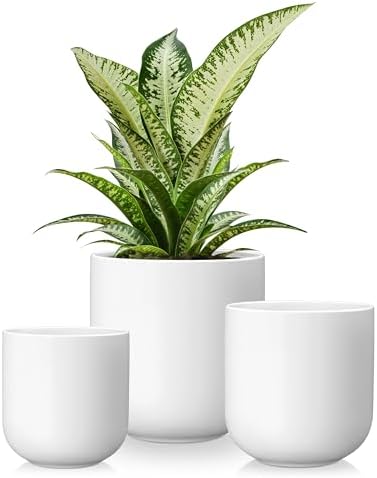
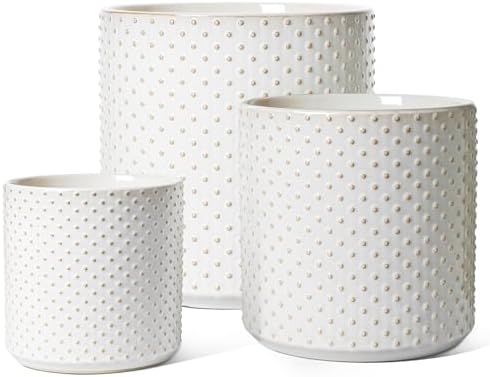
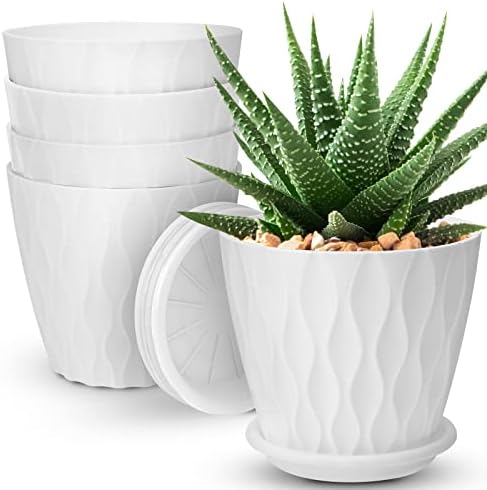
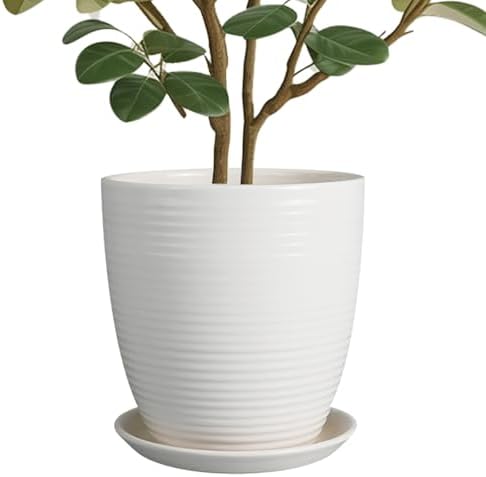
5. The Finish La Jolie Muse Large White Ceramic Outdoor Planter — Set of 2, 13-inch The last step in making a layered rug setup feel genuinely finished is weight — visual and physical. Two oversized white ceramic or matte stone planters at the two far corners of your base rug do two things simultaneously: they anchor the rug zone visually (the corners feel weighted and deliberate), and they literally anchor the rug against wind lift. Fill them with something structural — a trailing fern, a dwarf olive, ornamental grasses — and the whole composition feels like it grew there. Search: “La Jolie Muse large outdoor ceramic planter white matte 13 inch set of 2”
📌 Your Quick-Reference Summary (Pin This)
- The Rule: Base rug = at least 2 sizes larger than accent rug. Always.
- Best base: Solid or subtle weave, neutral tones, flatweave or low-pile, full hose-clean capability.
- Best accent: Washable, patterned or deeper-colored, centered under the coffee table.
- Best textures to pair: Sisal-look + soft pile. Flatweave + high-low pile. Tight weave + loose knit.
- Best patterns to pair: One solid + one pattern. Always.
- Front door formula: 3×5 decorative base rug + 2×3 coir or cotton top mat.
- Don’t forget: A rug pad under the base layer. It’s not optional.
- The maintenance logic: Put your most washable rug on top — that’s where the mess lands.
- It feels cozy? You’re done. That’s the goal.
Coming Next from Timeless Manor: “The Navy Patio Palette: How to Build a Complete Outdoor Living Space from One Rug Color Outward” — a room-by-room approach to building an entire backyard patio aesthetic around a single navy rug as the anchor. Furniture, planters, lighting — all of it, starting from the ground up.
Keywords: area rug · washable rugs · navy rug · outdoor living space · patio inspiration · plaid rug · striped rug · modern rug · front door rug · backyard patio · outdoor sitting area · performance rug · recycled PET outdoor rug · flatweave · non-slip outdoor rug pad
© 2026 Timeless Manor. This article contains affiliate links. We recommend only products we’d put on our own patios.