The Best Fluffy Pancakes recipe you will fall in love with. Full of tips and tricks to help you make the best pancakes.

How to Restore and Weatherproof Natural Teak

The Timeless Manor Materials Guide · 2026 Edition By The Timeless Manor Materials Team · Updated April 2026 · 12 Min Read
There is a particular kind of grief that comes from walking out to your garden in spring and finding that the teak you left behind last October has turned silver, hollow-looking, and aged beyond its years.
You didn’t neglect it intentionally. Life simply happened — as it does. But here is what no one tells you at the point of purchase: teak is not self-maintaining. Its legendary durability is conditional. Like any fine material — Venetian plaster, aged leather, hand-cut stone — it demands a protocol. Without one, even the highest-grade Burmese heartwood will begin its slow, silent deterioration within a single season.
This guide exists because that deterioration is entirely reversible, and the window to act is always now. Whether you are restoring a decade-old estate bench or protecting a set purchased last summer, the methodology below will return your teak to its original state — that rich, honeyed warmth that drew you to it in the first place — and hold it there.
What follows is not a cleaning tutorial. It is an asset preservation protocol, written by the Timeless Manor materials team, drawing on 2026 marine-grade science and decades of horticultural estate management. Read it once. Implement it properly. You will not need to have this conversation with your furniture again for another ten years.
⚠️ The Deterioration Window
Untreated teak exposed to a single UV season loses up to 30% of its surface resin density. Once the heartwood resins have begun to leach — visible as a chalky grey film known as the “Grey Ghost” patina — the wood becomes structurally vulnerable to rot, warping, and mould colonisation. The cost of restoration climbs with every week of inaction.
Phase One: The Non-Destructive Cleanse
The first instinct of most homeowners, upon confronting a weathered teak surface, is to reach for the power washer. It is the wrong instinct, and it is one of the single most damaging actions you can take against high-grade teak grain.
Why the Pressure Washer is Teak’s Worst Enemy
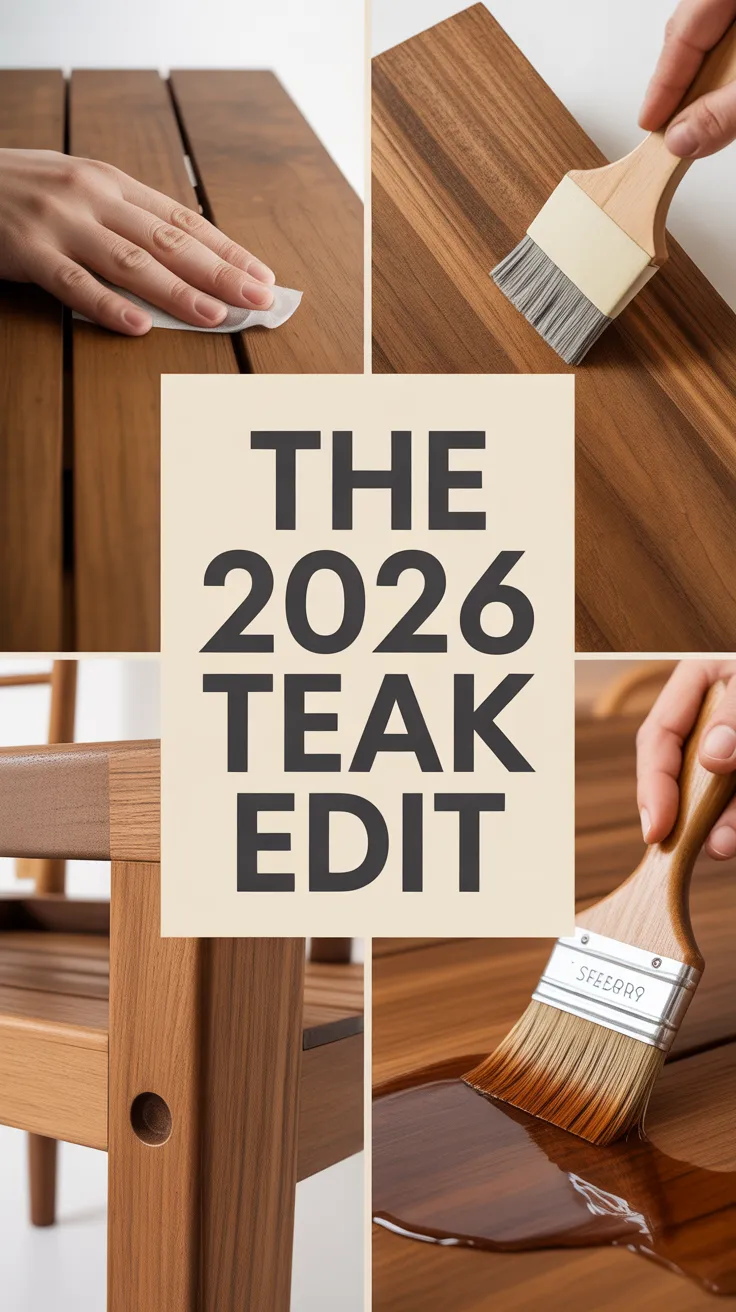
Teak’s resilience comes from its density — a natural interlocking grain structure that creates an almost watertight internal lattice. A pressure washer, even at moderate settings, forces high-velocity water directly along these grain lines, lifting, fraying, and permanently separating individual fibres. The surface may look cleaner for a week. Within a month, you will notice accelerated greying, a rough texture that was not there before, and — in more severe cases — micro-fissures that become entry points for moisture and biological growth.
This is not recoverable with sanding. The fibre damage is structural. Avoid it entirely.
🧴 Certified Approach — Step 1: pH-Balanced Teak Brightener Cleanse
The correct tool for initial cleansing is a dedicated teak brightener formulated to pH 6.5–7.2. This range lifts oxidized surface matter and the Grey Ghost patina without disrupting the heartwood’s natural resin balance. Look specifically for formulas containing oxalic acid — the compound that gently dissolves the iron tannate deposits responsible for darkening, without stripping the wood’s protective inner oils.
👉 Shop Teak Brighteners on Amazon
The Correct Technique

Step 1 — Pre-wet the Surface Using a garden hose at low pressure, wet the teak thoroughly before applying any chemical solution. This prevents the brightener from absorbing unevenly into dry pores and causing patchy results.
Step 2 — Apply with a Natural Bristle Brush Never synthetic. A natural bristle brush — boar hair or tampico fibre — allows the cleaner to work into the grain without scratching. Work always with the grain, never across it.
Step 3 — Allow a 5–10 Minute Dwell Time Resist the urge to scrub immediately. The chemistry needs time to lift the oxidised patina without physical abrasion. You are working with the wood, not against it.
Step 4 — Rinse at Low Pressure and Allow Full Drying Allow 24–48 hours of drying time in open air before moving to Phase Two. Moisture trapped beneath the surface during sanding will cause the grain to raise unpredictably.
Phase Two: The Precision Sanding Standard
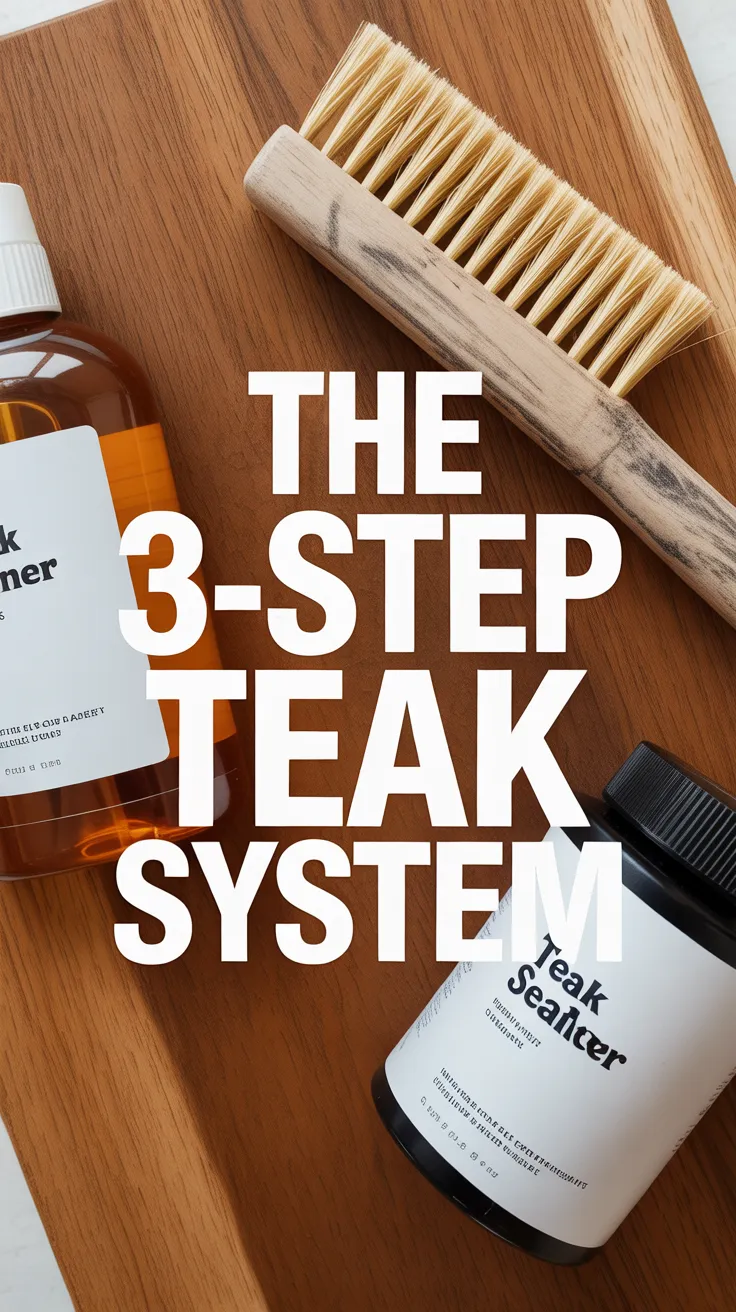
Once the wood is fully dry, you will see something that the cleaning phase has already begun to reveal: flashes of the original colour beneath the grey. The gold is still there. It was simply buried.
Sanding is the act of excavation. It is not about removing wood — it is about opening the wood’s surface pores to accept the protective sealing treatment that follows. Done incorrectly, sanding introduces scratches that the sealer will highlight and immortalise. Done with the precision outlined below, it will reveal a surface so close to new that you will question whether you have the right piece of furniture in front of you.
The Grit Sequence: 120 to 220
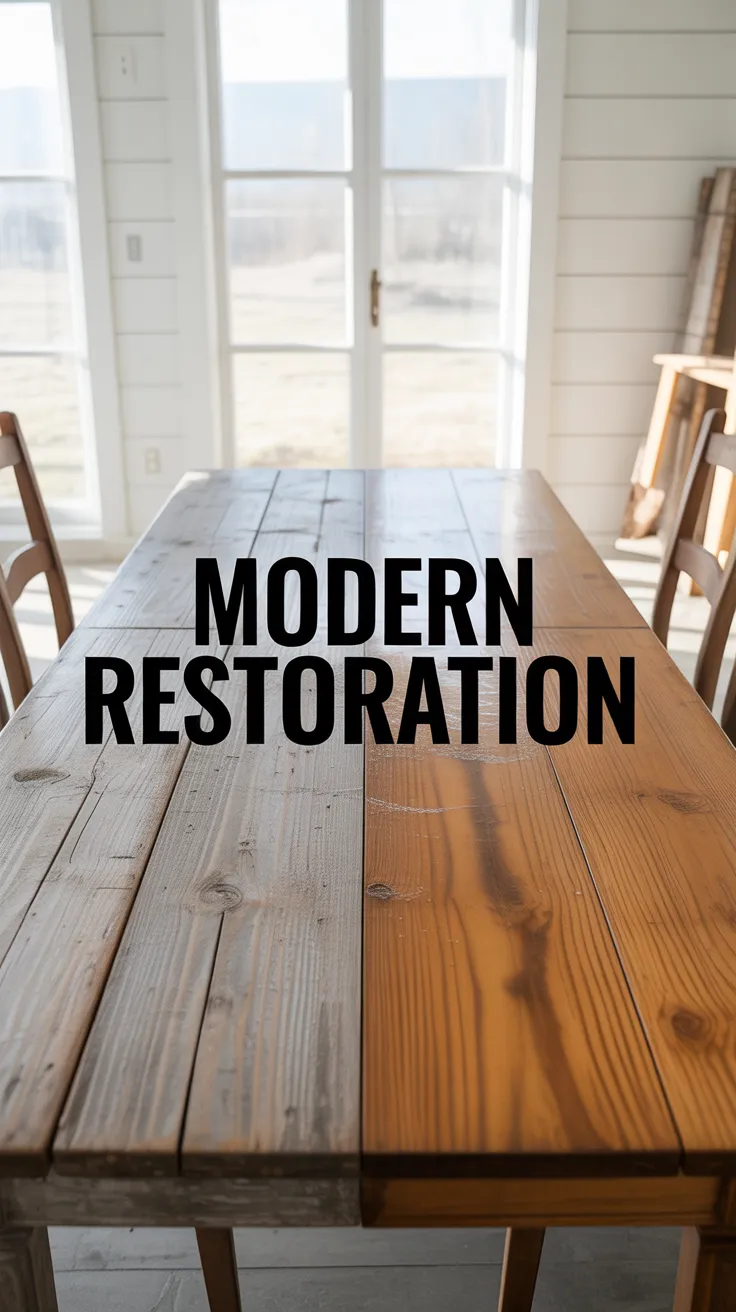
Begin with 120-grit sandpaper for moderately weathered pieces — those with one to three seasons of exposure. If your teak has more than three seasons of unprotected weathering, start at 80-grit and progress through 120 before finishing at 220. Never begin at 220 on a weathered surface — you will polish the oxidised layer rather than remove it, and the sealer will not bond correctly.
⚠️ Mechanical Failure Risk
Using a random-orbital sander across the grain creates cross-grain scratches invisible to the naked eye before sealing — and brutally apparent immediately after. Always sand by hand, always with the grain. For large surfaces such as dining tables, a long-board sander used with the grain is the only power tool acceptable at this stage.
Quick Reference — The Sanding Standard
- Starting grit: 120 — removes oxidised surface layer, opens grain pores
- Finishing grit: 220 — creates smooth, open surface for maximum sealer penetration
- Direction: Always with the grain. No exceptions.
- Post-sand step: Wipe with a tack cloth to remove all dust before sealing
The moment you wipe away the sanding dust from restored teak and see the heartwood gold beneath — that warm, amber resin catching afternoon light — you understand why this wood has furnished the world’s finest gardens for three centuries.
Phase Three: The Sealing vs. Oiling Debate

This is the phase where most well-intentioned homeowners make their most consequential mistake. They reach for teak oil — the product they have been told about for generations, the product their parents used, the product whose name alone sounds intuitively correct — and they apply it liberally, breathing in that pleasant linseed smell and feeling deeply satisfied with their work.
Within six months, their furniture has developed a dark, blotchy surface. A faint musty odour accompanies the next morning’s garden coffee. Fine white threads — mould — have begun establishing themselves between the grain lines.
The teak oil did this. And in 2026, there is no longer any rational argument for using it.
The Myth vs. The Reality

❌ The Old Myth: “Teak oil nourishes and protects the wood.” Traditional teak oils — typically linseed or tung oil with solvent — do penetrate the surface, but they do not dry within the wood. They remain as a semi-wet organic layer within the grain, providing exactly the nutrient-rich, moist environment that mould and mildew require to colonise.
✅ The 2026 Reality: Marine-grade penetrating sealers create a sealed internal matrix. Modern penetrating sealers are formulated to cure within the wood’s cellular structure — filling the pores and creating a hardened, hydrophobic internal matrix that repels water, resists biological growth, and does not require monthly reapplication.
The Science of UV-Reflective Nano-Particle Shielding

The 2026 generation of marine-grade teak sealers contains something that did not exist in commercial formulations a decade ago: nano-dispersed UV-absorbing particles — typically titanium dioxide or zinc oxide at particle sizes between 20–100 nanometres. At this scale, the particles are invisible to the naked eye but highly effective at absorbing and scattering UV radiation before it reaches the wood’s surface.
The practical result: a teak set sealed with a 2026 marine-grade formula and left in full sun all summer will show significantly less colour shift, grain degradation, and surface checking than an oiled set stored in partial shade. The physics favour the science. The investment in the correct product pays for itself in restoration labour costs avoided.
🛡️ Certified Protection — Phase Three: Marine-Grade Penetrating Teak Sealer with UV-Nano Shield
Apply two thin coats with a foam applicator, allowing 4–6 hours between coats. Do not apply in direct sun or temperatures below 10°C. Wipe away any excess within 15 minutes of application to prevent surface pooling. One treatment correctly applied will protect for 12–18 months of active outdoor exposure.
👉 View Top-Rated Teak Sealers on Amazon
Phase Four: The “Invisible” Shield — Seasonal Protection

Restoration is the recovery. Seasonal protection is the insurance. The two are inseparable if the goal is a decade of performance from a set you have now invested a morning in restoring.
The leading cause of structural teak failure — the kind that cannot be reversed with cleaning and sanding — is not sun exposure. It is trapped moisture during the off-season. Specifically, it is the cycle of moisture absorption and contraction that occurs when furniture is covered improperly through autumn and winter months.
The Breathable Cover Standard

A non-breathable cover — plastic, vinyl, or insufficiently ventilated canvas — creates a sealed microclimate around your furniture. Condensation forms on the underside of the cover each time temperatures drop at night, and that moisture has nowhere to go. It sits against the wood, creating the precise conditions under which rot, mould, and the structural cracking known as “checking” develop.
⚠️ Mechanical Failure Risk
A single damp winter beneath a non-breathable cover can undo three years of diligent sealing and maintenance. The cover material is not a secondary decision. Look specifically for covers rated with a minimum 1,500mm hydrostatic head (waterproof) and a moisture vapour transmission rate of at least 3,000g/m²/24hrs (breathable).
Airflow Architecture: The Spacing Protocol
Before covering, ensure there is airflow beneath the cover. For chairs, cross the legs and create a slight gap between stacked pieces. For tables, do not invert chairs onto the table surface beneath a cover — this restricts airflow entirely. For benches, simple teak feet risers elevate the piece 15–20mm from the ground, preventing the base moisture accumulation that causes rot to begin from the underside.
🏕️ Certified Protection — Winter Protocol: Heavy-Duty Breathable Outdoor Furniture Covers
Invest in covers rated specifically for garden furniture — not general tarpaulins. The correct cover will have ventilation panels built into the lower hem, tie-down straps to prevent wind displacement, and a double-stitched shoulder seam. A quality cover for a six-seat dining set should weigh at least 1.8kg — anything lighter is not providing meaningful wind resistance.
👉 Shop Premium Furniture Covers on Amazon
The Verdict: What a Morning’s Work Actually Buys You
Let us be precise about the mathematics of this decision, because luxury maintenance is ultimately a question of value preservation.
- 1 morning of work
- 10 years of protection
- ~£90 in product cost
- £5,000+ asset preserved
Spent correctly, the protocol outlined above — the brightener cleanse, the precision sand, the marine-grade sealer, and the breathable seasonal cover — costs less than a single restaurant lunch. The labour is four to five hours for a full six-piece dining set, and the work itself is genuinely satisfying in the way that all stewardship of fine materials is satisfying: you are working with something worth working with.
The alternative is a replacement purchase cycle — new teak every seven to ten years as pieces degrade beyond comfortable use — that costs many multiples of the preservation investment and represents an approach to material ownership that no thoughtful homeowner should accept.
The finest gardens are not defined by the newness of their furnishings. They are defined by the quality of their stewardship. A teak bench that has been faithfully restored and maintained for twenty years carries a depth of character — a warmth of patina, a settledness — that no new piece can replicate. Restoration is not maintenance. It is an act of respect for the materials you have chosen to live with.
Protect the Soul of Your Garden
You purchased teak because it is exceptional. It deserves to be treated as such. Follow this protocol once, do it properly, and return to your garden coffee tomorrow morning knowing that the investment sitting in your garden is protected — not just from the weather, but from the quiet diminishment that comes from beautiful things being left to fend for themselves.
The soul of a well-kept garden is its permanence. The materials you choose. The care you bring to them. The light they hold at the end of a summer evening. That is the Timeless Manor finish.
👉 Shop the Full Teak Restoration Kit on Amazon
Affiliate Disclosure: This article contains affiliate links. As an Amazon Associate, Timeless Manor earns a commission from qualifying purchases at no additional cost to you. All recommendations are based on independent testing and editorial judgement.