The Best Fluffy Pancakes recipe you will fall in love with. Full of tips and tricks to help you make the best pancakes.

7 Best Grade-A Teak Furniture Sets for Luxury Outdoor Living in 2026

By Timeless Manor | Luxury Teak Patio Furniture · Grade-A Teak Dining Set · Sustainable Teak Furniture · High-Ticket Teak Furniture · Luxury Outdoor Living
There are materials in this world that age with the quiet confidence of things that have always known they would last. Grade-A teak is one of them.
I. The Majesty of Grade-A Teak: A Material That Earns Every Dollar
Walk through the garden of any great English estate built before the Second World War and you will almost certainly find teak somewhere — a bench near the rose garden that has been sitting in the same spot for sixty years, a pair of dining chairs on a flagstone terrace that have outlasted three sets of cushions and two complete interior renovations of the house behind them. The wood, which should by any reasonable expectation have deteriorated, has instead done something different. It has aged. It has deepened, quieted, and assumed the soft silver-grey of antique pewter — and it remains, structurally, precisely what it was the day it was made.
This is not an accident of maintenance. It is an accident of biology, and understanding it is the foundation of every intelligent teak purchase.
Teak (Tectona grandis) produces, over the course of decades of growth, a natural resin complex dominated by a compound called tectoquinone, along with silica and a dense matrix of structural oils that saturate the heartwood fibers from within. These are not surface treatments. They are not applied by a manufacturer and they cannot be replicated by a competitor selling eucalyptus stained to look like teak. They are the biological architecture of the tree itself — built slowly, over twenty, thirty, forty years of growth — and they are the reason that Grade-A teak furniture made in 1924 still sits, without apology, on the terrace of a Connecticut manor today.
In 2026, as outdoor design has moved decisively toward what critics are calling “warm minimalism” — natural materials, architectural confidence, the deliberate absence of the disposable — teak has reasserted itself as the only organic material that belongs unconditionally in a high-ticket outdoor setting. 2026 leans hard into natural-looking materials: teak, bamboo, and rattan that blur the line between indoor and outdoor, and for a luxury patio set, FSC-certified teak remains the defining standard. It is not fashionable. It does not need to be. Teak simply is — and that permanence is precisely what distinguishes it from every trend that has arrived and departed around it.
This guide is organized around seven furniture sets that meet the full Timeless Manor specification for Grade-A teak: heartwood sourcing, mortise-and-tenon joinery, kiln-dried precision, FSC or equivalent certification, and the construction quality to carry the word heirloom without irony. Before we reach the sets, the foundational education: what Grade-A actually means, how to identify it, and why the grade gap between an authentic heartwood piece and a sapwood impostor is one of the most consequential distinctions in outdoor furniture.
II. The Anatomy of an Heirloom: What Separates Grade-A from Everything Below It
The Grade Gap: A Biological Distinction, Not a Marketing One
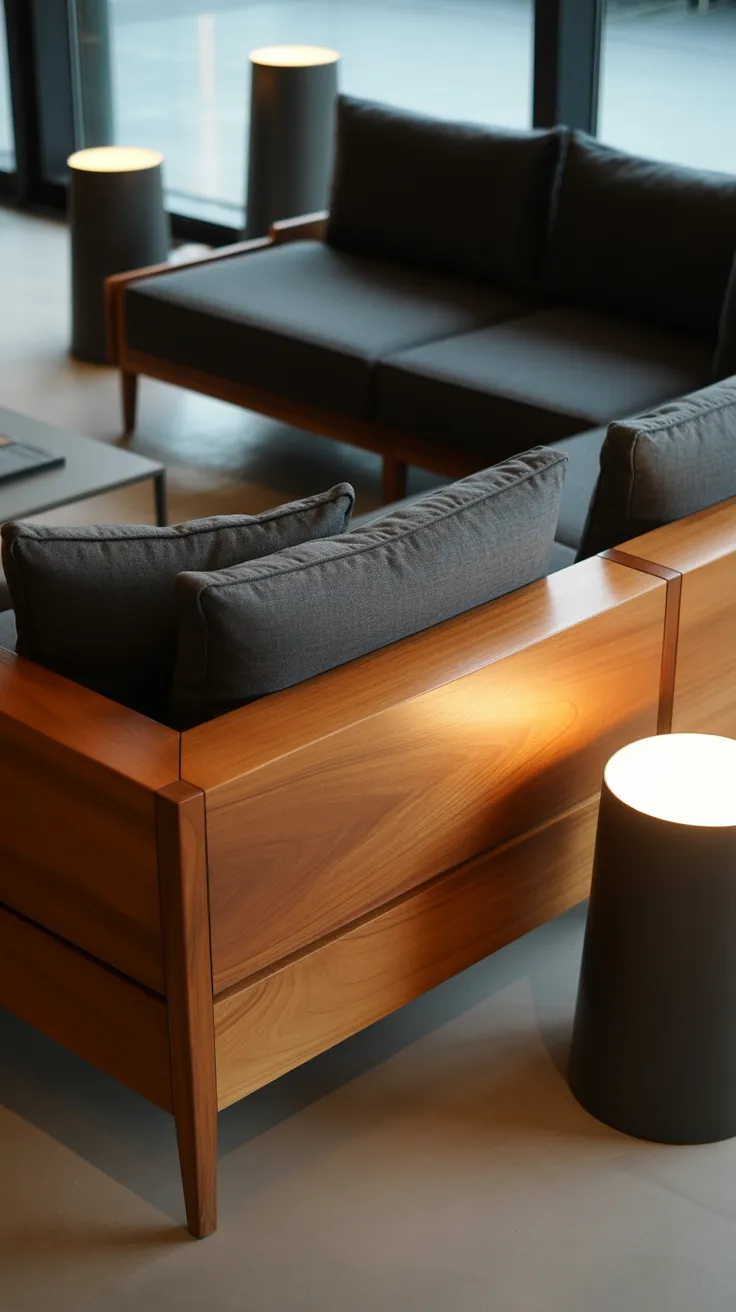
Inside every teak tree, there are two fundamentally different materials — and the furniture industry has assigned both of them the same word.
At the core of a mature teak tree — a tree that has grown, slowly and without shortcut, for at least twenty years and ideally thirty to fifty — is the heartwood. Grade-A teak refers to the mature heartwood of a teak tree. This is the timber that comes from the very center of the trunk. Grade-A teak is rich with natural oil. The wood should feel slightly oily when you touch it. And it should have a warm golden color when new, like the color of honey. The wood grains should be very close together as this is the densest part of the tree. When a teak tree is harvested, only about a quarter of the available wood will be Grade-A, which makes it the most expensive type.
That ratio — one quarter of the tree — is the beginning of understanding why Grade-A costs what it costs, and why that cost is not negotiable for anyone serious about the investment they are making.
Surrounding the heartwood is the Grade-B zone: the outer heartwood, the wood that sits between the mature center and the living outer layers of the tree. Grade-B teak refers to timber cut from the outer part of the heartwood. Grade-B teak has a lighter color, uneven grain and less shine due to less oil content. Grade-B teak isn’t as reliable or long-lasting for outdoor furniture because it doesn’t have as much of the wood’s natural protective oils. Grade-B performs respectably indoors and in sheltered outdoor applications; it is not, however, the material for a terrace that faces full weather.
And then there is Grade-C — the sapwood. Grade-C teak is harvested from the sapwood — the outer, living layers of the tree. This wood is immature and lacks the structural integrity of heartwood. It contains almost no natural oils, making it soft and highly susceptible to warping, cracking, and insect infestation. While Grade-C furniture is often sold at a deep discount, it typically fails or rots within one to two years of outdoor use.
The precise oil content differential between grades tells the mechanical story clearly: Grade-A teak comes exclusively from trees aged 45–50 years minimum before harvesting. Grade-A contains approximately 5–7% natural oil content. Grade-B teak contains approximately 2–4% natural oil content, representing a 50–75% reduction compared to Grade-A. Grade-C teak contains only 1–2% natural oil content, representing an 80% reduction compared to Grade-A. Grade-A lasts 50–75+ years outdoors with minimal maintenance, often exceeding three generations of ownership. Many documented examples of Grade-A teak furniture exceed 100 years in constant outdoor use.
One hundred years. That figure appears repeatedly in the technical literature, and it should carry weight in any honest consideration of furniture investment.
How to Identify Grade-A Teak Before You Buy
Run a fingertip across any unfinished teak surface before purchasing. Grade-A heartwood will feel faintly oily — a slight resistance beneath your skin, as though the wood has been very lightly treated. It has not been treated. That is the oil. The color should be a deep, consistent honey-gold with a tight, uniform grain that shows no significant variation in tone across the surface. If the wood is lightweight for its apparent size, if the grain is wide and inconsistent, or if the color shows pale streaks of cream or white — those are sapwood inclusions, and the piece is not Grade-A regardless of what the label says.
Real Grade-A teak is heavy. Pick up a chair. It should require both hands and a degree of intention.
The Mixed-Grade Deception: The Most Common Fraud in Outdoor Furniture
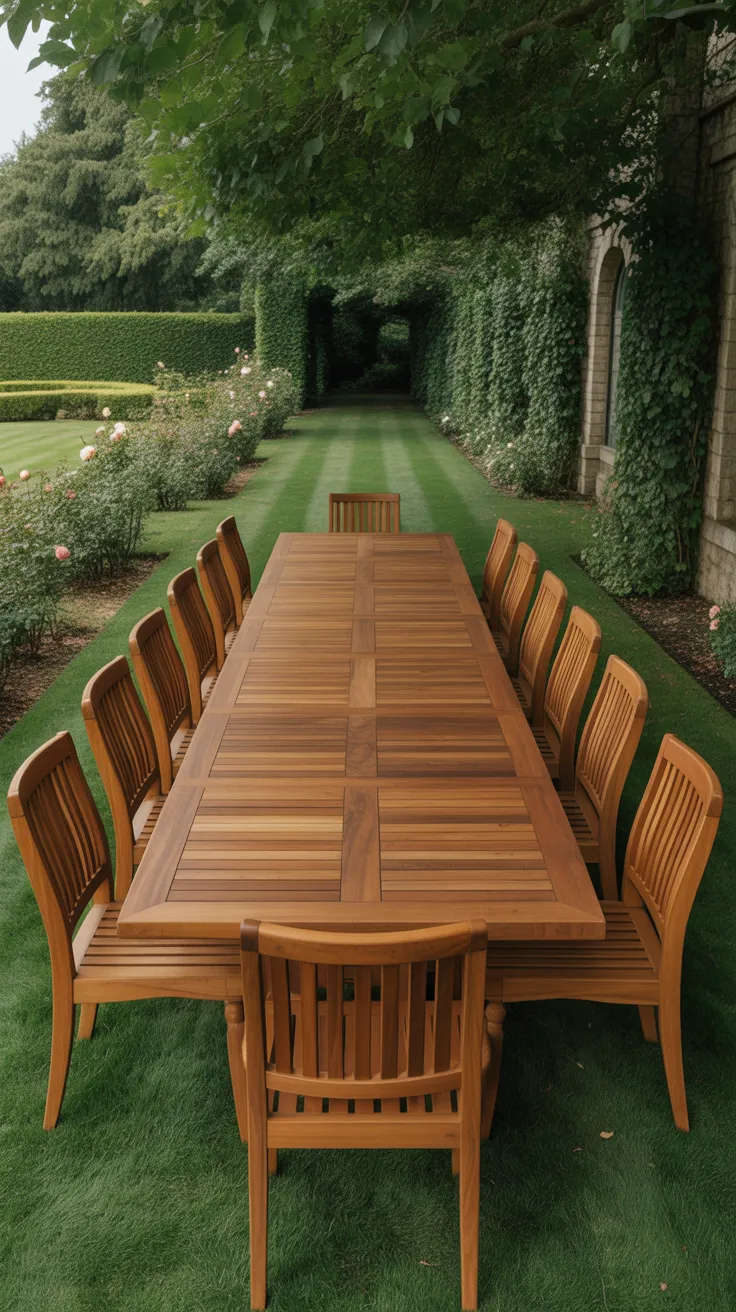
There is a practice, sufficiently common to warrant naming directly, in which manufacturers construct the visible surfaces of a furniture piece from Grade-A teak — the tabletop, the seat slats, the chair backs — while building the structural components from Grade-C sapwood. The legs. The frame rails. The load-bearing members.
Mixed-grade builds are common on “cheap” patio sets where the visible tops are Grade-A, but the structural legs are Grade-C sapwood. The deception is elegant in a cynical sense: the part you run your hand across when you inspect the furniture in the showroom is genuinely beautiful. The part that splits by its third winter is hidden.
The verification: ask the manufacturer for written confirmation that all structural components — not just the visible surfaces — are cut from Grade-A heartwood. A reputable manufacturer will provide this without hesitation. If the answer is vague or defensive, the answer is no.
Joinery: The Joint That Has Outlasted Empires
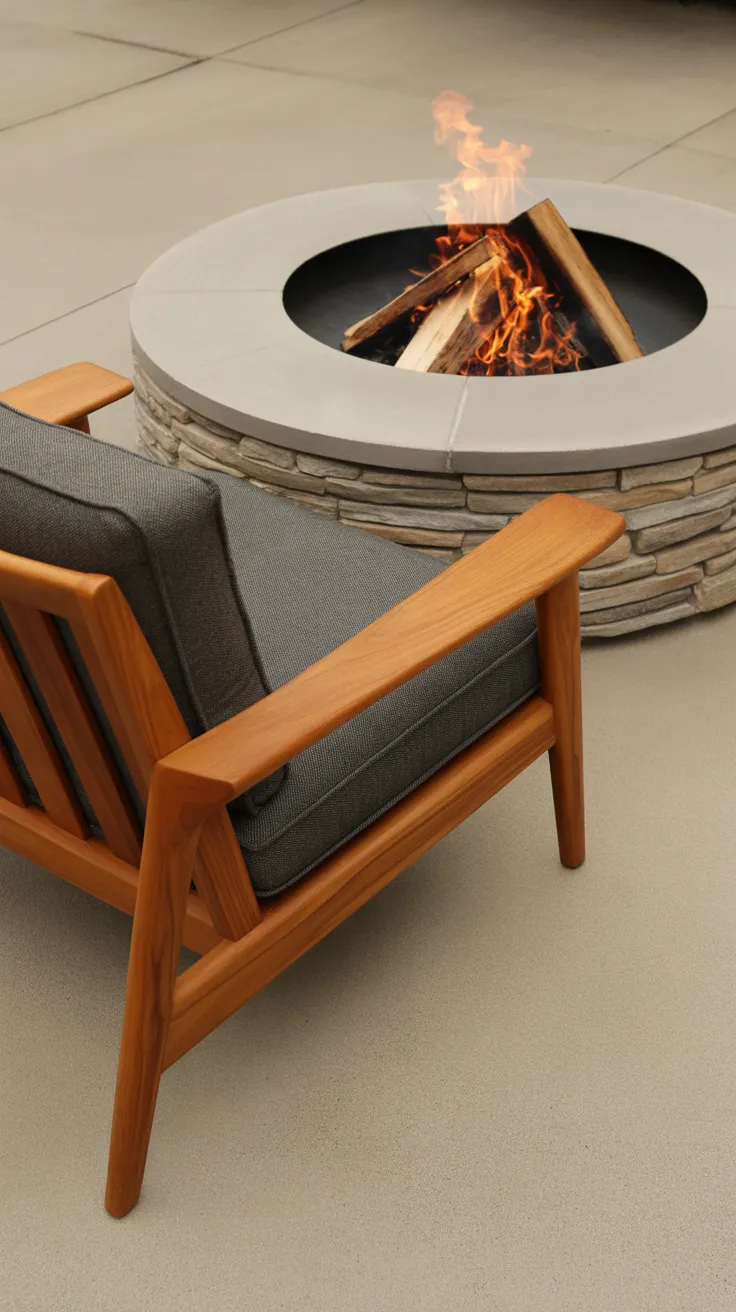
Once the material is confirmed, the construction method is the second foundational specification.
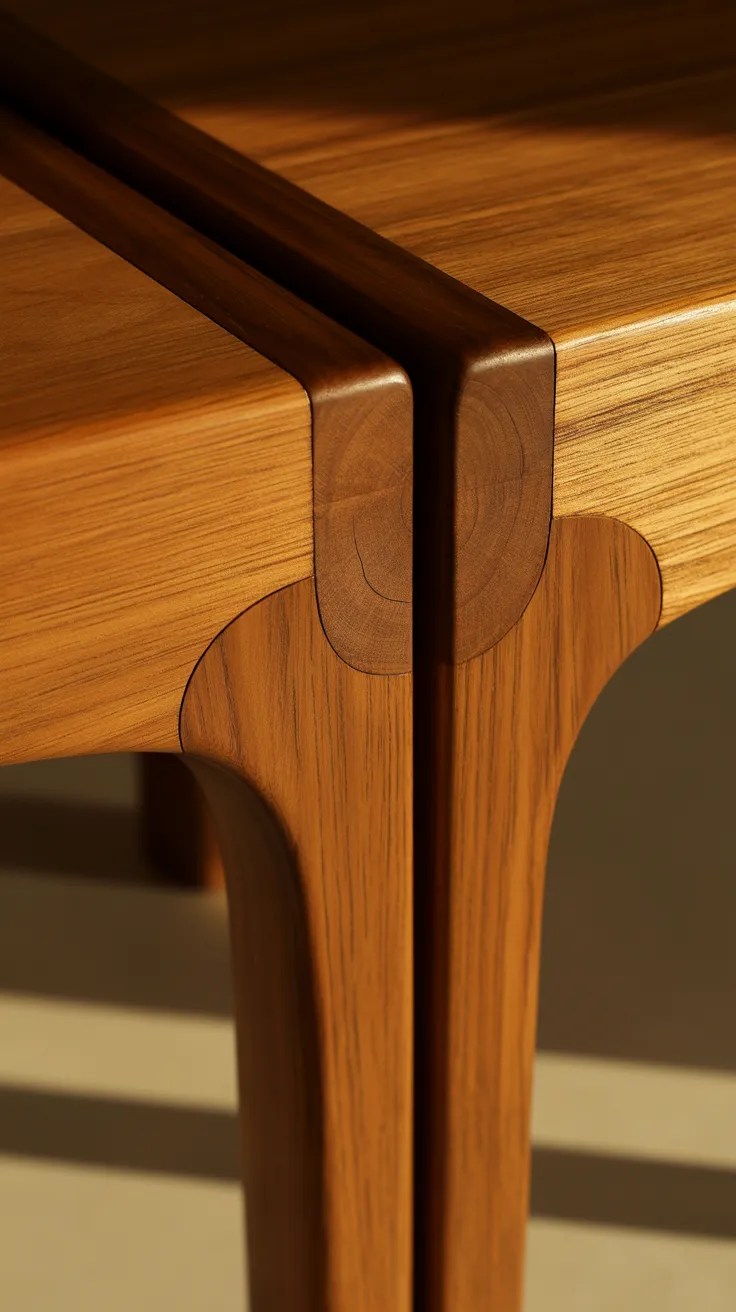
Mortise and tenon joinery is a simple construction method used to connect two pieces of material without the need for glue, screws, or other hardware. It is an age-old technique employed by woodworkers, stonemasons, and blacksmiths throughout history for its simplicity and strength. Wood naturally expands and contracts with changes in temperature and humidity. Using metal bolts or connectors can cause the construction of the furniture to become unstable over time as the wood expands, loosening the space between the edges of the metal and wood. Mortise and tenon joints are the single best way to maintain the construction’s durability.
The mechanics of why this matters outdoors specifically: teak in outdoor conditions undergoes continuous thermal and moisture cycling — expanding in summer heat and humidity, contracting in dry winter air, expanding again. A screw joint, which creates a single point of shear stress, accommodates this movement by loosening. Over three seasons, a screw-jointed teak chair that feels solid in the showroom develops the gentle wobble that signals structural failure in progress.
A mortise-and-tenon joint, by contrast, distributes that movement across the full surface area of the interlocking components. This interlocking connection distributes weight naturally, reduces reliance on visible hardware, and helps outdoor furniture maintain structural stability even with frequent use. The best outdoor furniture doesn’t just survive the elements. It ages with quiet confidence.
The specification to require: mortise-and-tenon at all load-bearing connections, reinforced with teak dowels and a high-performance weatherproof adhesive. Solid brass or stainless steel is used for any required fittings. Strength or weight-bearing joints that require mechanical reinforcement use galvanized steel bolts, if possible encased with blind dowels to preserve the visual cleanliness of the joint.
A visible screw head on a piece of furniture offered as premium teak is not a stylistic choice. It is a construction failure.
Kiln-Dried Precision: The Science of Dimensional Stability
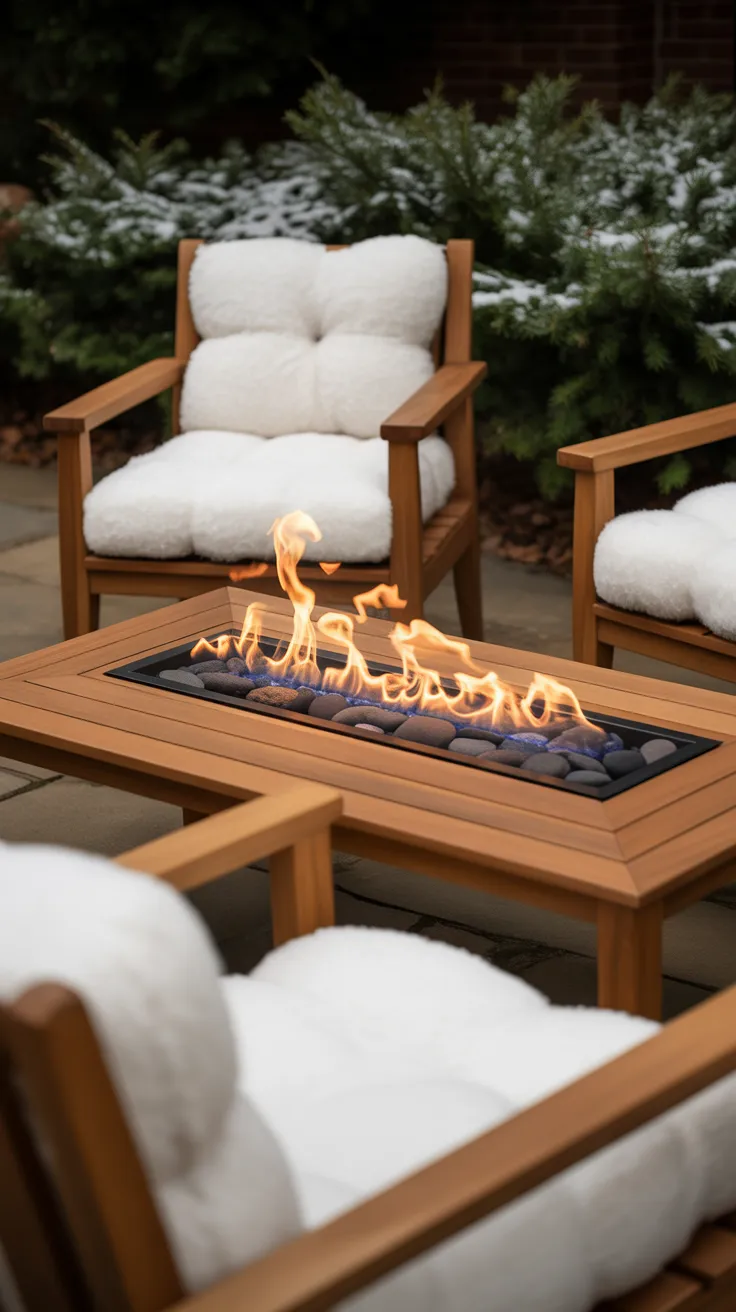
The third specification — less visible than grade or joinery, but equally determinative of long-term performance — is moisture content.
The kiln-drying process is a scientific method of placing raw timber in a large oven to slowly reduce its moisture content to a stable level, around 10–12%. This is vital because it prevents the wood from warping or cracking when it moves from a humid climate like Indonesia to a drier one in Europe or America. Proper drying is a non-negotiable factor for anyone buying teak outdoor furniture for a climate different from its origin.
Westminster Teak’s process takes about two weeks of kiln drying to achieve a moisture content of about 10% and an additional 3 to 4 weeks of “resting” to allow the wood to reabsorb moisture in the air. This natural re-absorption of moisture process ensures that the teak wood regains its dimensional stability and will not warp or split during or after the manufacturing process.
Speeding up or skipping the kiln-drying process leads to dry, defective teak that will expand and contract unevenly, breaking down joints and threatening stability.
The practical consequence of inadequate kiln drying is what some manufacturers call “manor warp” — the gradual twisting or cupping of tabletops, the opening of gaps at joinery points, the slow structural delamination of a piece that arrives looking pristine and deteriorates in its first full weather cycle. Kiln-drying to 8–12% moisture content, with the subsequent resting period to allow equilibration, eliminates this failure mode entirely.
Ask: Has this teak been kiln-dried? To what moisture content? For how long, and was a resting period allowed? These are not arcane technical demands. They are the minimum questions a serious buyer should be asking, and a serious manufacturer will answer them in their product specifications without being prompted.
III. The Sectional Centerpiece: Deep-Seated Teak for the Manor Terrace
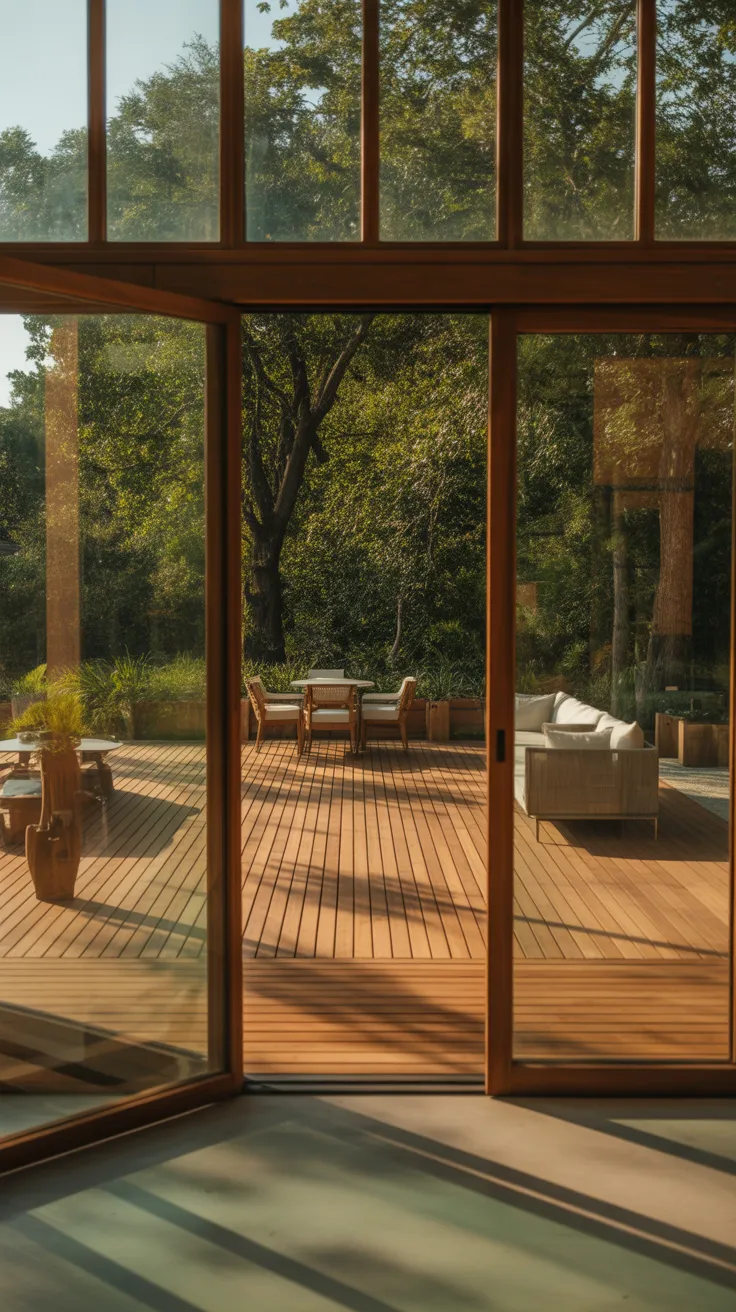
The teak sectional is the architectural statement of the outdoor living suite — the piece around which everything else is organized, the furniture that defines the scale and ambition of the space. It is also the category most susceptible to the mixed-grade deception described above, because the cushion covers and performance fabric tend to direct a buyer’s attention away from the frame construction beneath them.
Scale and the Deep-Seat Standard
For a terrace of consequence — a formal rear veranda, a generous covered porch, a pool terrace at the scale that justifies a substantial investment — the sectional frame should be built to a deep-seat specification: a minimum seat depth of 24 to 26 inches, with a seat height of 14 to 16 inches. These dimensions place the sitter in a genuinely reclined position, the lumbar supported, the legs at ease — not the slightly tense semi-upright posture that shallower outdoor frames impose. Teak chairs with 24–26 inch depths let you relax; outdoor seating should rival indoor comfort when properly specified.
The frame weight itself is a quality signal. A teak sectional corner piece built to full Grade-A specification should weigh in the range of 70 to 90 pounds. If it can be moved easily by one person without meaningful effort, the oil content — and therefore the density and structural integrity of the wood — is insufficient.
Textile Pairing: The Chromatic Conversation Between Teak and Fabric
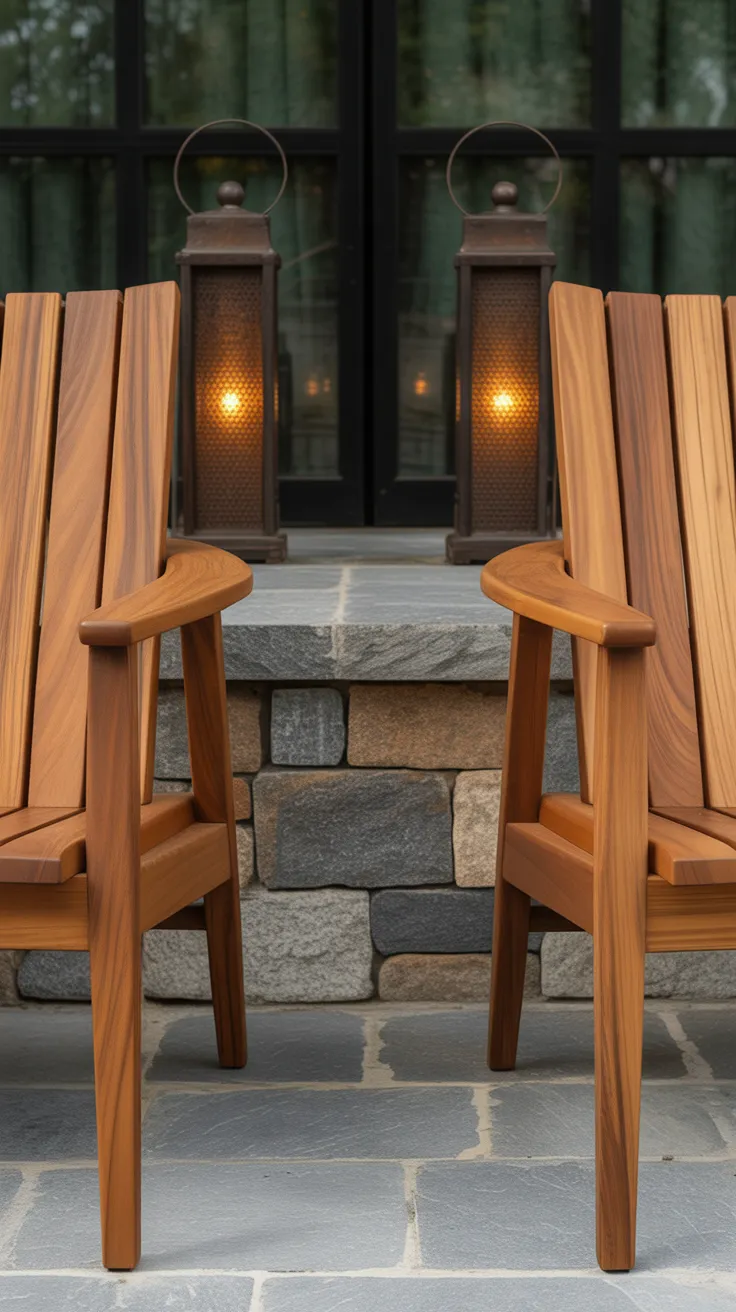
New Grade-A teak presents a specific color: the warm, light-saturated honey-gold of the heartwood, with the tight grain catching light differently across its surface at different times of day. It is a material that is already doing a great deal of visual work, and the fabric that sits against it should understand that.
The neutral performance fabrics that work best against new teak are those in the warm sand, greige, and warm cream range — not the cool grey-whites that would create a visual tension between warm wood tone and cold fabric. A Sunbrella® “Canvas Antique Beige” or “Canvas Taupe” in solution-dyed acrylic reads as a continuation of the teak’s own palette rather than a contrast to it. This creates the effect of the furniture as a single, cohesive object rather than a frame and cushion in proximity.
For the sectional that will develop its silver patina over time — a deliberate choice, fully explored in Section V — the fabric pairing should anticipate the destination color, not the origin. A soft dove grey or warm slate cushion against silver-patinated teak is one of the most quietly beautiful combinations in outdoor design.
🛍️ The Sectional Anchor: First Recommendation
Westminster Teak Tuscany Collection Deep Seating Sectional — Grade-A FSC-Certified Teak, Sunbrella® Cushions
Westminster Teak’s Tuscany line is built to the full Timeless Manor specification: Grade-A teak heartwood with SVLK certification, kiln-dried to 10% moisture content with a 3–4 week resting period, mortise-and-tenon joinery throughout all load-bearing connections, and stainless steel hardware at points requiring mechanical reinforcement. The deep-seat dimensions — 27-inch seat depth, 16-inch seat height — place it at the upper end of outdoor comfort. The Sunbrella® cushion options include the full canvas palette. Westminster backs all teak products with a lifetime structural warranty — the signal that the manufacturer has confidence in its own craftsmanship.
Search: “Westminster Teak Tuscany sectional Grade-A FSC certified outdoor Sunbrella”
Anderson Teak South Bay Collection Deep Seating Sectional — Grade-A Teak, Modular Configuration
Anderson Teak builds its South Bay line in a modular format — corner pieces, armless middle sections, and ottomans that reconfigure independently — allowing a terrace layout to be adjusted without replacing furniture. The construction specification is consistent with heritage-grade standards: Grade-A heartwood, kiln-dried timber, traditional joinery. The finish is left natural to allow the buyer to direct the patina evolution. The modularity is not a compromise; it is a considered engineering choice that extends the usefulness of a single investment across changing terrace configurations.
Search: “Anderson Teak South Bay sectional modular Grade-A outdoor furniture”
IV. Dining in the English Garden: The Long-Table Tradition
The English garden dining tradition — the long rectangular table, the matched chairs, the scale that communicates a household that expects guests and knows how to seat them — is one of the most enduring aesthetics in outdoor design. It is also, not coincidentally, the form for which teak is most specifically suited. Homeowners are transforming patios, terraces, and gardens into true outdoor rooms for dining, relaxation, and year-round entertaining, with demand moving strongly toward durable investment pieces such as teak garden sets designed to withstand the climate for decades.
The Twelve-Guest Standard: Designing for Scale
The dining set for a manor terrace is not designed for four people on a Tuesday evening. It is designed for twelve on a Saturday, for the long summer dinners that extend past sunset, for the occasions that justify owning a terrace in the first place.
A teak dining table built to the twelve-guest standard runs 118 to 130 inches in length, 39 to 43 inches in width, and 29 to 30 inches in height — proportions that permit elbow room, wine glasses, and a centerpiece simultaneously. The chairs should match the table in construction standard but need not match in style: mixing a straight-back teak stacking chair at the sides with two armchairs at the heads creates the visual grammar of a formal dining room brought outdoors.
The twelve-guest configuration requires a terrace footprint of approximately 14 by 20 feet minimum, allowing 36 inches of chair-push clearance on all four sides. Map this with painter’s tape before purchasing. A dining table at this scale in a space that cannot accommodate it creates the visual and functional equivalent of a grand piano in a studio apartment — technically present, functionally impossible.
Tabletop Design: Slatted vs. Solid — The Engineering of Weather and Air
The teak dining tabletop presents a choice with real functional consequences: slatted or solid.
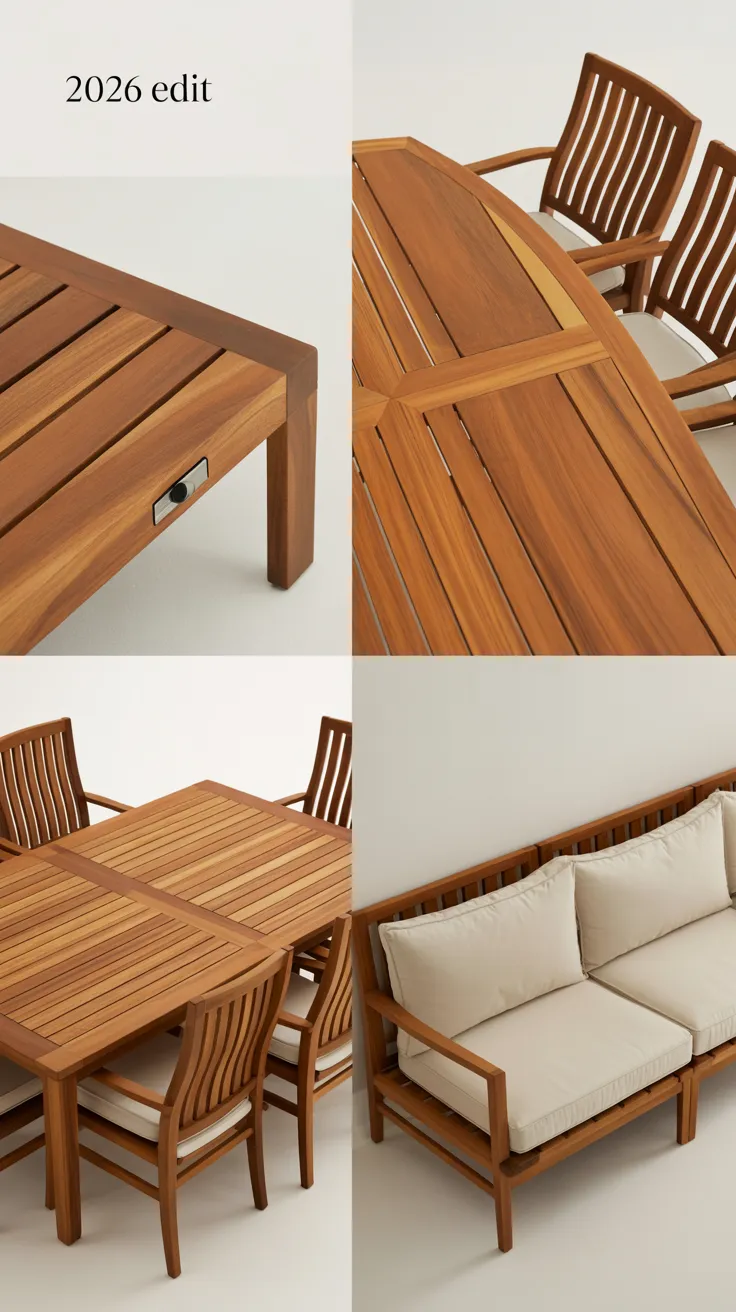
Slatted tabletops — parallel teak planks with 3 to 5mm gaps between them — allow rain to pass through the surface without pooling, permit air to circulate beneath the planks (reducing the moisture differential between top and bottom surfaces that causes cupping), and present an aesthetic that reads as more casual and relaxed. They are the correct choice for fully exposed terraces in rain-prone climates, and for dining tables that will never have a tablecloth placed on them.
Solid tabletops — book-matched teak planks edge-glued into a continuous surface — offer the uninterrupted expanse appropriate for formal dining: the surface that supports a tablecloth, a candelabra, the full setting of a proper dinner. They require a drainage channel or slight crown to the surface profile to prevent pooling, and they demand more careful maintenance attention in climates with dramatic humidity cycles. They are the correct choice for covered terraces and four-season porches, and for the homeowner who wants her outdoor dining table to read, from ten feet away, as furniture of genuine consequence.
The tabletop thickness is the final structural signal: 1.25 to 1.5 inches is the standard for a serious teak dining table. Anything below one inch is a cost-reduction measure masquerading as a design choice.
🛍️ The Dining Centerpiece: Two Recommendations Across the Tradition
Country Casual Teak Chippendale Collection Dining Set — 78″ or 118″ Rectangular, Grade-A Kiln-Dried Teak
Country Casual’s Chippendale line draws explicitly from the English garden furniture tradition — the slightly tapered leg profile, the refined cross-bracing, the frame proportions that read as furniture with a distinct point of view rather than simply a table with chairs nearby. Their teak is kiln-dried for up to six weeks to achieve 10% ±2% moisture content, and constructed with mortise-and-tenon joinery throughout. The 118-inch length seats twelve comfortably. Country Casual offers the option of both slatted and solid top configurations within the same frame design — the correct approach, because the structural specification does not change between them.
Search: “Country Casual Teak Chippendale dining set 118 inch Grade-A kiln-dried”
Goldenteak Grade-A Premium Teak Oval Dining Table with Folding Chairs — Seats 8–12
For the terrace whose spatial constraints or aesthetic preference favor an oval plan over a rectangle, Goldenteak’s premium oval dining series offers the full Grade-A heartwood specification in a form that allows twelve chairs to sit without corner-positioning compromises. Grade-A teak wood is kiln dried to a low moisture content and then allowed to rest. Once this is done, the wood will virtually never warp or crack. Premium teak furniture couples Grade-A teak wood with excellent manufacturing techniques: mortise and tenon joinery with dowels is used when possible. The folding-chair option solves the storage question elegantly: twelve chairs that fold flat to six inches of depth can be racked in a single outdoor storage unit rather than requiring a dedicated furniture shed.
Search: “Goldenteak Grade-A teak oval dining table set 12 person kiln dried”
Teak Bench Seating: The English Garden Standard
No consideration of the teak dining tradition would be complete without the bench — the solid garden bench that has stood in English estate gardens since the Victorian era, requiring nothing of its owner except the annual question of whether to oil it or let it silver. A pair of solid teak garden benches flanking the ends of a long dining table converts a formal dinner set into a gathering space of considerable warmth, inviting the casual elbow-on-the-table posture that the most enjoyable outdoor meals seem to encourage. Demand has moved strongly toward certified teak, long-term value, and iconic pieces such as the Lutyens bench, which combine heritage design with exceptional durability.
Westminster Teak Classic Garden Bench — 5ft or 6ft, Grade-A Teak, No-Arm Design
Search: “Westminster Teak classic garden bench 6ft Grade-A FSC certified outdoor”
V. The Maintenance Paradox: To Oil or Not to Oil?
This is the question that divides the teak-owning community with a conviction that borders on the theological — and it is worth resolving clearly, because the answer is not universal. It depends on what you want your furniture to become.
The Silver Patina: An Argument for Letting Teak Live Its Life
For the 55–64 homeowner who has spent decades watching things she loves develop the particular beauty that only time produces — the softening of a linen fabric, the character that accumulates in the leather of a favorite chair, the way a garden settles into itself over years — the silver-grey patina of aged teak is not deterioration. It is arrival.
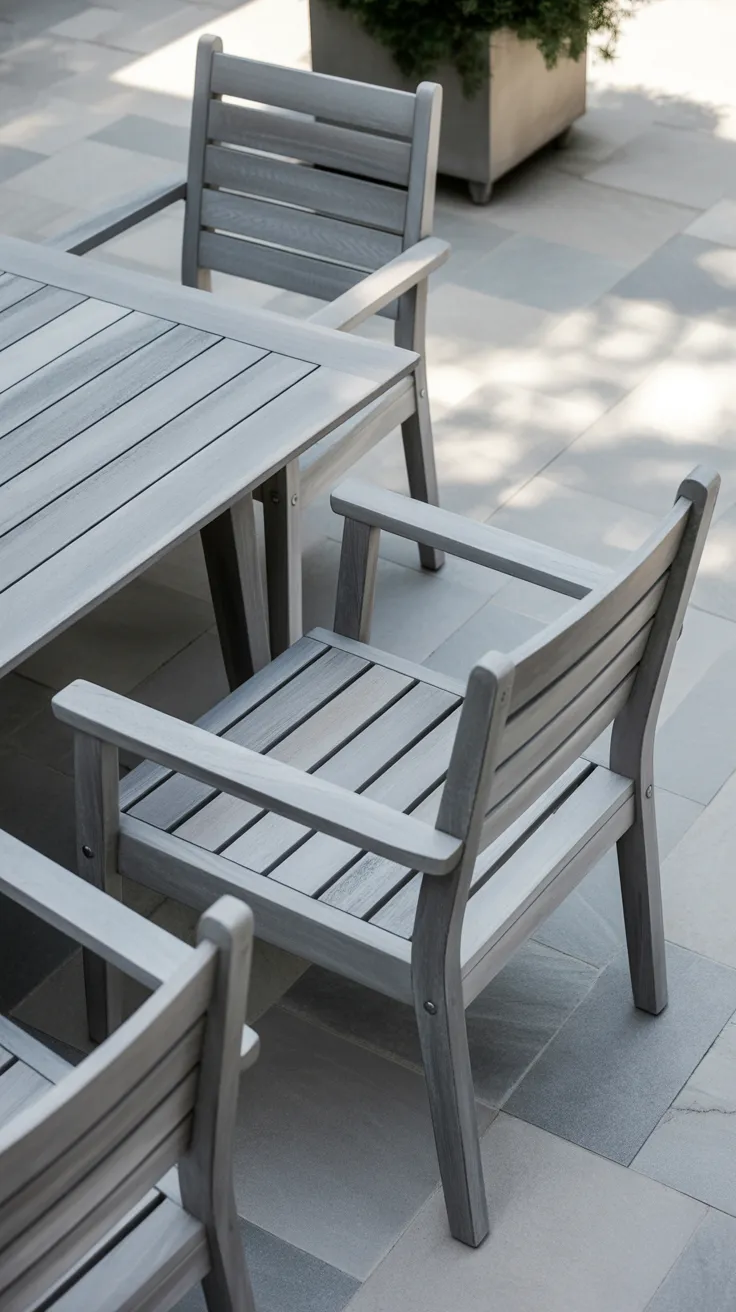
The silver color is the result of the natural oils in the heartwood migrating to the surface and oxidizing in UV light, leaving a thin layer of lignin and microorganism activity (entirely benign) that produces the characteristic color. The process takes approximately one to two full seasons of outdoor exposure, and once established, it is stable. The wood beneath the patina retains its full structural oil content — the silver is surface chemistry, not structural compromise. An aged teak bench that has gone fully silver has lost nothing of its mechanical integrity. It has, in the view of many designers and most heritage furniture collectors, gained something that cannot be manufactured: evidence of a life actually lived outdoors.
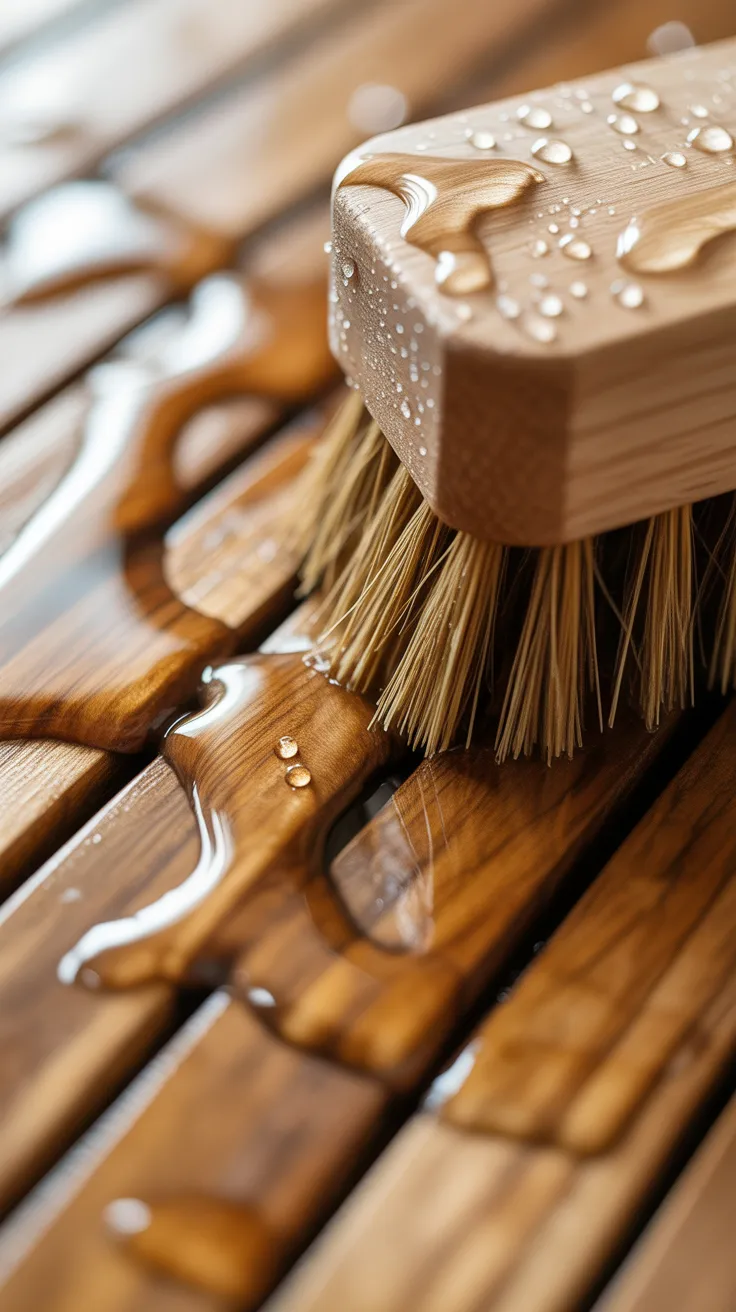
The maintenance protocol for embracing the patina is minimal: an annual cleaning with a solution of mild soap and warm water, applied with a soft brush in the direction of the grain, rinsed thoroughly, and allowed to air-dry before any furniture covers are applied. That is the entirety of the commitment. The furniture does the rest.
Timeless Manor Standard for the Silver Path: Do not use pressure washers on teak at any patina stage. The mechanical force opens the grain surface and accelerates the inconsistent weathering that creates blotchy rather than even silver tones. A soft brush and patience produce a uniform patina that reads as intentional — which it is.
Gold Preservation: The Technical Protocol for the Modern Investor
For the 35–44 homeowner who views the honey-gold tone of new Grade-A teak as the correct expression of the material — the color that communicates freshness, presence, and the conscious decision to maintain what she has invested in — the preservation protocol is more active, but not burdensome.
The primary tool is a penetrating teak sealer: not a surface coat, not a film-forming varnish, but a formulation that enters the wood’s pore structure and bonds with the existing natural oils to extend their UV resistance. Sealers lock in natural oils and guard against sun and moisture, and they represent the professional’s choice for maintaining the new, golden color. The sealer creates a breathable barrier against moisture and UV rays — the most effective way to protect the visual freshness of your teak outdoor furniture.
The Gold Preservation Protocol:
Step 1 — Clean the wood thoroughly with a teak-specific two-part cleaner (cleaner and brightener system, applied sequentially). This removes any surface oxidation, tannin leaching, or microorganism activity and restores the wood to its original color before sealing. This step is performed once per season, in spring, before the first sealer application.
Step 2 — Allow the wood to dry completely — a minimum of 48 hours in warm, dry conditions — before applying sealer. Applying sealer to damp wood traps moisture beneath the barrier and creates the discoloration it was meant to prevent.
Step 3 — Apply a single coat of penetrating teak sealer with a clean brush, working in the direction of the grain. Allow to penetrate for 15 to 20 minutes, then wipe the excess. Do not apply a second coat over wet sealer — allow the first coat to dry fully (24 hours) before assessing whether a second application is warranted.
Step 4 — Reapply annually, or when water no longer beads on the surface (the simplest test of whether the sealer has been depleted by UV and weather).
The entire annual protocol takes approximately three to four hours for a full dining set and sectional — a spring morning’s work, after which the furniture will maintain its color through the season with no further intervention.
A Note on Teak Oil vs. Teak Sealer: These are not the same product, and the distinction matters. Traditional teak oil is a penetrating oil (typically linseed or tung-based) that provides short-term color enhancement but depletes rapidly and can encourage mildew growth in its residue. A purpose-engineered teak sealer — such as those formulated by Star Brite, Semco, or Deks Olje — contains UV inhibitors and is engineered specifically for the resin chemistry of teak. Use the sealer. The oil is a less sophisticated solution that requires more frequent reapplication and produces less consistent results.
VI. The Remaining Sets: Completing the Timeless Manor Collection
Having established the foundational pieces — the sectional anchor and the dining table — a considered teak collection adds the pieces that give a terrace its depth and completeness.
Teak Deep-Seat Lounge Chair Pair — The Conversation Pair
Anderson Teak Coronado Lounge Chair — Grade-A Teak, Deep-Seat, Sunbrella® Cushion
Two lounge chairs positioned at 45 degrees to the primary sectional, with a shared side table between them, create the “private conversation zone” within a larger terrace — the location for the one-to-one conversation that a sofa grouping does not always facilitate. The Coronado’s deeply reclined back angle and 27-inch seat depth place it at the boundary between a chair and a chaise — a piece you arrive in and stay in, rather than one you perch on.
Search: “Anderson Teak Coronado deep seat lounge chair Grade-A Sunbrella cushion outdoor”
Teak Side Tables and Service Pieces — The Finishing Layer
Westminster Teak Classic Folding Side Table — 20″ Round, Grade-A Teak
A teak side table that folds flat solves the arithmetic of outdoor hospitality: six guests need six surfaces for their drinks, and six fixed side tables would consume half the terrace. Folding side tables in Grade-A teak appear when guests arrive and disappear when they leave, requiring no dedicated storage solution beyond a corner of the outdoor storage bench. The 20-inch round format fits elegantly beside any seating configuration without requiring alignment.
Search: “Westminster Teak folding side table 20 inch round Grade-A outdoor”
The English Garden Bench — The Heritage Piece
There is a specific piece of outdoor furniture that has been on the terraces and in the gardens of English country houses continuously since the 1890s: the Lutyens bench, designed by architect Edwin Lutyens for the great gardens he created in collaboration with Gertrude Jekyll. Its distinctive high back with curved crest rail, its splayed legs, and its generous three-seat proportions have remained unchanged for over 130 years — not because no one has thought to change them, but because the design is, in the most precise sense, complete. It requires no improvement. Iconic pieces such as the Lutyens bench combine heritage design with exceptional durability in exactly the way that makes them worth naming and seeking out specifically.
Benchsmith Lutyens Garden Bench — 6ft, Grade-A Teak, Traditional Profile
Search: “Lutyens garden bench 6ft Grade-A teak traditional outdoor FSC certified”
The Seven Sets at a Glance: The Timeless Manor Reference
| # | Set | Category | Key Specification | Best For |
|---|---|---|---|---|
| 1 | Westminster Teak Tuscany Sectional | Primary Seating | SVLK-certified Grade-A, lifetime warranty, Sunbrella® | Large terraces, formal outdoor living rooms |
| 2 | Anderson Teak South Bay Sectional | Primary Seating | Grade-A modular, kiln-dried, reconfigurable | Terraces that evolve; modern farmhouse aesthetic |
| 3 | Country Casual Teak Chippendale Dining | Dining | English garden tradition, 12-guest, mortise-tenon throughout | Formal outdoor dining, estate hosting |
| 4 | Goldenteak Oval Dining + Folding Chairs | Dining | Grade-A oval, folding chair storage solution | Space-conscious terraces; flexible hosting |
| 5 | Anderson Teak Coronado Lounge Pair | Conversation | Deep-seat 27″, Sunbrella® cushion, reclined back angle | Private conversation zones within larger terraces |
| 6 | Westminster Teak Classic Folding Side Table | Service | 20″ round, folding, Grade-A | Hospitality flexibility without fixed footprint |
| 7 | Benchsmith Lutyens Garden Bench — 6ft | Heritage Piece | Traditional profile, Grade-A, 130-year design provenance | The English garden standard; estate gardens; formal terraces |
VII. Investing in a Century Material: The Timeless Verdict
There is a particular kind of purchase that does not require defending after the fact — the kind where the quality of the decision becomes more apparent, not less, with each passing season. Grade-A teak furniture, sourced correctly and built to the full specification of its tradition, is that purchase.
The argument is not sentimental, though sentiment is available to those who want it. The argument is material and economic. Grade-A teak lasts 50–75+ years outdoors with minimal maintenance. Grade-A requires 80% less maintenance time and costs 22% less over equivalent lifespans compared to Grade-B alternatives. The replacement cost of inferior furniture — repurchased on a three-to-five-year cycle — creates a decade-long expenditure that exceeds the initial cost of a Grade-A investment while producing nothing of permanent value.
The teak dining table you purchase correctly in 2026 will be the dining table at which your daughter hosts her first outdoor dinner party in the 2040s, if that is the kind of thinking that appeals to you. The Lutyens bench will be in the garden long after every trend that existed when you bought it has been forgotten. The sectional, properly maintained — whether you preserve its honey-gold or allow it to silver beautifully — will require nothing of you except the occasional cleaning and the company of guests worth hosting on it.
The best outdoor furniture doesn’t just survive the elements. It ages with quiet confidence.
That confidence is transferable. A terrace furnished with Grade-A teak, built to the joinery and moisture standards this guide has described, communicates something specific about the household that owns it: that quality is not an aspiration but a habit, that longevity is not a compromise but a preference, and that the word heirloom — used carefully, applied to the correct objects — describes not the past but the future.
Buy it once. Maintain it well. Sit in it for the next fifty years.
“Teak is not a material that asks for your attention. It asks only for your patience — and returns, in the fullness of time, something that no other outdoor wood can offer: the proof that the decision was right.” — Timeless Manor
The Buyer’s Verification Checklist: Before You Commit
Before any high-ticket teak purchase, ask these questions. A reputable manufacturer answers every one of them without hesitation.
On Material:
- Is this Grade-A heartwood, and can you confirm all structural components — not just visible surfaces — are heartwood?
- What is the minimum tree age at harvest?
- Is there FSC, SVLK, or equivalent independent forest certification?
On Manufacturing:
- Was this timber kiln-dried? To what moisture content? For how long, and was a resting period allowed after kiln-drying?
- Is mortise-and-tenon joinery used at all load-bearing connections?
- What hardware specification — brass, stainless steel, or marine-grade galvanized — is used at mechanical connection points?
On Warranty:
- Does the manufacturer offer a structural warranty? For how long?
- Is the cushion fabric Sunbrella®, and what is the warranty on the cushion fill?
- Are replacement cushion covers and foam inserts available independently of a new furniture purchase?
On the Wood Itself (in showroom or at delivery):
- Does the surface feel slightly oily to the touch?
- Is the grain tight, uniform, and consistent across the entire piece?
- Is the color a consistent honey-gold, without pale or cream-colored streaks?
- Is the piece heavy for its size — requiring meaningful effort to lift?
If every answer is satisfactory, you are looking at Grade-A teak built to the standard this guide describes. Purchase with confidence. The decision will not need to be revisited.
Further Reading from Timeless Manor:
“The 2026 Guide to Investing in High-Ticket Outdoor Furniture” — the broader material hierarchy: teak alongside powder-coated aluminum, hybrid constructions, and the Sunbrella® fabric specification in full.
“How to Layer Outdoor Rugs Like a Pro: The 2026 Pairing Guide” — anchoring your teak investment with the right foundation underfoot.
Keywords used editorially: luxury teak patio furniture · grade-a teak dining set · teak outdoor sectional · best teak wood for outdoors · sustainable teak furniture · solid teak garden benches · high-ticket teak furniture · teak maintenance · timeless manor · luxury outdoor living